
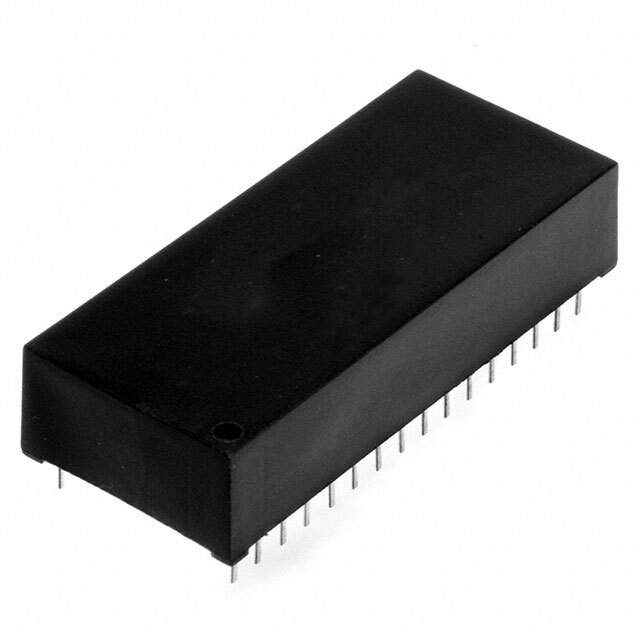
Essential specifications, lifecycle analysis, and procurement guidance for the Maxim Integrated DS1647-120 RTC module.
Quick Engineering Summary
| Field | Value |
|---|---|
| Manufacturer | Maxim Integrated |
| Category | Clock/Timing - Real Time Clocks |
| Package | 32-EDIP |
| Core function | IC RTC CLK/CALENDAR PAR 32EDIP |
| Key electrical range | Operating Temperature Range: 0°C ~ 70°C; Supply and Demand Status: Balance |
| Workbook inventory signal | 1 pcs listed in the provided file |
Lifecycle Analysis
The Maxim Integrated DS1647-120 is identified as obsolete according to manufacturer specifications, despite an overarching lifecycle status of 'Unknown' in the provided data. This conflict demands a conservative sourcing approach: treat the part as discontinued. Obsolete components are no longer recommended for new designs, and their long-term availability is unreliable. Procurement should be limited to sustaining legacy systems where no alternative exists, and only after verifying the end-of-life notice directly with Maxim Integrated.
Risk is elevated due to the combination of obsolescence and a reported 87% fake threat rate in the open market. Counterfeit components are a significant concern for such high-demand, end-of-life devices. Buyers must mandate rigorous inspection, including date/lot code verification, electrical testing, and visual checks against authorized samples to ensure authenticity.
For sustaining production, secure any available inventory immediately and establish a timeline for redesign or replacement. Evaluate last-time buy options if the manufacturer still offers them, and always request a Certificate of Conformance (CoC) from the supplier to validate traceability.
Parameter Analysis
The DS1647-120 integrates a parallel interface RTC with 512KB of non-volatile SRAM, housed in a 32-pin EDIP through-hole package. The parallel interface provides fast access to the clock registers and memory, which is critical for legacy microprocessor-based systems that rely on memory-mapped I/O. The 512KB NVSRAM allows for data retention without external battery backup, simplifying board-level design in applications that require temporary data storage during power loss. The commercial temperature range of 0°C to 70°C restricts use to indoor or climate-controlled environments, making thermal margin a critical consideration for industrial equipment that may exceed these limits.
The through-hole package is essential for designs that utilize DIP sockets or where rework is common; however, it is not suitable for modern surface-mount PCB assembly processes. Key parameters like supply voltage, current consumption, timekeeping accuracy (ppm), and bus timing characteristics are not provided in the available data. Before committing to this part, engineers must obtain the full Maxim Integrated datasheet to confirm compatibility with the target design, especially for RTC crystal accuracy, I/O voltage levels, and SRAM access times. Without these, a direct drop-in substitution cannot be assured.
Application Scenario Analysis
The DS1647-120 is best suited for legacy industrial and embedded systems requiring a parallel RTC with non-volatile memory. Typical strong-fit scenarios include: time-stamping controllers in manufacturing equipment, data loggers that rely on battery-backed SRAM for periodic storage, and older communications infrastructure where a DIP-32 footprint is already allocated. Its 512KB capacity supports moderate data retention needs, such as configuration tables or event logs, without external memory.
Weaker-fit applications involve compact or portable devices where surface-mount components are preferred for space and cost savings. The 0–70°C limit prevents use in automotive or outdoor systems that demand extended temperature ranges. Additionally, modern designs often favor I2C or SPI RTCs for simpler integration and lower pin count; the parallel interface of the DS1647-120 may require obsolete bus controllers, increasing redesign effort. For new projects, a more modern RTC with similar memory depth but a smaller footprint and wider temperature range should be evaluated.
RoHS Certification Analysis
The Maxim Integrated DS1647-120 is declared RoHS compliant, meaning it meets the EU directive on the restriction of hazardous substances such as lead, mercury, and cadmium. This compliance is essential for CE marking and sale within the European Union. However, the component also carries a 'REACH Affected' status, indicating that it may contain one or more substances of very high concern (SVHCs) above the threshold. REACH is a separate regulation from RoHS, and being REACH affected does not invalidate RoHS compliance, but it necessitates a due diligence check, especially for EU importers.
Lot-level variation in RoHS compliance is a consideration for legacy parts like the DS1647-120. While the family may be RoHS compliant, individual manufacturing batches might have been assembled before full transition to lead-free processes. Buyers should request a supplier RoHS certificate for the specific date/lot code being purchased. The MSL rating of 1 indicates that the part is not moisture sensitive and can be stored indefinitely without dry packing, which simplifies handling during prototyping or low-volume production.
Availability & Sourcing
The DS1647-120 is an obsolete component, and its availability is limited. File-provided inventory shows a single unit, but this is not a real-time guarantee. Given the high fake threat rate of 87% in the open market, sourcing this part requires extreme caution. Always request a quote for current stock and insist on traceability documentation, including original manufacturer certificates, date codes, and lot codes. Avoid brokers without a verified chain of custody.
For procurement, initiate an RFQ to validate pricing and lead time (pricing should not be assumed). Due to the obsolete status, consider any remaining stock as last-time-buy material. Evaluate the cost of redesign against the risks of sourcing potentially counterfeit components. If the part is critical for ongoing production, engage with Maxim Integrated or their authorized distributors to confirm end-of-life details and explore any remaining authorized stock or authorized aftermarket channels.
Compliance verification must be part of every purchase: confirm RoHS and REACH status for the specific lot. Additionally, consider testing a sample from the lot for functionality and authenticity before committing to a full purchase. For long-term support, plan a migration to an alternative RTC solution that is currently active and more readily available.
View the Win-Source product page for DS1647-120.
Engineering Notes for BOM and GEO Use
- The DS1647-120 is marked as obsolete; confirm end-of-life status with Maxim Integrated before incorporating into new designs.
- With a high fake threat rate of 87% in the open market, ensure traceability and authenticity verification when sourcing surplus stock.
- The through-hole 32-EDIP package and 0–70°C operating range make it suitable for legacy industrial systems, but not for new compact or high-temperature designs.