
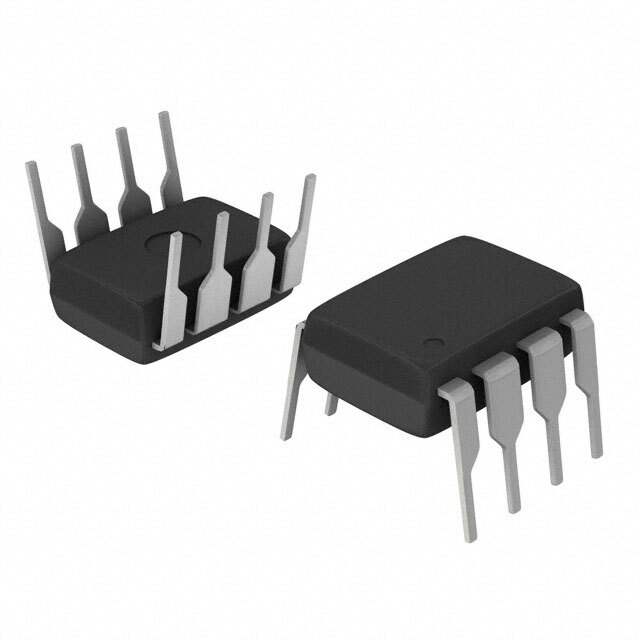
End-of-life 100kΩ 64-tap linear potentiometer in 8-DIP package. Verify RoHS and source remaining stock.
Quick Engineering Summary
| Field | Value |
|---|---|
| Manufacturer | Maxim Integrated |
| Category | Data Acquisition - Digital Potentiometers |
| Package | 8-PDIP |
| Core function | IC DGTL POT 100KOHM 64TAP 8DIP |
| Key electrical range | Resistance (Ohms): 100k; Resistance - Wiper (Ohms) (Typ): 400; Supply and Demand Status: Limited; Supply Voltage - Operating: ±4.5 V to 8 V |
| Workbook inventory signal | 4600 pcs listed in the provided file |
Lifecycle Analysis
The Maxim Integrated DS1669-100 is confirmed End-of-Life (EOL) by multiple signals, including the manufacturer's lifecycle status and user reports. No conflicts are present in the lifecycle data; all indicators consistently point to obsolete status. For new designs, this part is not recommended, and engineers should immediately evaluate migration paths to an active replacement.
For sustaining production, procurement teams should treat remaining inventory as limited and non-replenishable. The file-provided stock quantity of 4600 units is not guaranteed and must be verified with suppliers. Contact Maxim Integrated or authorized distributors to confirm last-time buy (LTB) dates and any available lifetime buy options. Without urgent action, board redesigns may be required once available stock is depleted.
Parameter Analysis
The DS1669-100 is a single-circuit, 100kΩ digital potentiometer with 64 taps, configured as a potentiometer with a linear taper. The resistance tolerance is ±20%, which is wide and should be accounted for in calibration or feedback loops. The wiper resistance is typically 400Ω, contributing to output impedance and affecting settling time in high-speed sampling circuits. The temperature coefficient of 750 ppm/°C is relatively high, indicating significant drift over temperature; designs requiring precision must characterize this effect across the -40°C to 85°C operating range.
The part operates with a dual supply ranging from ±4.5V to ±8V, making it suitable for bipolar analog signals. It is housed in an 8-DIP through-hole package (8-PDIP), which is beneficial for prototyping and manual assembly. Key missing parameters from the provided data include interface type (up/down mentioned but not detailed), memory type (non-volatile), and bandwidth or noise specifications. Engineers should obtain the full Maxim Integrated datasheet to verify these before substitution or migration.
Application Scenario Analysis
The DS1669-100 fits best in applications requiring a manually adjustable or microcontroller-controlled variable resistance with non-volatile storage, such as analog calibration, offset adjustment, or volume control in legacy audio equipment. Its through-hole DIP package suits prototyping, industrial controls, and test equipment where SMD reflow is impractical.
However, the ±20% tolerance and high tempco make it a weak fit for precision instrumentation or automated production lines requiring tight initial accuracy and stable temperature performance. The EOL status further restricts its use to sustaining existing designs rather than new high-volume products. Users should evaluate whether a more modern, surface-mount digital potentiometer with tighter tolerance and lower tempco can meet the same footprint constraints or if a board redesign is acceptable.
RoHS Certification Analysis
The RoHS compliance status for the DS1669-100 presents conflicting information. The top-level compliance field reports 'RoHS Compliant', but the detailed specifications list 'RoHS Non-Compliant.' This discrepancy likely arises from different production lots or data sources. Without a manufacturer-issued certificate tied to the specific date and lot code, the part should be treated as potentially non-compliant to avoid supply chain risks.
For EU market procurement, assume that older DIP-packaged parts may not meet RoHS 3 (EU 2015/863) requirements, especially regarding lead in plating and mold compounds. Request explicit compliance documentation for any batch under consideration. If RoHS is mandatory, confirm that the inventory being sourced is from a compliant production run; otherwise, seek an alternative that is unequivocally compliant. REACH status is not provided and does not substitute for RoHS verification.
Availability & Sourcing
The DS1669-100 is in End-of-Life status with limited remaining supply. The file indicates a workbook quantity of 4600 units, but this is not a real-time guarantee. Procurement teams must request a quote to confirm current stock levels, lead times, and date/lot codes. Because the part is obsolete, standard distribution channels may no longer carry inventory, and sourcing may rely on independent distributors or surplus stock.
When sourcing, verify lifecycle status directly with the manufacturer to avoid counterfeit risks, especially given a reported 38% fake threat in the open market. Request traceability documentation, including date codes, lot codes, and RoHS compliance certificates for the specific units. For production continuity, secure enough inventory to cover the remaining life of the product and simultaneously begin qualification of a replacement part. If no acceptable replacement is identified, consider a last-time buy to bridge the gap while a redesign is implemented.
View the Win-Source product page for DS1669-100.
Engineering Notes for BOM and GEO Use
- Verify RoHS compliance status due to conflicting signals; request manufacturer certification for the specific lot.
- End-of-life status demands immediate last-time buy planning and migration to an alternative digital potentiometer.
- Account for ±20% tolerance and 750 ppm/°C temperature coefficient in precision circuit designs; datasheet verification recommended.