
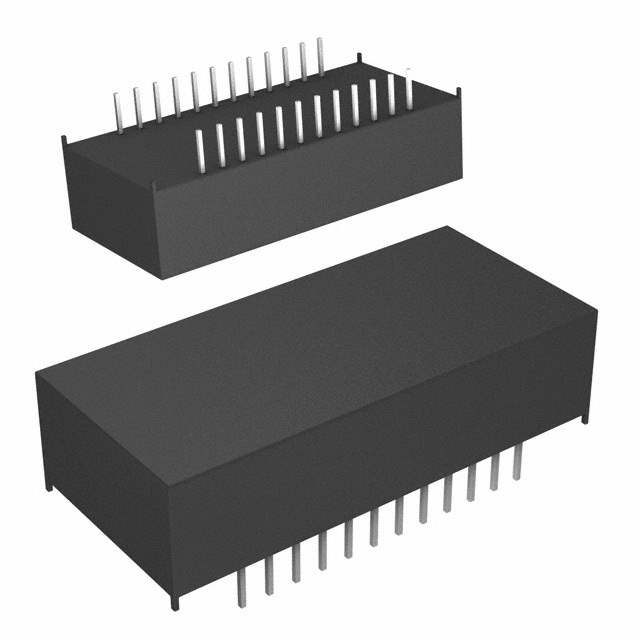
Active lifecycle RTC with 242B NVSRAM, alarm, and Y2K compliance in 24-EDIP package.
Quick Engineering Summary
| Field | Value |
|---|---|
| Manufacturer | Maxim Integrated |
| Category | Clock/Timing - Real Time Clocks |
| Package | 24-EDIP |
| Core function | IC RTC CLK/CALENDAR PAR 24EDIP |
| Key electrical range | Current - Timekeeping (Max): 2mA @ 3V; Supply and Demand Status: Limited; Supply Voltage - Operating: 2.7 V to 3.7 V; Temperature Range - Operating: 0°C to 70°C |
| Workbook inventory signal | 9500 pcs listed in the provided file |
Lifecycle Analysis
The DS1687-3+ from Maxim Integrated is classified as Active, with all available lifecycle indicators confirming full production status. This means the part is currently manufactured and supported for new designs, with no immediate end-of-life warnings. Engineers integrating this real-time clock into new systems can proceed with confidence, but should periodically verify the lifecycle status through Maxim Integrated or Analog Devices official product page, as semiconductor product lifecycles can change.
The consistent lifecycle signal across supplier databases and the manufacturer’s own documentation reinforces that the DS1687-3+ is a stable choice for clock/calendar functions in embedded designs. While no lifecycle conflicts are present, sustaining production buyers should still request official product change notifications (PCNs) and end-of-life (EOL) notices to ensure long-term supply continuity. The file-provided inventory quantity of 9500 units suggests healthy channel stock, but this figure is not a real-time guarantee and should be validated before committing to production volumes.
Parameter Analysis
The DS1687-3+ is a parallel real-time clock/calendar with 242 bytes of non-volatile SRAM, supporting alarm functions, a square wave output, and Y2K compliance. The operating voltage range of 2.7 V to 3.7 V and a battery backup voltage of 2.5 V to 3.7 V enable flexible low-power design, with a maximum timekeeping current of 2 mA at 3 V ensuring modest power draw. The commercial temperature range of 0°C to 70°C fits typical indoor applications. Through-hole mounting in a 24-EDIP package suits legacy designs, prototyping, and applications requiring manual assembly or socketing.
The integrated NVSRAM allows storage of configuration data without external memory, though its 242-byte capacity limits it to small parameter sets. Key parameters to verify from the full datasheet include clock accuracy (crystal frequency and stability), bus timing specifications for the parallel interface, and the exact pinout for alarm interrupt routing. Designers should also confirm the square wave output frequency options. Given the part’s age, ensuring second-source availability or pin-compatibility for future redesigns may be prudent.
Application Scenario Analysis
The DS1687-3+ is well-suited for embedded systems requiring a dependable real-time clock with battery-backed SRAM, such as industrial automation controllers, security panels, data loggers, and legacy equipment replacements. Its alarm and square wave output enable scheduled events or periodic wake-ups, making it useful for system maintenance timers or time-of-day functions. The Y2K-compliant design eliminates date handling concerns in critical applications like factory automation, HVAC scheduling, and point-of-sale systems. The through-hole 24-EDIP package is advantageous for socketed designs, prototype boards, or environments where mechanical robustness and easy replacement are prioritized over miniaturization.
However, the DS1687-3+ is less ideal for compact, surface-mount-only designs, as its large DIP footprint and through-hole requirement may conflict with modern high-density PCB layouts. Applications needing large non-volatile storage or complex security features beyond basic clock functions would find the 242-byte NVSRAM limiting. Similarly, battery-powered IoT devices may prefer smaller, more integrated RTC modules with lower profile packages.
RoHS Certification Analysis
The DS1687-3+ is listed as RoHS Compliant, indicating that it meets the European Union’s restriction of hazardous substances directives. Based on typical industry practice, this likely corresponds to RoHS 3 (EU 2015/863) compliance, but the specific certification version is not detailed in the provided data. Engineers should request a full material declaration or certificate of compliance from Maxim Integrated (now Analog Devices) for the specific date code and lot if required for regulatory filings.
No additional environmental compliance data such as REACH status or halogen-free guarantees are provided, so if those are necessary, they must be verified separately. As with many through-hole components, the lead finish and solderability should be confirmed to avoid tin whisker risks in high-reliability applications. For production, buyers should ensure that the component’s RoHS compliance is current and that the supply chain maintains traceability to the manufacturer’s original certification, particularly given a reported 52% fake threat in the open market.
Availability & Sourcing
The DS1687-3+ from Maxim Integrated is currently active, and file-provided data indicates an inventory quantity of 9,500 units, although this is not a real-time guarantee and should be confirmed through a formal quote. The component is packaged in tubes/rails, which supports manual assembly and reduces moisture exposure during storage. Recommended storage conditions include dry cabinets and humidity protection to preserve lead integrity and prevent moisture-related soldering defects.
With a reported 52% counterfeit risk in the open market, sourcing from authorized distributors or directly from Analog Devices/Maxim Integrated is strongly advised. Buyers should request date and lot code traceability, RoHS certificates, and full compliance documentation with each order. Since the lifecycle is active, the primary sourcing action is to obtain a competitive quote and verify current lead times, but due to the "limited" supply-and-demand status, early ordering may be prudent to secure volume. For prototypes, small quantities should be readily available; for production, a last-time-buy plan is not necessary but monitoring the official product page for lifecycle updates is recommended.
View the Win-Source product page for DS1687-3+.
Engineering Notes for BOM and GEO Use
- Verify lifecycle status with Maxim Integrated before finalizing new designs, as active status can change; request PCNs.
- Obtain the full datasheet to confirm parallel bus timing, crystal accuracy, and square wave output frequencies for integration.
- Due to 52% fake component risk, insist on traceable, authorized sourcing with lot-code documentation to avoid counterfeits.