
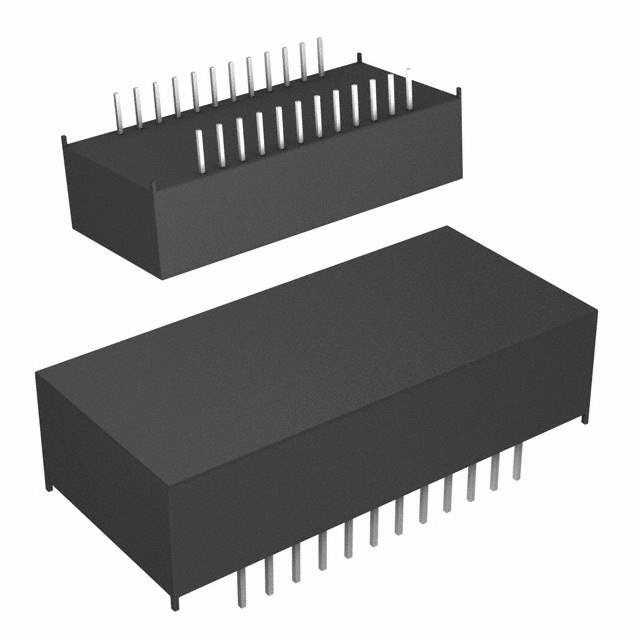
EOL Real-Time Clock with Alarm, NVSRAM, and Y2K Compliance in 24-EDIP Through-Hole Package
Quick Engineering Summary
| Field | Value |
|---|---|
| Manufacturer | Maxim Integrated |
| Category | Clock/Timing - Real Time Clocks |
| Package | 24-EDIP |
| Core function | IC RTC CLK/CALENDAR PAR 24EDIP |
| Key electrical range | Current - Timekeeping (Max): 2mA @ 3V; Supply and Demand Status: Limited; Supply Voltage - Operating: 2.7 V to 3.7 V; Temperature Range - Operating: 0°C to 70°C |
| Workbook inventory signal | 9500 pcs listed in the provided file |
Lifecycle Analysis
The DS1687-3 is classified as End-of-Life (EOL) by Maxim Integrated, indicating that the manufacturer has discontinued production. All lifecycle signals align on this status, so there is no ambiguity. This means the part should not be used in new designs, and sustaining production should secure remaining inventory and plan for a replacement.
File-provided data shows a stock quantity of 9,500 units, but this is not a real-time guarantee; actual availability must be confirmed through a formal RFQ. Designers should immediately evaluate migration paths and obtain last-time buy (LTB) schedules from the manufacturer or authorized distributors. Without an official migration roadmap, extending product life with this component carries high risk.
For new designs, consider modern alternatives like the DS3231 or other Maxim RTCs with better availability and updated features.
Parameter Analysis
The DS1687-3 operates from a 2.7 V to 3.7 V supply with a timekeeping current draw of 2 mA at 3 V, which is critical for battery-backed systems where low power is essential. Its 242 bytes of NVSRAM store configuration or alarm data, retained via external battery (2.5 V to 3.7 V). The part uses a parallel interface and comes in a 24-EDIP through-hole package, making it suitable for legacy designs that cannot adopt surface-mount.
The date format supports YY-MM-DD-dd, and features include alarm, square wave output, and Y2K compliance. When evaluating this part, engineers must verify protocol timing diagrams and bus loading from the datasheet, as the parallel interface can load the system bus. Key datasheet items to confirm include the write-cycle timing, battery-switchover threshold, and oscillator accuracy, which are not fully detailed in the available summary. The commercial temperature range of 0°C to 70°C limits operation to standard environments; industrial applications require validation.
Application Scenario Analysis
The DS1687-3 is a strong fit for maintaining date and time in legacy embedded systems where through-hole mounting is already designed in, such as older telecom shelves, industrial automation controllers, and security time-stamping equipment. Its integrated alarm and square-wave output make it useful for event scheduling in these systems. The 242-byte NVSRAM allows storage of custom configurations, enhancing field-upgrade flexibility.
However, it is a weak fit for new portable or IoT designs because of its relatively high timekeeping current (2 mA) and large DIP footprint. Modern designs typically require lower standby power, surface-mount packaging, and I2C/SPI interfaces. Also, the 0°C to 70°C range restricts use in outdoor or automotive applications. For new designs where DS1687-3 was originally specified, engineers should evaluate pin-compatible replacements with lower power and industrial temperature range if migration is feasible.
RoHS Certification Analysis
The DS1687-3 is labeled as RoHS Compliant according to provided data, indicating it meets the restrictions of hazardous substances under EU RoHS directives. The declaration likely refers to RoHS 3 (EU 2015/863) unless otherwise noted by the manufacturer. No specific exemptions are mentioned; many RTC modules may use lead in internal solder for battery attachment, but this must be verified.
It is advisable to request the full material declaration from the supplier for lot-level confirmation, especially since EOL parts may have been manufactured under earlier RoHS versions. Although no REACH data is provided, REACH compliance does not substitute for RoHS; both may be needed depending on the end market. For procurement, ensure that the compliance certificate covers the specific date codes received, as older inventory may have been exempted originally.
Availability & Sourcing
The DS1687-3 is an EOL component with limited supply, as indicated by the file-provided quantity of 9,500 units. This inventory is not guaranteed real-time, so immediate availability must be confirmed via RFQ. Given the high open-market counterfeit risk of 37%, sourcing should be restricted to authorized Maxim Integrated distributors or qualified independent suppliers with rigorous traceability processes.
Buyers should request date and lot codes, full RoHS compliance certificates, and photographic evidence of physical markings to avoid non-conforming parts. The part is shipped in tube/rail packaging from dry storage, which helps preserve solderability. For any remaining procurement, act quickly to secure stock while evaluating migration to an alternative like the DS3231/DS3232 series. Always obtain a formal last-time buy notice from the manufacturer to validate the discontinuation timeline before making large purchases.
View the Win-Source product page for DS1687-3.
Engineering Notes for BOM and GEO Use
- Verify EOL status and last-time buy notices with Maxim Integrated or authorized distributors before committing to new production.
- The 2mA timekeeping current and 242B NVSRAM require careful design validation for battery-backed applications.
- With a high open-market fake threat of 37%, source only from authorized or qualified independent distributors with traceability documentation.