
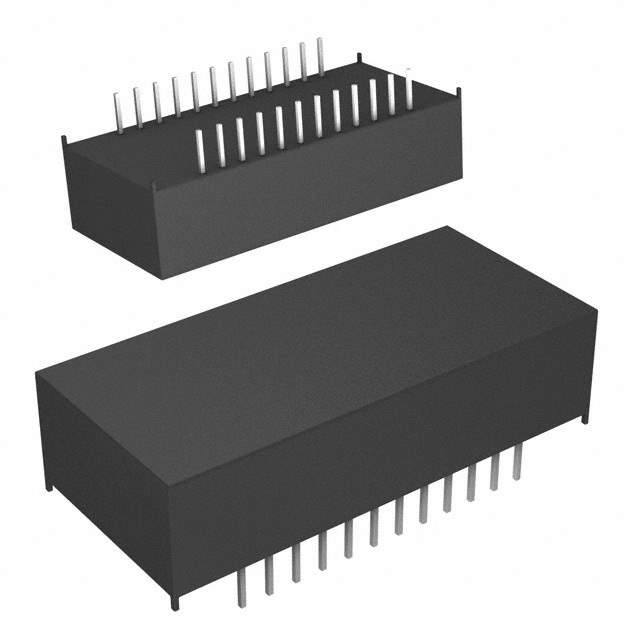
Maxim Integrated parallel real-time clock with NVSRAM and alarm, industrial temperature range, RoHS compliant.
Quick Engineering Summary
| Field | Value |
|---|---|
| Manufacturer | Maxim Integrated |
| Category | Clock/Timing - Real Time Clocks |
| Package | 24-EDIP |
| Core function | IC RTC CLK/CALENDAR PAR 24EDIP |
| Key electrical range | Current - Timekeeping (Maximum): 2mA @ 3V; Operating Supply Voltage: 2.7 V ~ 3.7 V; Operating Temperature Range: -40°C ~ 85°C; Supply and Demand Status: Limited |
| Workbook inventory signal | 1 pcs listed in the provided file |
Lifecycle Analysis
The DS1687-3IND+ is currently listed as Active by Maxim Integrated, and all supplied lifecycle signals align on this status. However, the specification table includes an 'Estimated EOL Date' of 2024, which introduces a planning consideration. While the part remains in production, the projected end-of-life indicates a finite procurement window.
For sustaining existing designs, the risk is low in the near term, but buyers should secure adequate inventory and obtain a formal product change notification (PCN) from the manufacturer. For new designs, the 2024 EOL estimate makes this part less suitable; engineering teams should evaluate modern real-time clock alternatives with longer lifecycles and potentially lower power consumption.
Because the lifecycle status and EOL estimation originate from the same dataset, there is no direct conflict, but the EOL date adds urgency. Always cross-reference with the manufacturer's official website or authorized distributors before committing to long-term production.
Parameter Analysis
Key parameters for the DS1687-3IND+ center on its real-time clock function and non-volatile memory integration. The operating voltage range of 2.7V to 3.7V and battery backup voltage of 2.5V to 3.7V allow direct connection to 3V lithium coin cells, simplifying power management. The timekeeping current draw is specified at a maximum of 2mA at 3V, which is moderate for a parallel-interface RTC; designers should account for this in battery life calculations.
The 242 bytes of NVSRAM are valuable for storing critical data during power loss. The industrial temperature range (-40°C to 85°C) ensures operation in harsh environments, and the through-hole 24-EDIP package suits designs where manual assembly or high reliability is required. Features like alarm, square wave output, and Y2K compliance are standard but essential for many embedded applications.
Several parameters are not provided in the source data and must be verified from the DS1687 datasheet: timekeeping accuracy (typically ±1 minute per month at 25°C), battery switchover threshold, and the internal crystal frequency tolerance. The parallel interface necessitates a dedicated bus, which may limit integration in pin-constrained designs. Missing specifications such as ESD rating and moisture sensitivity level (MSL) should also be confirmed before production.
Application Scenario Analysis
The DS1687-3IND+ is well-suited for embedded systems that require a reliable real-time clock with non-volatile RAM, particularly in industrial control, data logging, and utility metering. Its parallel interface and 24-DIP module make it easy to prototype and integrate into through-hole PCB designs where space is not at a premium. The industrial temperature range and Y2K compliance further extend its applicability to outdoor or unconditioned installations.
Strong-fit scenarios include legacy equipment that uses Maxim integrated clocks and needs a drop-in or electrically compatible RTC with NVSRAM. The alarm and square wave output are beneficial for time-stamping events or generating periodic interrupts. However, the 2mA timekeeping current is relatively high for battery-powered IoT devices that demand microampere-level consumption; in such cases, newer serial-interface RTCs would be a better choice. Space-constrained designs will also find the through-hole package bulky.
Additionally, the part's estimated EOL in 2024 makes it less attractive for new long-lifetime products. Engineers should weigh the ease of replacement against the risk of obsolescence. For short-run industrial projects or repairs, the DS1687-3IND+ remains a practical option provided inventory is secured.
RoHS Certification Analysis
The DS1687-3IND+ is declared RoHS Compliant according to the supplied data. This typically means conformity with EU Directive 2011/65/EU and its amendments (e.g., 2015/863), which restrict lead, mercury, cadmium, and other hazardous substances. No specific exemption is noted, so the part likely achieves compliance without reliance on material exemptions.
While REACH or halogen-free data are not included, the RoHS statement is sufficient for many markets. For exhaustive regulatory documentation, request a full material declaration or certificate of compliance from Maxim Integrated. The designated storage condition—dry cabinet with humidity protection—aligns with standard MSL handling for moisture-sensitive packages, though the exact MSL level is not given.
During incoming inspection, spot-check the part marking and packaging labels for RoHS logos or codes. Because the compliance status applies to the family DS1687, lot-level verification is advisable, especially when sourcing from independent distributors, to avoid counterfeit or non-compliant older stock.
Availability & Sourcing
Availability of the DS1687-3IND+ is characterized as limited, with a reported stock quantity of one unit in the file-provided inventory. The supply and demand status is classified as limited, reflecting constrained availability. The fake threat in the open market is relatively high at 47%, signaling a need for rigorous anti-counterfeit measures.
Buyers should request a quote for current lead times and stock from authorized Maxim Integrated distributors. When sourcing from independent channels, insist on full traceability documentation, date/lot codes, and compliance certificates. The part is packaged in tubes, which may influence minimum order quantities and handling.
Given the active lifecycle with an estimated EOL in 2024, secure inventory for existing production and evaluate alternate parts for future designs. Always verify lifecycle status with the manufacturer before placing large orders, and perform functional testing on a sample from each lot to confirm timekeeping accuracy and NVSRAM operation.
View the Win-Source product page for DS1687-3IND+.
Engineering Notes for BOM and GEO Use
- The estimated EOL of 2024 suggests a limited procurement window; evaluate alternative parts for new designs.
- Verify timekeeping accuracy and battery current consumption from the official DS1687 datasheet before finalizing the BOM.
- High open-market fake threat (47%) requires rigorous anti-counterfeit inspection and authorized sourcing.