
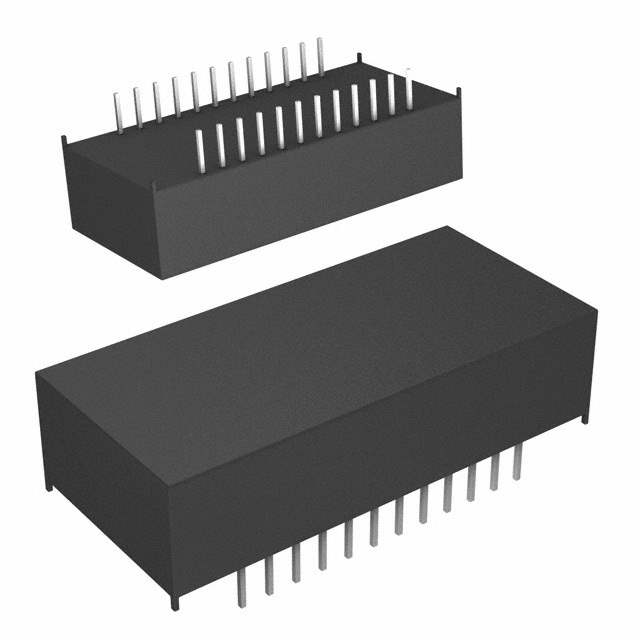
End-of-Life Parallel Interface Clock/Calendar with NVSRAM, Alarm, and Square Wave Output
Quick Engineering Summary
| Field | Value |
|---|---|
| Manufacturer | Maxim Integrated |
| Category | Clock/Timing - Real Time Clocks |
| Package | 24-EDIP |
| Core function | IC RTC CLK/CALENDAR PAR 24EDIP |
| Key electrical range | Current - Timekeeping (Max): 3mA @ 5V; Supply and Demand Status: Limited; Supply Voltage - Operating: 4.5 V to 5.5 V; Temperature Range - Operating: 0°C to 70°C |
| Workbook inventory signal | 264 pcs listed in the provided file |
Lifecycle Analysis
The Maxim Integrated DS1687-5 real-time clock has been classified as End-of-Life (EOL). This means Maxim Integrated (now Analog Devices) has discontinued manufacturing, and no more new stock will be produced. For procurement, this translates to high risk: the part is not suitable for new designs, and any ongoing production relying on it must secure last-time buys immediately.
A conflicting signal exists in the supplied data — while primary lifecycle parameters and the manufacturer’s lifecycle status both indicate EOL, a general ‘Status’ field shows ‘Active’. We adopt the conservative position that the part is EOL, as the manufacturer’s lifecycle authority supersedes a generic status flag. Engineers and buyers should treat the DS1687-5 as unavailable for new BOMs and plan for migration to an active alternative.
File-provided inventory data shows 264 units, but this is not a real-time quantity. It is a point-in-time signal and may not reflect actual stock. Authorized distributors should be contacted to verify availability and obtain formal EOL notices, which will specify final purchase dates and last shipment windows. Any stock purchased should be authenticated, and a redesign timeline should be set to replace the DS1687-5 with a currently manufactured RTC.
Parameter Analysis
The DS1687-5 is a parallel interface real-time clock in a 24-pin EDIP through-hole package. Key parameters include an operating voltage of 4.5V to 5.5V and a timekeeping current draw of 3mA at 5V, which is important for power budget calculations in legacy systems. The battery backup voltage range of 2.5V to 3.7V supports a separate battery supply, and the part integrates 242 bytes of NVSRAM — useful for storing system settings during power loss.
Operating temperature range is 0°C to 70°C, limiting the DS1687-5 to commercial-grade applications. Features like alarm, square wave output, and Y2K compatibility enhance its utility in embedded control and industrial timing. The through-hole mounting style confines use to designs that can accommodate a 0.600-inch wide DIP module, ruling out surface-mount-only layouts.
Critical specifications missing from the supplied data include interface timing characteristics, oscillator stability, battery lifespan, and solderability details. Designers should obtain the original Maxim datasheet to verify these parameters before qualifying existing stock for a particular design. Pay special attention to the internal battery’s shelf life and discharge characteristics, which directly affect data retention reliability in the field.
Application Scenario Analysis
The DS1687-5 fits well in legacy embedded systems that need a battery-backed real-time clock with parallel bus interface and integrated NVSRAM. Typical use cases are industrial controllers, data loggers, security panels, and older test equipment where the physical form factor is already designed-in and a redesign is costly. The alarm and square wave outputs serve time-stamping and wake-up functions in these applications.
Weak-fit scenarios include any new design requiring small footprint, low power, or serial interface clocks (I²C, SPI). The through-hole EDIP package is increasingly obsolete for modern compact electronics. Commercial temperature range precludes outdoor or automotive use without environmental hardening. The DS1687-5’s EOL status makes it unsuitable for products with long production lifecycles, because supply will vanish; designers should instead select an active RTC from Analog Devices or another supplier.
For sustaining existing fielded units, the DS1687-5 can still be sourced for repair and replacement, but only as long as last-time-buy stock holds. Any procurement for maintenance must be accompanied by thorough authenticity checks given the high fake threat rate in the open market. Plan for eventual redesign once the supply is exhausted.
RoHS Certification Analysis
According to the supplied data, the DS1687-5 is RoHS Compliant. Because no specific directive or exemption details are provided, it is likely compliant to the EU RoHS directive (2011/65/EU as amended by 2015/863). The absence of listed exemptions suggests that hazardous substances such as lead, mercury, and cadmium are within permissible limits across all homogeneous materials, but this should not be assumed without verification.
For procurement, request a formal RoHS certificate for the purchased lot. Compliance can vary between production batches, especially for parts that have been in storage for extended periods. The DS1687-5 is a through-hole EDIP module; confirm that the terminal finish (e.g., tin plating) meets RoHS requirements without relying on lead exemptions. REACH compliance is not indicated in the source data; obtain a separate declaration if required by your company’s environmental policies.
In high-reliability sectors such as medical or aerospace, lot-level documentation is mandatory. Cross-check that the certificate of conformance aligns with the date code and packaging of the received units. If the part was manufactured before RoHS enforcement dates, it may be non-compliant; always authenticate compliance traceability before trusting a generic “RoHS Compliant” flag.
Availability & Sourcing
The DS1687-5 is an EOL component, and available inventory is limited. File-provided data indicates 264 units in stock at the time of this report, but that quantity is not guaranteed and may change rapidly. The supply and demand status is noted as ‘Limited’, and the open-market counterfeit threat is rated at 43 percent — a high risk that demands rigorous sourcing discipline.
To procure the DS1687-5, start by sending an RFQ to authorized Analog Devices distributors to check real-time availability, date codes, and packaging (tube/rail). Request a full compliance package: RoHS certificate, lot traceability documentation, and manufacturer’s EOL/PCN notice. Do not accept parts without clear date codes and a verifiable chain of custody. Third-party testing for authenticity is recommended if sourcing from non-franchised channels, given the high fake risk.
Because the part is discontinued, you should evaluate migration to an active RTC as a parallel activity. If the DS1687-5 is still needed for sustaining production, secure as many units as allowed by the last-time-buy program and store them in the recommended dry storage conditions. This sourcing guide is a preliminary assessment; contact suppliers directly and verify lifecycle status before committing to any procurement for new production use.
View the Win-Source product page for DS1687-5.
Engineering Notes for BOM and GEO Use
- Verify manufacturer EOL notice before any new design-in; the DS1687-5 is discontinued and not recommended for production.
- The integrated battery and 242 bytes of NVSRAM support data retention, but battery shelf life impacts long-term reliability — confirm date codes when buying.
- Given 43% open-market counterfeit risk, mandate authorized sources, lot traceability, and third-party authentication for remaining inventory.