
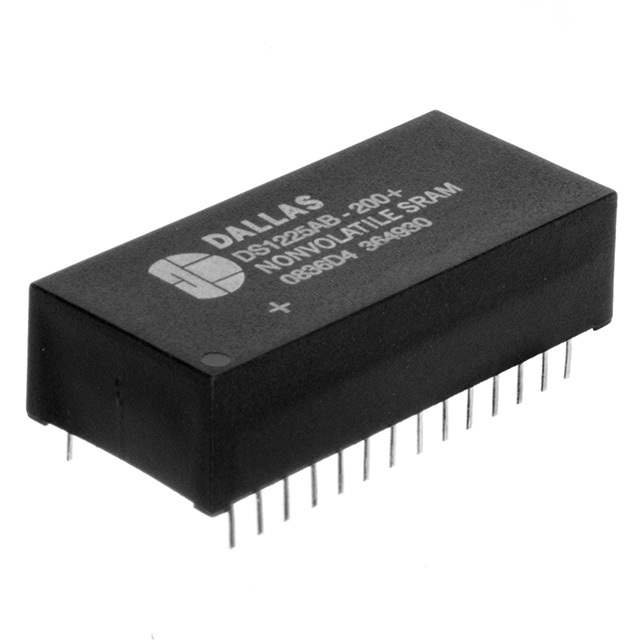
EOL parallel RTC with NVSRAM and through-hole package; confirm RoHS compliance and inventory before procurement.
Quick Engineering Summary
| Field | Value |
|---|---|
| Manufacturer | Maxim Integrated |
| Category | Clock/Timing - Real Time Clocks |
| Package | 28-EDIP |
| Core function | IC RTC CLK/CALENDAR PAR 28EDIP |
| Key electrical range | Current - Timekeeping (Max): 2mA @ 3V, 3mA @ 5V; Supply and Demand Status: Limited; Supply Voltage - Operating: 2.7 V to 3.3 V, 4.5 V to 5.5 V; Temperature Range - Operating: 0°C to 70°C |
| Workbook inventory signal | 10 pcs listed in the provided file |
Lifecycle Analysis
The DS1693 from Maxim Integrated is classified as End-of-Life (EOL). All lifecycle signals uniformly confirm this status, with no conflicting data. For new designs, this part should not be considered; engineers must select an alternative RTC. For existing production, the EOL status necessitates immediate evaluation of last-time-buy opportunities and migration planning. The manufacturer may have limited or no support for this device, making documentation and technical assistance scarce.
EOL parts carry inherent risks including supply discontinuity and counterfeit proliferation. The high risk level reflects the combination of obsolete status, limited inventory, and a reported counterfeit threat of 57%. Buyers should secure inventory only after verifying the manufacturer’s end-of-life notice and authenticating lot codes. The workbook quantity of 10 pieces is a file-provided snapshot and not a real-time guarantee.
Parameter Analysis
Key parameters for the DS1693 include its operating voltage ranges: 2.7V to 3.3V or 4.5V to 5.5V, with battery backup voltage of 2.5V to 3.7V. This dual-range capability allows integration into both 3.3V and 5V systems, but careful power sequencing is required. The timekeeping current is 2mA at 3V and 3mA at 5V, which must be accounted for in power budgets, especially in battery-backed modes. The 114-byte NVSRAM provides non-volatile storage for critical data, while the date format YY-MM-DD-dd and parallel interface define the communication protocol.
The 28-EDIP through-hole package dictates a specific PCB layout with a 0.600-inch width spacing, making it unsuitable for surface-mount designs. Mounting and thermal considerations are minimal for this low-power device.
Missing critical specifications include clock accuracy (ppm), interface timing parameters, and any alarm or watchdog features. Designers must obtain the full datasheet to verify these parameters before integration.
Application Scenario Analysis
The DS1693 fits legacy embedded systems requiring a real-time clock with integrated NVSRAM. Its through-hole package and parallel bus interface are typical of designs from the 1990s and early 2000s, such as industrial controllers, medical equipment, and telecom infrastructure. The NVSRAM feature allows critical data retention without a battery, making it suitable for data logging and event timestamping in older equipment.
For new applications, this part is a poor fit due to its EOL status, through-hole packaging, and high power consumption relative to modern RTCs. Modern designs would benefit from smaller surface-mount RTCs with lower current draw and I2C/SPI interfaces. The limited temperature range of 0°C to 70°C restricts it to commercial environments, disqualifying it for industrial extended-temperature or automotive use.
In maintenance and repair scenarios, the DS1693 serves as a direct replacement for existing boards, provided factory-original parts can be sourced.
RoHS Certification Analysis
The DS1693 presents a compliance conflict. The primary compliance record indicates RoHS Compliant, but a separate specification field lists the part as RoHS Non-Compliant. Such discrepancies may arise from variations in manufacturing date codes, different assembly sites, or database errors. For EOL parts, compliance status can change over production runs.
Neither REACH status nor halogen-free declarations are provided. The MSL rating is not specified, which is critical for through-hole parts if they undergo high-temperature soldering.
Engineers and buyers must request lot-specific RoHS certificates from the supplier. Until verified, it is prudent to assume the part is non-compliant for new designs requiring RoHS. The EU RoHS directive (2015/863) may not be met by all existing stock. Procure only with documented compliance evidence.
Availability & Sourcing
The DS1693 is an EOL component with limited availability. The supplier workbook indicates a stock quantity of 10 units, but this is not a real-time inventory figure. Buyers must request a quote to confirm current availability and pricing. Packaging is tube/rail, which is standard for through-hole DIP parts.
Given the high counterfeit threat (57%), sourcing should prioritize authorized distributors or qualified independent distributors with robust testing and traceability protocols. Verify date codes, lot codes, and physical characteristics upon receipt. For production needs beyond available stock, consider last-time-buy programs from the manufacturer if still offered.
Request a quote from Win Source or other approved channels, and explicitly require RoHS compliance documentation and EOL lifecycle confirmation. For new designs, transition to an active RTC alternative immediately.
View the Win-Source product page for DS1693.
Engineering Notes for BOM and GEO Use
- Verify RoHS compliance on a per-lot basis due to conflicting data; request certificates from the supplier.
- The 57% counterfeit threat demands rigorous authentication: inspect marking, packaging, and electrical performance.
- Do not use for new designs; for legacy equipment, secure inventory now and plan migration to a modern RTC.