
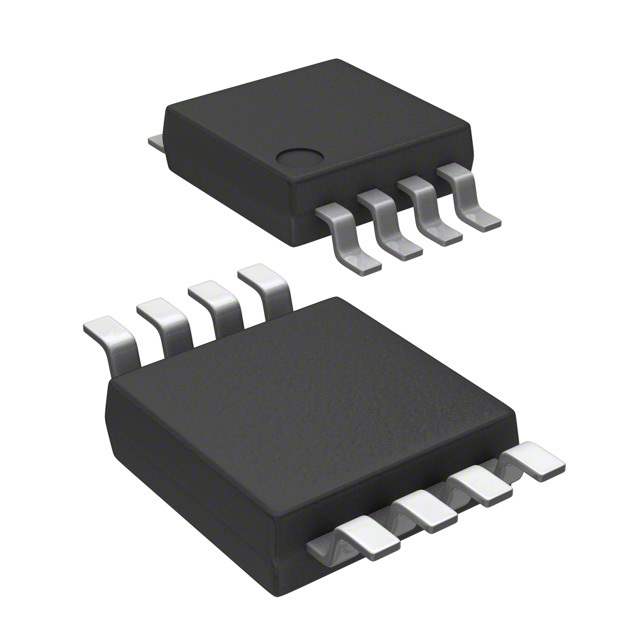
Digital, local temperature sensor with I2C interface, 11-bit resolution, and one-shot mode. Active lifecycle, RoHS compliant.
Quick Engineering Summary
| Field | Value |
|---|---|
| Manufacturer | Maxim Integrated |
| Category | Temperature Sensors - Analog and Digital Output |
| Package | 8-uMAX |
| Core function | SENSOR DIGITAL -55C-125C 8UMAX |
| Key electrical range | Output Type: I2C; Sensing Temperature - Local: -55°C to 125°C; Supply and Demand Status: Balance; Supply Voltage - Operating: 2.7 V to 5.5 V |
| Workbook inventory signal | 7391 pcs listed in the provided file |
Lifecycle Analysis
The DS1721U+ is in Active lifecycle status according to Maxim Integrated’s product database and associated supply-chain signals. This classification indicates full manufacturer support for new designs, ongoing volume production, and continued availability of technical documentation. There are no conflicting lifecycle warnings in the provided data, and the risk level is low. For both new development and current production, engineers can incorporate the DS1721U+ without immediate migration concerns.
While the part is actively produced, periodic revalidation of the manufacturer’s PCN (Product Change Notification) notices is recommended to catch any early NRND or discontinuance announcements. A file-provided inventory quantity of 7,391 units suggests a healthy stock position, but this figure is not a real-time guarantee. Buyers should confirm current on-hand quantities through the RFQ process before committing to production schedules.
Parameter Analysis
Key decision-driving parameters for the DS1721U+ include its I2C digital output, local sensing range from -55°C to 125°C, and supply voltage flexibility of 2.7 V to 5.5 V. The accuracy is specified as ±1°C over the -10°C to 85°C range and ±2°C for the full operating span. This makes it suitable for general-purpose thermal monitoring where precise point-of-measurement data is needed but ultra-stable remote diode tracking is not required.
The 11-bit resolution provides sufficient granularity for many embedded systems, while the 8-uMAX package eases board layout in space-constrained designs. Parameters not supplied in the summary data—such as conversion time, current consumption in active and standby modes, and I2C bus pull-up requirements—should be extracted from the full datasheet. This information is critical for calculating power budgets and verifying signal integrity in multi-device bus configurations.
Application Scenario Analysis
The DS1721U+ fits well in microcontroller-based systems across consumer electronics, industrial instrumentation, and sensing & monitoring applications. Its I2C interface allows direct connection to most MCUs, and the programmable temperature limits enable hardware alert functionality without constant polling. The one-shot and standby modes are particularly useful in battery-powered or energy-harvesting designs where sporadic sampling conserves power.
It is less appropriate for applications requiring analog voltage output to interface with legacy analog inputs, or for remote diode sensing where a separate transistor junction is used. Also, in high-speed multi-channel temperature scanning systems, the conversion time and I2C bus overhead might be a limiting factor, making a faster SPI sensor a better choice. Engineers should evaluate these fit factors against system-level requirements.
RoHS Certification Analysis
The DS1721U+ is listed as RoHS Compliant, indicating that it meets European Union restrictions on hazardous substances according to the relevant directive. The supplied data does not specify which revision of the standard applies, but typical semiconductor compliance at this stage covers RoHS 3 (EU 2015/863). Because no exemptions are mentioned, it can be assumed that the part contains no intentionally added restricted materials above allowable thresholds.
For high-reliability sectors such as aerospace or medical, or when precise EU declaration conformity is required, it is prudent to request the manufacturer’s detailed material declaration or certificate of compliance. Additionally, note that RoHS status is often defined at the product family level; verification at the purchased lot level through supplier-provided documentation is advised when regulatory non-compliance could halt production.
Availability & Sourcing
The DS1721U+ is a commonly used digital temperature sensor with high popularity and balanced supply-demand status. The file-provided inventory shows 7,391 units, but this quantity should be validated through a live RFQ as lead times and stock levels can shift. Packaging is Tube/Rail, and storage conditions call for a dry environment with humidity-protective packaging, which is essential for preserving solderability.
A reported 28 percent open-market fake threat rate underscores the need to source through authorized Maxim Integrated distributors or platforms that provide lot-code traceability and conformity documentation. For Active parts, the recommended action is to request a quote, verify current availability, and confirm that compliance certificates (RoHS, REACH if needed) match your lot. This ensures both engineering confidence and procurement integrity.
View the Win-Source product page for DS1721U+.
Engineering Notes for BOM and GEO Use
- Verify accuracy performance beyond the -10°C to 85°C range by reviewing the full datasheet for -55°C to 125°C extremes.
- The 28% open-market fake threat rate highlights the importance of sourcing from authorized distributors or applying meticulous incoming inspection.
- Leverage one-shot and standby modes to reduce power consumption in battery-powered or intermittent measurement applications.