
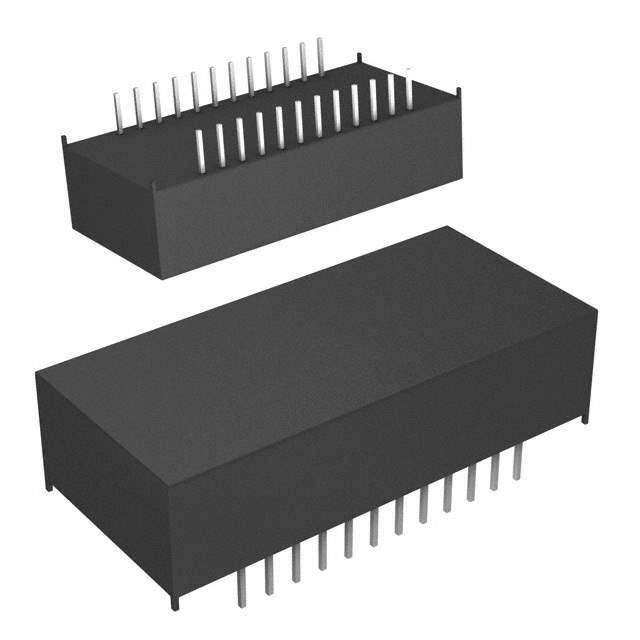
EOL parallel real-time clock with 2KB NVSRAM from Maxim Integrated – key specifications, lifecycle analysis, and procurement considerations.
Quick Engineering Summary
| Field | Value |
|---|---|
| Manufacturer | Maxim Integrated |
| Category | Clock/Timing - Real Time Clocks |
| Package | 24-EDIP |
| Core function | IC RTC CLK/CALENDAR PAR 24EDIP |
| Key electrical range | Current - Timekeeping (Max): 3mA @ 5V; Supply and Demand Status: Limited; Supply Voltage - Operating: 4.5 V to 5.5 V; Temperature Range - Operating: 0°C to 70°C |
| Workbook inventory signal | 633 pcs listed in the provided file |
Lifecycle Analysis
The DS1742-100+ is marked as End-of-Life (EOL) by Maxim Integrated (now Analog Devices). This status means the part has been discontinued and is no longer recommended for new product designs. Engineers maintaining legacy systems must evaluate remaining inventory levels and plan for a form, fit, and function replacement if long-term production is required. All available lifecycle signals from the source data consistently indicate EOL, leaving no ambiguity about its obsolescence.
For sustaining production, procurement teams should secure inventory immediately and assess last-time-buy opportunities if any remain. The supplied file-based quantity of 633 units is a snapshot and should not be considered real-time guaranteed stock. The open-market fake threat rate of 30% underscores the need for robust incoming inspection and traceability when purchasing from non-authorized channels. Revalidation of manufacturer documentation, including product change notices and discontinuance letters, is strongly advised before committing to purchases.
Parameter Analysis
The DS1742-100+ integrates a real-time clock/calendar with 2KB of non-volatile SRAM (NVSRAM) in a through-hole 24-EDIP package. The parallel interface requires a multi-bit address/data bus, making it suitable for designs with direct memory-mapped I/O. Key operational parameters include a supply voltage range of 4.5V to 5.5V and a typical timekeeping current of 3mA at 5V. This current draw is relatively high for a modern RTC, so power budget considerations are critical in battery-backed applications. The commercial temperature range of 0°C to 70°C limits its use to indoor or controlled environments.
Missing from the provided data are critical details such as clock accuracy, integrated crystal specifications, and battery or capacitor integration for memory retention. Engineers should consult the full Maxim datasheet to verify whether the NVSRAM includes an embedded lithium cell and to confirm timing characteristics and bus protocol requirements. The through-hole mounting style may complicate replacement in surface-mount dominated designs. Additionally, the date format (YY-MM-DD-dd) and lack of century bit may require software workarounds for proper century rollover, despite the Y2K feature.
Application Scenario Analysis
The DS1742-100+ is best suited for legacy embedded systems requiring a non-volatile real-time clock with a parallel interface. Typical applications include older industrial controllers, telecommunications infrastructure, and time-stamping equipment where a direct memory-map interface was standard. The 2KB NVSRAM allows storage of time-stamp data or configuration parameters without external memory, benefiting systems with limited EEPROM or flash resources.
Conversely, this part is a poor fit for any new design effort. Its EOL status, high counterfeiting risk, and through-hole packaging disqualify it from modern compact, low-power, or serial-bus centric products. The limited temperature range further restricts it from rugged or automotive applications. Migration candidates should consider active RTC offerings with I2C or SPI interfaces, wider temperature ratings, and integrated power-fail control.
RoHS Certification Analysis
According to the source data, the DS1742-100+ is RoHS Compliant. This indicates that it meets the original EU RoHS Directive restrictions on hazardous substances such as lead, mercury, and cadmium. However, since the part is now obsolete, compliance likely refers to the standard in effect at the time of its last production run, which may not include more recent RoHS amendments like RoHS 3 (EU 2015/863) covering additional phthalates.
For procurement, it is important to request the manufacturer’s Declaration of Conformity or test reports specific to the lot being purchased. REACH compliance is not mentioned in the supplied data and should be verified separately if required for the end application. Exemptions, such as lead in glass or ceramics for the DIP package, may apply but are not detailed; buyers should confirm this with their supplier to ensure full regulatory compliance in the target market.
Availability & Sourcing
As an EOL component, DS1742-100+ stock is limited and supply is constrained. The provided inventory figure of 633 units is a file-based reference and not a live quantity; availability can change rapidly. The part is packaged in tubes, and recommended storage conditions call for a dry cabinet with humidity protection, reflecting its sensitivity to moisture and the need to maintain solderability for through-hole assembly.
Procurement teams should exercise extreme caution due to the 30% reported counterfeit risk in the open market. Always request a date/lot code and verify traceability back to Maxim Integrated or authorized distributors. A formal request for quote (RFQ) is essential to confirm current pricing, stock levels, and compliance documentation. For long-term support, secure the remaining inventory and simultaneously develop a migration strategy to an active RTC product that meets your functional and regulatory needs.
View the Win-Source product page for DS1742-100+.
Engineering Notes for BOM and GEO Use
- Verify integrated battery condition if the NVSRAM relies on an internal cell; EOL parts may have depleted batteries.
- The 30% counterfeit threat demands sourcing only through verified, traceable channels and implementing incoming testing.
- Begin migration to a modern RTC with a serial interface and wider temperature range for new designs to avoid future obsolescence.