
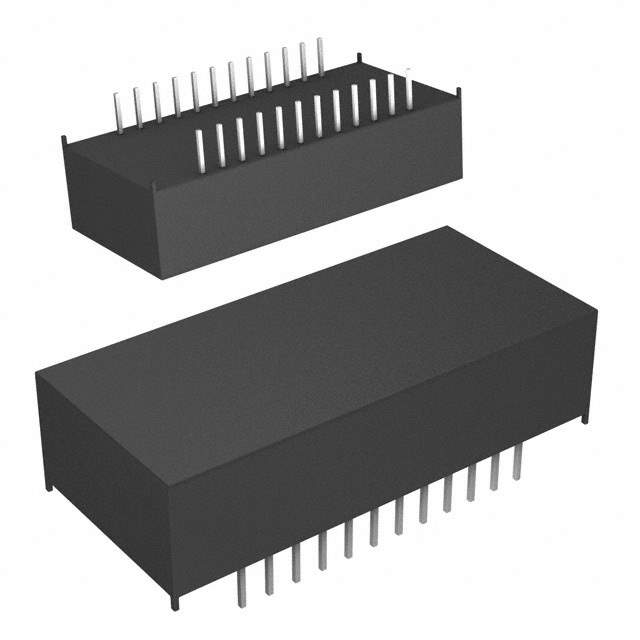
Discontinued through‑hole RTC with 2 KB NVSRAM, Y2K, leap year, and parallel interface
Quick Engineering Summary
| Field | Value |
|---|---|
| Manufacturer | Maxim Integrated |
| Category | Clock/Timing - Real Time Clocks |
| Package | Tube |
| Core function | IC RTC CLK/CALENDAR PAR 24EDIP |
| Key electrical range | Current - Timekeeping (Max): 3mA @ 5V; Temperature Range - Operating: 0°C ~ 70°C; Voltage - Supply: 4.5V ~ 5.5V |
| Workbook inventory signal | 633 pcs listed in the provided file |
Lifecycle Analysis
The DS1742-100 from Maxim Integrated is in the Discontinued lifecycle status, with a high risk level for new designs. All lifecycle signals received—EOL notation and Product Status—confirm that the part is no longer in active production. This means the DS1742-100 should never be specified for new product introductions. For existing designs, the device may still be used in sustaining builds, but procurement must be based on verified remaining inventory or last-time-buy opportunities.
The file-provided workbook indicates a quantity of 633 units. However, this static figure does not represent guaranteed real-time availability. Engineers and buyers must contact suppliers directly to confirm current stock levels and request a quote. Because the part is discontinued, manufacturer documentation such as PCN (Product Change Notification) or EOL notices should be rechecked to identify any suggested replacements or upgrade paths.
Given the high fake threat rate (80%) reported for this part, any procurement should emphasize traceability, date/lot code validation, and sourcing from authorized channels. Do not assume continuous supply; treat every lot as potentially limited. For production planning, initiate a migration evaluation to a newer RTC solution as soon as possible.
Parameter Analysis
The DS1742-100 integrates a real-time clock/calendar with 2 KB of non-volatile SRAM. Key specifications include a parallel interface, a 4.5 V to 5.5 V supply voltage, and a timekeeping current of 3 mA at 5 V. The device supports date format YY-MM-DD-dd and features leap year compensation, NVSRAM, and Y2K compliance. Operating temperature range is 0 °C to 70 °C, suiting commercial applications. Mounting is through-hole, with a 24-DIP module (0.600 inch, 15.24 mm width).
From a design perspective, the 2 KB memory offers ample room for system parameters or time-stamped data. The parallel interface simplifies integration with legacy microcontrollers, but the 5 V supply must be considered in modern 3.3 V or lower systems. The through-hole package dictates PCB layout and cannot be used for surface-mount designs. Critical parameters missing from the provided data include the backup battery voltage range, SRAM data retention time, and clock accuracy (ppm). When qualifying the DS1742-100, verify these values directly from the manufacturer's datasheet. Also confirm the exact timing diagrams and control signals for the parallel bus to ensure compatibility with host processors.
Application Scenario Analysis
The DS1742-100 serves as a full-featured timekeeping solution with integrated non‑volatile memory. Typical strong‑fit applications include legacy industrial controllers, embedded systems requiring time-stamped event logs, and equipment where a parallel bus and through‑hole package are already designed in. Its Y2K and leap year handling make it suitable for long-duration logging in utility meters, security panels, and point‑of‑sale terminals.
However, because the device is discontinued, it is a weak fit for any new design. Modern designs should instead choose an active, surface‑mount RTC from Maxim Integrated (now Analog Devices) that supports lower voltages and smaller footprint. For sustaining or repair of existing systems, the DS1742-100 can still be sourced, but availability is declining. The 80% counterfeit risk in the open market means these parts must be procured from authorized or traceable sources only.
Engineers maintaining end‑of‑life equipment should cross‑verify the exact firmware and hardware dependencies on the DS1742-100’s parallel interface, as migrating to a drop‑in replacement may require substantial redesign. No drop‑in substitute is specified in the available data, so any replacement would need to match the 24‑EDIP footprint, NVSRAM size, and interfacing protocol.
RoHS Certification Analysis
The DS1742-100 is listed as RoHS Compliant. This status indicates that the part meets the requirements of the EU Restriction of Hazardous Substances Directive, typically meaning lead-free and free of other restricted materials. However, the source data does not specify which RoHS standard version (e.g., EU 2015/863 for RoHS 3) applies. As a discontinued device, its compliance status was likely certified under an earlier revision.
REACH status is given as REACH Unaffected, meaning that to the manufacturer’s knowledge, the part does not contain Substances of Very High Concern (SVHC) above the threshold requiring disclosure. This is separate from RoHS compliance and should not be interpreted as a substitute. The MSL (Moisture Sensitivity Level) is indicated as Level 1 (Unlimited), which means the through‑hole package is not moisture sensitive and can be handled without pre‑baking before soldering, simplifying assembly for legacy lines.
When procuring the DS1742-100, buyers should request a Certificate of Compliance (CoC) or full material declaration for the specific date/lot code to confirm that the batch adheres to the required regulations. Family‑level compliance documents may not reflect any changes made in later production batches before discontinuation.
Availability & Sourcing
The DS1742-100 is discontinued, so availability is strictly limited to remaining distributor stock or authorized aftermarket sources. The workbook indicates a quantity of 633 units, but this is a static snapshot and does not reflect real‑time inventory. Buyers must submit a request for quote (RFQ) to obtain current pricing and stock levels.
Given the reported 80% counterfeit risk in the open market, sourcing strategy must prioritize authenticity. Insist on full traceability documentation, including date codes, lot codes, and original manufacturer packaging (tube, standard package of 14). Verify that the supplier can provide RoHS compliance certificates for the specific lot being purchased. Do not accept parts with unknown provenance, as fakes can lead to field failures and liability.
For sustaining production of legacy systems, consider a last‑time buy now, while stock remains. Since the part is no longer active, no further production is planned, and lead times are effectively infinite. If long‑term availability is critical, evaluate migrating to a newer RTC. Contact Maxim Integrated (now Analog Devices) for any official cross‑reference or suggested replacement, but be mindful that a drop‑in substitute is unlikely. Use the DS1742-100 only as a service part, and plan a redesign to a modern clock/calendar IC when feasible.
View the Win-Source product page for DS1742-100.
Engineering Notes for BOM and GEO Use
- Verify battery backup voltage and timekeeping accuracy from the official datasheet, as these parameters are not fully specified in available data.
- Counterfeit risk is reported at 80%; source only from authorized distributors or trusted suppliers with full traceability.
- The DS1742-100 is discontinued; plan an immediate migration path and secure last‑time‑buy quantities where possible.