
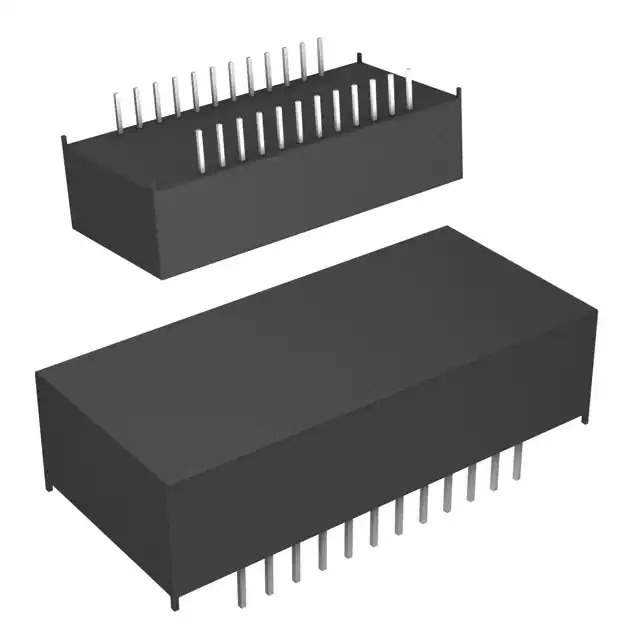
Discontinued real-time clock with parallel interface, 2KB NVSRAM, and ±5V supply. Verify lifecycle and source genuine stock carefully.
Quick Engineering Summary
| Field | Value |
|---|---|
| Manufacturer | Maxim Integrated |
| Category | Clock/Timing - Real Time Clocks |
| Package | Tube |
| Core function | IC RTC CLK/CALENDAR PAR 24EDIP |
| Key electrical range | Current - Timekeeping (Max): 3mA @ 5V; Temperature Range - Operating: 0°C ~ 70°C; Voltage - Supply: 4.5V ~ 5.5V |
| Workbook inventory signal | 1 pcs listed in the provided file |
Lifecycle Analysis
The Maxim Integrated DS1742-70 real-time clock is officially discontinued according to multiple lifecycle signals, including a Discontinued product status and an EOL Excel lifecycle parameter. This high-risk status indicates that the manufacturer has ceased production, and no further units will be manufactured. For new designs, this part is unsuitable, and any existing product lines relying on the DS1742-70 should immediately begin migration planning to alternative RTCs with similar functionality.
Conflicting lifecycle signals—EOL versus Discontinued—both converge on the same practical outcome: the part is no longer in active production. Procurement teams should treat all signals conservatively and assume zero future availability from authorized distribution. The file-provided inventory shows a single unit in workbook records, but this is not a real-time stock guarantee and should be verified with the supplier before quoting.
Engineers should review Maxim Integrated’s (now Analog Devices) official discontinuation notice and product change notifications to understand last-time buy dates and recommended replacements. Without an active supply chain, the DS1742-70 carries high procurement risk, and system designs must account for either a redesign or a secure source of verified, genuine stock for legacy repairs.
Parameter Analysis
The DS1742-70 integrates 2KB of NVSRAM with a real-time clock/calendar, using a parallel interface for host communication. The 2KB non-volatile memory is critical for retaining time, date, and user data during power loss without relying solely on a battery, though the device still requires external battery backup (voltage not specified in source data). The parallel interface, while simple to implement, may be less common in modern designs compared to I²C or SPI, making this part best suited for legacy parallel bus architectures.
Key operating parameters include a supply voltage range of 4.5V to 5.5V and a timekeeping current of 3mA at 5V. This current draw must be factored into power budgets, especially when moving to lower-power alternatives. The 0°C to 70°C commercial temperature range limits the DS1742-70 to indoor or benign environments; designs requiring industrial or extended temperature ranges must select a different part. The part supports Leap Year compensation and Y2K compliance, which were important at the time of design but are now standard in most RTCs.
Missing from the provided data are critical timing parameters such as clock accuracy (ppm), battery backup voltage and current, and access or cycle times for the parallel interface. Procurement and engineering teams should consult the full Maxim datasheet for these values before qualifying any remaining stock. The 24-DIP through-hole package may also constrain PCB layout in modern surface-mount designs, so mechanical compatibility must be verified.
Application Scenario Analysis
The DS1742-70 is a classic parallel-interface RTC with integrated NVSRAM, making it a strong fit for legacy embedded systems that were originally designed around this exact part. Applications such as industrial controllers, point-of-sale terminals, data loggers, and telecommunications equipment from the 1990s and early 2000s often used these Maxim RTCs. The through-hole 24-DIP package is compatible with socketed or hand-soldered through-hole PCBs, which is typical of these older designs.
For any new design, the DS1742-70 is a weak fit due to its discontinued status and the availability of modern RTCs with serial interfaces, lower power consumption, smaller surface-mount footprints, and integrated power management. Designs requiring industrial temperature ranges, extended shock/vibration tolerance, or automated assembly are particularly ill-suited to this part. If a form/fit/function replacement is required, engineers must search for drop-in compatible modules, but no direct substitutes are provided in the source data.
When sourcing for legacy repair or production bridge, confirm that the operating temperature range (0°C to 70°C) and 5V supply alignment are compatible with the target system. The NVSRAM’s 2KB capacity and Y2K compliance ensure timekeeping integrity for existing applications, but verification against the system’s specific memory map and timing requirements is essential before integrating remaining stock.
RoHS Certification Analysis
The provided data indicates that the DS1742-70 meets RoHS compliance standards, as shown by a RoHS Status of 'RoHS Compliant.' While the specific EU directive version (e.g., 2015/863) is not explicitly stated, this designation generally aligns with EU RoHS requirements for hazardous substance restrictions. The part is also listed as REACH Unaffected, suggesting no high-concern substances of very high concern (SVHC) are present above threshold levels.
For a discontinued part, RoHS compliance is typically based on the original manufacturing data and is expected to be valid for the lots produced before discontinuation. However, since the part is no longer in active production, any remaining stock may have been manufactured years ago, and it is prudent to request a certificate of compliance for the specific date/lot code being purchased. MSL Level 1 (Unlimited) indicates the part has no moisture sensitivity constraints, which simplifies storage and handling of legacy stock.
No specific exemptions (such as lead in glass or ceramic) are listed in the source data, but the compliance status does not guarantee exemption-free status. Engineers should confirm that the RoHS compliance covers all homogeneous materials in the 24-DIP module, including the internal battery or any internal solder, if applicable. For EU market access, verify the compliance documentation directly with the distributor.
Availability & Sourcing
The Maxim Integrated DS1742-70 is a discontinued part with high sourcing risk. The source data shows a file-provided inventory of only one unit, and the optional open market analysis indicates a 49% counterfeit threat level, underscoring the need for extreme caution when procuring from non-authorized channels. Any remaining stock is likely old date-code material, and engineers should request detailed inspection reports, date/lot code verification, and authenticity testing before purchase.
For procurement, the standard packaging is Tube, with 14 pcs per standard package. Buyers should request a quote through a reputable distributor and explicitly ask for RoHS compliance certificates and traceability documentation. Given the part’s lifecycle, any available inventory is likely from overstock or broker channels, not factory-fresh production. Insist on a warranty and a return policy in case of functional or authenticity issues.
Because the DS1742-70 is not recommended for new designs, sourcing should be limited to sustaining existing products or repairs. Evaluate migration to an active replacement RTC as the long-term solution. If a direct replacement is not specified, consult Maxim Integrated’s (Analog Devices) product line for functionally similar parts with serial interfaces and smaller packaging. Always verify the latest lifecycle status and inventory with the supplier before committing to production use.
View the Win-Source product page for DS1742-70.
Engineering Notes for BOM and GEO Use
- The DS1742-70 is discontinued; do not use in new designs and secure remaining inventory only for legacy repairs or production bridges.
- Verify RoHS and REACH compliance with lot-specific documentation before integrating any remaining stock.
- Due to a 49% counterfeit risk in the open market, source only from trusted, authorized channels with traceability.