
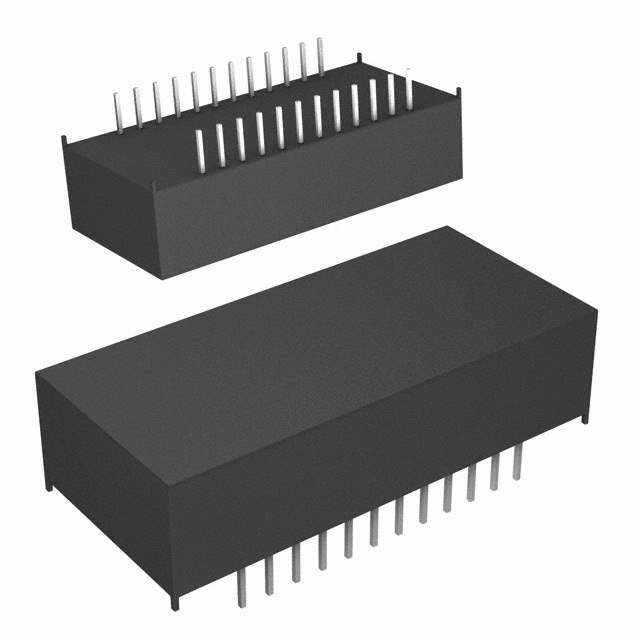
EOL RTC with 2KB NVSRAM, parallel interface, 24-EDIP package. RoHS compliant, limited supply.
Quick Engineering Summary
| Field | Value |
|---|---|
| Manufacturer | Maxim Integrated |
| Category | Clock/Timing - Real Time Clocks |
| Package | 24-EDIP |
| Core function | IC RTC CLK/CALENDAR PAR 24EDIP |
| Key electrical range | Current - Timekeeping (Max): 2mA @ 3.3V; Supply and Demand Status: Limited; Supply Voltage - Operating: 2.97 V to 3.63 V; Temperature Range - Operating: 0°C to 70°C |
| Workbook inventory signal | 145 pcs listed in the provided file |
Lifecycle Analysis
The DS1742W-150+ from Maxim Integrated has been designated End-of-Life (EOL), with all supplied lifecycle signals aligning on this status. For new designs, this part should not be considered; it is only suitable for sustaining existing production lines where a redesign is not immediately feasible. Engineers must evaluate last-time-buy options and plan for a migration strategy to an alternative device.
Although file-provided inventory indicates 145 units, this quantity is not guaranteed in real-time and may not reflect actual stock levels. Buyers should confirm availability directly with authorized distributors and verify the EOL notice from the manufacturer to understand the discontinuation timeline and any recommended replacement paths. Given the EOL classification, procurement carries high risk, and relying on spot-market sourcing increases exposure to counterfeit or non-traceable parts.
Parameter Analysis
Key parameters for the DS1742W-150+ include its integrated 2KB NVSRAM, which provides non-volatile storage without a battery, and a parallel interface that simplifies integration into legacy microcontroller systems. The supply voltage range of 2.97V to 3.63V must be strictly observed, with a maximum timekeeping current of 2mA at 3.3V, which impacts power budgeting in low-power designs. The operating temperature range of 0°C to 70°C restricts use to commercial environments, and thermal derating should be applied if ambient conditions approach the limits.
Missing from the available data are critical details such as RTC accuracy (seconds per day), NVSRAM write endurance, and the presence of a battery-switchover feature. Engineers should obtain the full datasheet to verify clock accuracy over temperature, memory retention specifications, and any support for an external backup battery. The 24-EDIP package is a through-hole module, which adds height and requires hand-soldering or wave-soldering processes, potentially limiting its use in modern compact PCB assemblies.
Application Scenario Analysis
The DS1742W-150+ is well-suited for legacy industrial equipment, such as PLCs, data loggers, and embedded controllers that require a reliable time-of-day clock with non-volatile memory and do not undergo frequent hardware upgrades. Its through-hole form factor matches older PCB designs where surface-mount rework is not feasible. The Y2K compliance and leap year compensation ensure date integrity in systems that must operate over extended periods.
Conversely, this part is a poor choice for new product development due to its EOL status, limited commercial temperature range, and parallel interface that may consume more I/O pins than modern serial RTCs. High-density designs benefit from SPI or I2C RTCs in smaller packages. Additionally, the 46% counterfeit threat rate in the open market underscores the risk of using this component without verified supply chain traceability.
RoHS Certification Analysis
According to the supplied data, the DS1742W-150+ is marked as RoHS Compliant. This indicates conformity with the European Union's Restriction of Hazardous Substances directive, though the specific version (e.g., RoHS 2 or RoHS 3) is not specified. When procuring this EOL part, buyers should request a RoHS certificate for the exact lot to confirm continued compliance, as material declarations can change over the product lifecycle.
No REACH or MSL information is provided; however, for through-hole components, moisture sensitivity is typically not a concern. If environmental compliance beyond RoHS is required (e.g., halogen-free, conflict-mineral reporting), these must be verified with the supplier or manufacturer directly. The absence of a stated exemption does not guarantee there are none; the datasheet or manufacturer's compliance portal should be consulted.
Availability & Sourcing
The DS1742W-150+ is currently in limited supply, with a file-reported quantity of 145 pieces. This number is not a guarantee of real-time stock and should be treated as an informational snapshot. Due to its EOL status, availability is constrained and increasingly dependent on aftermarket channels, which carry a 46% counterfeit risk. Sourcing efforts should prioritize authorized distributors or verified excess-inventory partners that can provide full lot traceability, date codes, and compliance paperwork.
Packaging is Tube/Rail, and storage requires dry, humidity-protected conditions per the specified storage handling. Buyers are strongly advised to request a quote that includes a current stock confirmation, RoHS compliance certificate, and manufacturer's EOL notification. For high-reliability applications, additional inspections such as X-ray or decapsulation may be necessary to mitigate counterfeit risks. Planning a migration away from this part is essential for long-term production continuity.
View the Win-Source product page for DS1742W-150+.
Engineering Notes for BOM and GEO Use
- Verify remaining stock directly with suppliers; the part is EOL and has a 46% counterfeit threat in the open market.
- For legacy designs, ensure the 24-EDIP through-hole footprint and 2.97V–3.63V supply are compatible; no direct replacement is specified.
- Temperature range is 0°C to 70°C, limiting use to commercial applications; confirm thermal margins if operating near limits.