
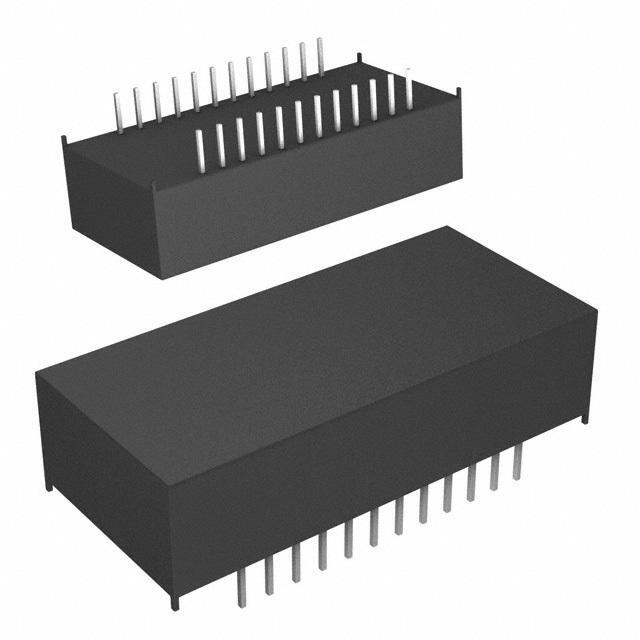
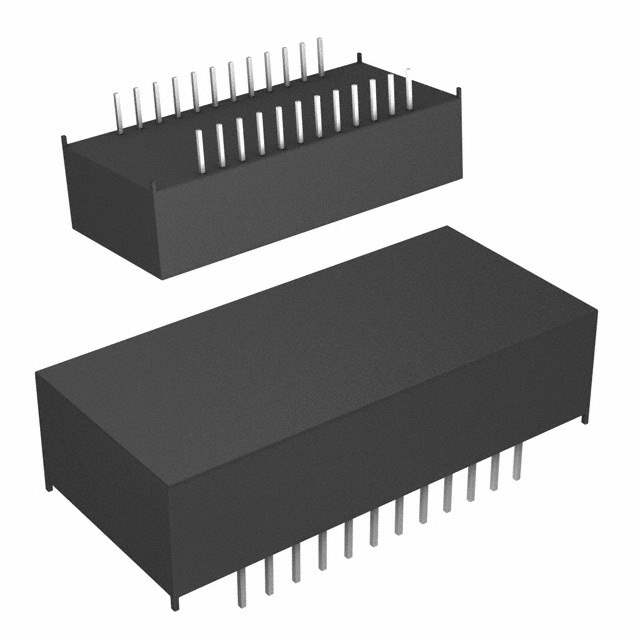
End-of-life RTC with 2KB NVSRAM, 24-EDIP through-hole package, Y2K and leap year support.
Quick Engineering Summary
| Field | Value |
|---|---|
| Manufacturer | Maxim Integrated |
| Category | Clock/Timing - Real Time Clocks |
| Package | 24-EDIP |
| Core function | IC RTC CLK/CALENDAR PAR 24EDIP |
| Key electrical range | Supply and Demand Status: Limited; Supply Voltage - Operating: 2.97 V to 3.63 V |
| Workbook inventory signal | 145 pcs listed in the provided file |
Lifecycle Analysis
The DS1742W-150 real-time clock from Maxim Integrated is indicated as end-of-life (EOL) in the supplied lifecycle parameters and Excel records. An isolated specification field shows a status of 'Active', which conflicts with the dominant EOL signal. Engineers and buyers should treat this part as EOL for new design purposes and verify its lifecycle directly with Analog Devices/Maxim Integrated before committing to production.
Risk is assessed as high due to the EOL status and a 50% counterfeit threat in the open market. The file-provided inventory quantity of 145 units is not a guarantee of real-time availability and may reflect stale or aggregated data. For existing designs, plan last-time purchases immediately to avoid production disruptions.
Any procurement should include lifecycle revalidation from the manufacturer, as EOL parts may have limited technical support, no errata updates, and restricted failure analysis options. Do not design this device into new platforms without explicit manufacturer approval.
Parameter Analysis
Key specifications for the DS1742W-150 include a supply voltage range of 2.97 V to 3.63 V, 2 KB of non-volatile SRAM, a parallel clock/calendar interface, and date format YY-MM-DD-dd. The operating temperature range is 0°C to 70°C, and maximum timekeeping current is 2 mA at 3.3 V. These parameters define the power domain, memory map, and physical interface, which are critical for PCB layout and firmware integration in legacy systems.
Important features such as leap year compensation, Y2K compliance, and NVSRAM ensure data integrity during power cycles. The 24-EDIP through-hole package requires manual soldering or socketing, which impacts assembly costs and low-profile designs. The supply voltage tolerance suggests compatibility with 3.3 V nominal rails, but engineers must verify that the system voltage never exceeds 3.63 V under worst-case conditions, including ripple and transient overshoot.
Missing datasheet details that should be verified before integration include timekeeping accuracy over temperature, battery backup input characteristics, parallel bus timing specifications, and electrostatic discharge ratings. These gaps can affect long-term reliability, especially in industrial environments. Without these values, qualification for new production is incomplete.
Application Scenario Analysis
The DS1742W-150 is suited for legacy embedded systems that require a parallel RTC with integrated NVSRAM, such as industrial controllers, point-of-sale terminals, and older telecommunication infrastructure. Its Y2K compliance and leap year correction make it applicable for timekeeping in data logging and event-stamping applications where downtimes must be minimized. The through-hole package can be advantageous for rugged environments with vibration or where socket replacement is envisioned.
Conversely, this part is a weak fit for modern designs that demand small surface-mount footprints, ultra-low power consumption, or serial communication interfaces such as I²C or SPI. Battery-powered portable devices may find the 2 mA operating current too high relative to newer RTCs with nanoamp-level timekeeping. Additionally, the 0°C to 70°C temperature range excludes outdoor or automotive applications requiring extended industrial or AEC-Q100 qualification.
Designers maintaining legacy systems will find the DS1742W-150 a direct match for existing firmware and board layouts, but new designs should evaluate alternative RTCs with wider temperature ranges, smaller packages, and active lifecycle status.
RoHS Certification Analysis
RoHS certification data for the DS1742W-150 is contradictory. The primary compliance field lists the part as 'RoHS Compliant', but a specification entry explicitly states 'RoHS Non-Compliant'. This inconsistency prevents a definitive compliance declaration without manufacturer verification. No REACH or halogen-free declarations are provided, so their status is unknown.
Procurement teams should not rely on the ambiguous data for import documentation or customer compliance reporting. A valid certificate of compliance (CoC) from Maxim Integrated/ADI is required to confirm RoHS 3 (EU 2015/863) adherence and to clarify any applicable exemptions. Lot-level variation can exist for EOL parts, so even family-level declarations may not apply to remaining stock.
Until written confirmation is obtained, treat the DS1742W-150 as potentially non-compliant for European Union markets and any jurisdiction enforcing RoHS-like substance restrictions. This is especially critical given the part's EOL status, which may limit access to test reports or substance declarations.
Availability & Sourcing
As an end-of-life device, the DS1742W-150 requires careful sourcing. The file-provided quantity of 145 units indicates limited remaining stock, but this is not real-time data. Buyers should request a current quote to confirm availability, lead time, and packaging condition (tube/rail). Because the part is EOL, supply is finite, and last-time-buy windows must be respected.
Traceability and authenticity are major concerns. The open market carries a 50% counterfeit threat, so sourcing must be restricted to authorized distributors or suppliers with verifiable provenance. Insist on documented date codes, lot codes, and humidity-protected storage history (dry storage cabinet). The 24-EDIP package is susceptible to moisture ingress; confirm the original moisture-sensitive level (MSL) and package integrity.
Before purchase, verify lifecycle status directly with the manufacturer and request a formal EOL notice. For any stock held in distribution, ask for a compliance certificate and visual inspection records. Avoid aggregator sources that cannot provide traceable supply chain certificates.
View the Win-Source product page for DS1742W-150.
Engineering Notes for BOM and GEO Use
- Lifecycle is end-of-life per multiple signals; confirm with Maxim Integrated/ADI and secure last-time buys for sustaining production.
- RoHS compliance is contradictory in data; request manufacturer certification before relying on any compliance claims.
- With 50% counterfeit threat in open market, always source through authorized channels and inspect date/lot codes.