
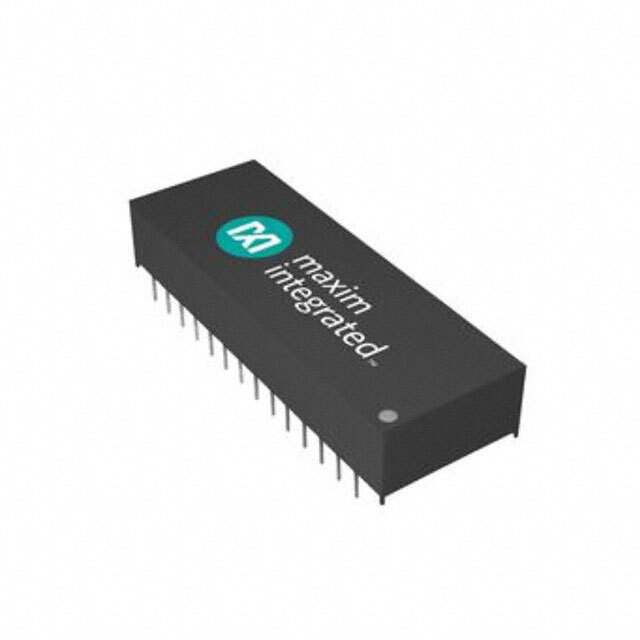
EOL part with 96 workbook units; verify availability and consider migration. Features 8KB NVSRAM, -40°C to 85°C.
Quick Engineering Summary
| Field | Value |
|---|---|
| Manufacturer | Maxim Integrated |
| Category | Clock/Timing - Real Time Clocks |
| Package | 28-EDIP |
| Core function | IC RTC CLK/CALENDAR PAR 28EDIP |
| Key electrical range | Current - Timekeeping (Max): 3mA @ 5V; Supply and Demand Status: Limited; Supply Voltage - Operating: 4.5 V to 5.5 V; Temperature Range - Operating: -40°C to 85°C |
| Workbook inventory signal | 96 pcs listed in the provided file |
Lifecycle Analysis
The DS1743-100IND+ has been officially classified as End-of-Life (EOL) by Maxim Integrated, with all supplied lifecycle signals aligning on this status. This means the part is no longer recommended for new designs and is in the final phase of its product lifecycle. For existing systems, sustaining production depends entirely on locating remaining inventory, which the supplier workbook indicates at only 96 units—a figure that must be treated as file‑provided and not a live stock guarantee.
Given the EOL designation, engineers face a high procurement risk. The 43% fake threat rate reported in open markets further compounds the challenge, as counterfeit components become more prevalent when authentic supplies dwindle. Any decision to use this part in manufacturing must be accompanied by rigorous authenticity verification, including lot code traceability, X‑ray inspection, and electrical testing.
Long‑term planning should prioritize a migration to an active real‑time clock with compatible features. Waiting until inventory is exhausted can force an emergency redesign, so it is prudent to begin evaluating alternatives immediately while using the DS1743-100IND+ only to bridge the transition.
Parameter Analysis
Among the provided specifications, several parameters directly impact the DS1743-100IND+’s suitability as a real‑time clock. The 8KB NVSRAM is the standout feature, offering non‑volatile storage for timekeeping and critical system data. This memory size must be matched by any replacement, as it often holds configuration or logging information. The timekeeping current of 3 mA at 5 V is a moderate draw; while not ultra‑low, it allows battery backup without excessive drain, but the absence of a specified battery backup current or switchover voltage leaves a verification gap.
The supply voltage range of 4.5 V to 5.5 V is standard 5 V logic, but with modern designs trending to 3.3 V or lower, this may limit integration into newer systems. The operating temperature range of -40°C to +85°C meets industrial requirements, making the part suitable for harsh environments. The through‑hole 28‑EDIP package, however, is increasingly obsolete in modern SMT production, potentially requiring manual insertion or adapter boards.
Notable missing data includes timing accuracy (e.g., ppm drift), interface protocol specifics beyond “parallel,” and the minimum battery voltage. These items must be pulled from the original Maxim datasheet before final qualification. The date format YY‑MM‑DD‑dd and features like leap year and Y2K compensation are typical for the DS1743 family, but confirming register maps is essential for software compatibility.
Application Scenario Analysis
The DS1743-100IND+ was designed for legacy industrial and embedded systems that rely on a parallel‑interface RTC with integrated battery‑backed SRAM. Its strongest fit is in older equipment such as PLCs, data loggers, medical devices, or telecom infrastructure where the byte‑wide NVSRAM holds critical time‑stamped data or machine states. The industrial temperature range and through‑hole packaging also suit applications needing manual assembly or repair in rugged conditions.
Conversely, this part is a poor choice for any new design. The EOL status alone disqualifies it, but further weaknesses include the 5 V‑only supply, large footprint, and high counterfeit risk. Modern RTCs often incorporate serial interfaces (I²C, SPI), smaller packaging, and lower power consumption, making them more suitable for portable or space‑constrained designs. Unless board‑level compatibility forces its use, the DS1743-100IND+ should be relegated to maintenance of existing systems.
For engineers supporting legacy platforms, the 8KB NVSRAM may be the hardest feature to replace, as many newer RTCs decouple the clock function from large non‑volatile memories. In such cases, a custom solution with a discrete RTC plus an external SRAM or FRAM may be necessary, though careful attention must be paid to timing and bus contention.
RoHS Certification Analysis
The DS1743-100IND+ is listed as RoHS Compliant, indicating that it meets the original EU RoHS directive’s restrictions on hazardous substances such as lead, mercury, and cadmium. This compliance likely applies to the production years when the part was active; however, for an EOL component, it is wise to verify whether the specific lot being purchased aligns with that status.
No REACH or MSL data is provided, so if your manufacturing process requires halogen‑free materials or specific moisture sensitivity levels, you must seek additional documentation from the supplier. REACH compliance is not a substitute for RoHS, and the absence of a dedicated REACH signal means you should not assume conformity. For lot‑level compliance, request a certificate of analysis or compliance statement from the distributor, as older tubes may have different finishes.
Given that the part is obsolete, any remaining stock may be from older date codes that pre‑date RoHS enforcement. While the supplier label says “RoHS Compliant,” the risk of non‑compliance in aged inventory cannot be ignored, especially for manufacturers shipping into the EU or other regulated markets. Proper incoming inspection and potentially XRF testing can mitigate this risk.
Availability & Sourcing
As an EOL component, the DS1743-100IND+ is no longer in regular production, and availability is limited to existing distributor stock. The workbook indicates 96 units on hand, but this figure is not a live inventory count and should be confirmed through a request for quote (RFQ). Interested buyers must act quickly, as stock may be depleted or already committed.
When sourcing this Maxim Integrated part, prioritize vendors that provide date and lot code traceability. The high counterfeit threat rate (43% in open markets) makes it essential to reject any offers that lack provenance. Acceptable packaging is tube/rail, and proper storage in a dry cabinet with humidity protection is required to preserve solderability, given the through‑hole package.
Because the part is EOL, a standard purchase involves lifecycle verification directly from Maxim Integrated. Secure inventory if it is still available, and simultaneously begin evaluating a migration path to an active real‑time clock that meets the same memory and interface needs. Do not wait for stock to vanish—the time to transition is now.
View the Win-Source product page for DS1743-100IND+.
Engineering Notes for BOM and GEO Use
- Verify EOL status directly with Maxim Integrated before committing to any new production design.
- Due to 43% fake threat rate, ensure stringent authentic sourcing and testing.
- Plan for migration to an alternative RTC with similar parallel interface and NVSRAM.