
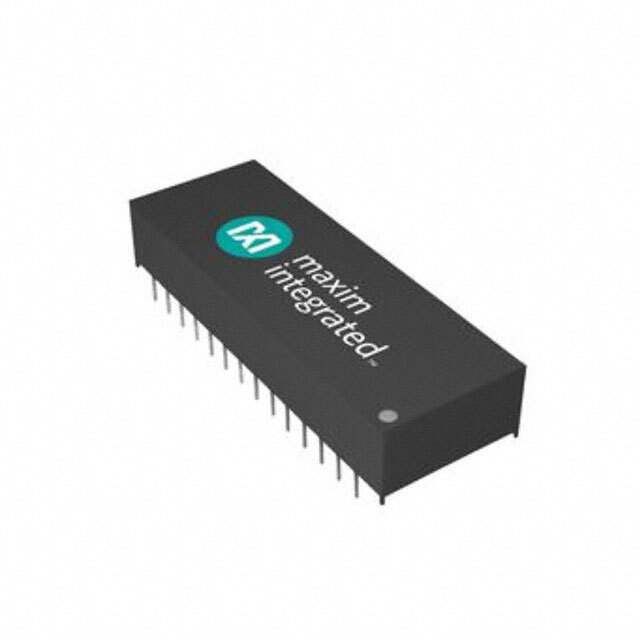
Through-hole RTC with 32KB NVSRAM, parallel interface, and 0°C to 70°C commercial temperature range.
Quick Engineering Summary
| Field | Value |
|---|---|
| Manufacturer | Maxim Integrated |
| Category | Clock/Timing - Real Time Clocks |
| Package | 28-EDIP |
| Core function | IC RTC CLK/CALENDAR PAR 28EDIP |
| Key electrical range | Current - Timekeeping (Max): 4mA @ 5V; Supply and Demand Status: Limited; Supply Voltage - Operating: 4.5 V to 5.5 V; Temperature Range - Operating: 0°C to 70°C |
| Workbook inventory signal | 1 pcs listed in the provided file |
Lifecycle Analysis
The DS1744-70+ is listed as Active by Maxim Integrated with all available lifecycle signals aligning. This status indicates that the part is in full production and suitable for new designs as well as sustaining existing product lines. Engineers can confidently include this RTC in new BOMs, but it remains prudent to verify lifecycle status directly with the manufacturer or an authorized distributor for long-term volume planning, as product roadmaps can change.
The risk level is low given the active status. However, supply data shows a limited availability note, so while the part is not obsolete, procurement should account for possible allocation or lead time. The file-provided inventory quantity of one unit is not a real-time guarantee; always check with suppliers for current stock before committing to production schedules.
Parameter Analysis
The DS1744-70+ operates with a supply voltage of 4.5 V to 5.5 V, drawing a maximum timekeeping current of 4 mA at 5 V. This 5 V compatibility makes it suitable for legacy 5 V logic systems. The commercial temperature range of 0°C to 70°C limits its use to indoor or controlled environments, excluding extreme industrial or automotive applications. Its 32 KB of NVSRAM provides ample non-volatile storage for timestamps, configuration data, or event logs, backed by an internal battery or supercapacitor.
The parallel interface and 28-pin EDIP through-hole package make the part easy to use in prototyping and repair-friendly designs but may not be ideal for high-density surface-mount layouts. Key missing parameters include timekeeping accuracy (typically in ppm), backup current for battery estimation, and interface timing characteristics. Designers must consult the full Maxim Integrated datasheet to verify these values, as well as to confirm ESD ratings and mechanical dimensions for board layout.
Application Scenario Analysis
The DS1744-70+ fits well in embedded systems that require a reliable real-time clock with integrated non-volatile memory, such as industrial controllers, data loggers, utility meters, and point-of-sale terminals. Its through-hole package is advantageous for legacy equipment upgrades, bench prototypes, and applications where manual assembly or socketing is preferred. The 5V operation is standard for many industrial power rails.
Less suitable scenarios include portable battery-operated devices where the 4 mA timekeeping current and 5V supply would drain batteries quickly, and high-temperature environments above 70°C. The through-hole package also rules out use in space-constrained mobile or miniature products. Engineers should evaluate whether the 32 KB memory size matches their logging needs and ensure that the parallel bus timing is compatible with their microcontroller or processor.
RoHS Certification Analysis
The DS1744-70+ is designated as RoHS Compliant. This implies compliance with EU RoHS directives restricting hazardous substances, but the exact directive version (e.g., 2011/65/EU or 2015/863) is not specified in the available data. For through-hole DIP components, exemptions such as 7(a) for lead in high melting temperature solders may apply. Designers should request the manufacturer's Declaration of Conformity to confirm the specific directive and any applicable exemption details.
Without lot-level certification, compliance should be verified for each shipment, especially when exporting to EU markets. The presence of an MSDS note suggests hazardous material information is accessible; obtaining it can further validate safety and environmental compliance. Overall, RoHS compliance is asserted, but documentation must be confirmed in procurement to avoid compliance gaps.
Availability & Sourcing
With an active lifecycle, the DS1744-70+ can be sourced through normal distribution channels. However, the supply and demand status is noted as limited, and the file-provided inventory shows only one unit, which may not reflect real-time availability. Buyers should request a quote from authorized distributors and inquire about lead times and factory order options.
The open-market fake threat is reported at 72 percent, making it critical to source from authorized Maxim Integrated or Analog Devices distributors. Requests should include verification of date/lot codes, full traceability, and RoHS compliance certificates. The part is packaged in tubes, and storage conditions require a dry environment with humidity protection—ensure your handling and storage processes meet these requirements to maintain part integrity upon receipt. For production, consider buffer stock or scheduled orders to mitigate potential shortages.
View the Win-Source product page for DS1744-70+.
Engineering Notes for BOM and GEO Use
- Verify the exact RoHS directive and any lead-in-solder exemption for the through-hole 28-EDIP package with the manufacturer.
- With an open-market fake threat of 72% and limited supply, always source from Maxim Integrated authorized distributors and request full traceability documentation.
- The 4mA timekeeping current at 5V is specified for active operation; for battery backup design, consult the datasheet for standby current requirements.