
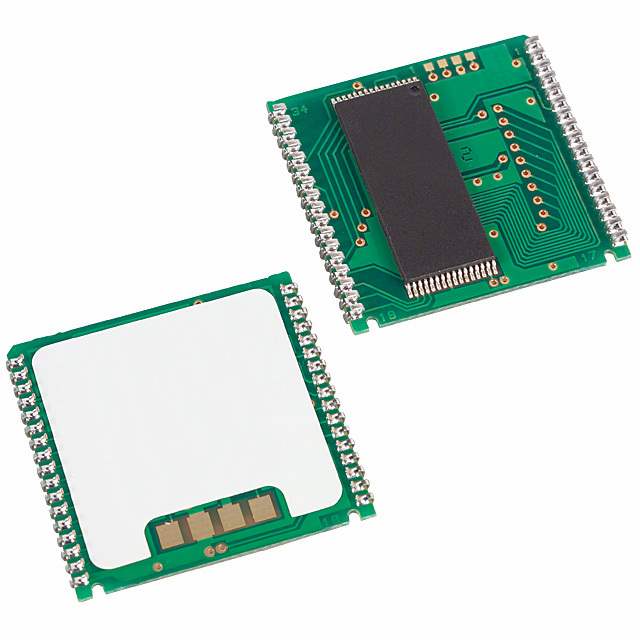
Active clock/calendar RTC with 128KB NVSRAM in 34-PowerCap module; 5V supply, commercial temperature range.
Quick Engineering Summary
| Field | Value |
|---|---|
| Manufacturer | Maxim Integrated |
| Category | Clock/Timing - Real Time Clocks |
| Package | 34-PowerCap Module |
| Core function | IC RTC CLK/CALENDAR PAR 34PCM |
| Key electrical range | Current - Timekeeping (Max): 4mA @ 5V; Supply and Demand Status: Limited; Supply Voltage - Operating: 4.5 V to 5.5 V; Temperature Range - Operating: 0°C to 70°C |
| Workbook inventory signal | 100 pcs listed in the provided file |
Lifecycle Analysis
The DS1746P-70+ from Maxim Integrated carries an Active lifecycle status, indicating the part is in full production and available for new designs. This status is confirmed by consistent manufacturer labeling and no reported discontinuation notices. For engineers, this means the part can be incorporated into both new PCB layouts and existing production lines with a low risk of sudden obsolescence. Nevertheless, for long-lifecycle programs, it is prudent to periodically revalidate the status with Maxim Integrated or authorized distributors, as product roadmaps can shift. The file-provided quantity of 100 units suggests immediate batch availability, but real-time stock must be confirmed via RFQ.
From a procurement standpoint, an Active part simplifies supply chain planning, but the component’s limited supply/demand status (as reported) warrants buffer stock strategies. The DS1746P-70+ does not show conflicting lifecycle signals, so no special urgency is required. However, because the part uses a proprietary 34-PowerCap module, second sources may be limited, making lifecycle monitoring essential. In summary, the DS1746P-70+ is a safe choice for current designs, with the usual caveat of verifying leading-edge production status for critical or extended-life applications.
Parameter Analysis
The DS1746P-70+ integrates a real-time clock/calendar with 128KB of NVSRAM in a 34-PowerCap module. Key parameters for design integration include the supply voltage range of 4.5V to 5.5V, which aligns with standard 5V logic rails but excludes low-power 3.3V systems without level shifting. The maximum timekeeping current of 4mA at 5V is modest, but designers must account for this in power budgets, especially during backup-battery operation where the 3V battery input takes over. The commercial temperature range of 0°C to 70°C restricts usage to indoor or climate-controlled environments, not suited for industrial extended range.
The 128KB NVSRAM offers significant non-volatile storage, but the datasheet should be consulted for write-cycle endurance and data retention specifications, which are not listed in the sourcing data. The date format YY-MM-DD-dd and features like leap year and Y2K compliance indicate standard RTC capabilities. Missing parameters that require verification include RTC accuracy (typically ±1 minute per month drift) and the parallel interface timing characteristics. For PCB layout, the 34-PowerCap module’s footprint must accommodate the snap-on cap height and SMT soldering profile. Always check the full datasheet for initialization sequences and crystal requirements.
Application Scenario Analysis
The DS1746P-70+ is well-suited for embedded systems requiring a parallel-interface real-time clock with integrated non-volatile memory. Strong application fits include legacy industrial controllers, point-of-sale terminals, and networked equipment that operate on 5V power rails and need bit-level NVSRAM access. The Y2K and leap-year features make it appropriate for long-deployment devices. Equipment maintained within 0°C to 70°C, such as lab instruments or indoor automation, can use this part without thermal concerns.
However, weak-fit scenarios emerge for modern low-power designs: the 5V-only operation and 4mA current draw preclude battery-operated or 3.3V microcontroller applications without extra regulation. Outdoor or automotive uses exceed the temperature limits. The 34-PowerCap module’s size and snap-on battery cap may conflict with high-density or low-profile assemblies. Additionally, if the application demands an I²C or SPI interface, this parallel device is not suitable. Engineers evaluating the DS1746P-70+ should weigh these constraints against the benefit of 128KB NVSRAM in the RTC’s address space.
RoHS Certification Analysis
The DS1746P-70+ is declared RoHS Compliant by Maxim Integrated, indicating conformity with EU Directive 2011/65/EU and its amendments. While the sourcing data does not specify the exact RoHS version (e.g., RoHS 3 or 2015/863), the designation typically covers the current standard unless otherwise noted. For procurement, this means the part meets lead-free and hazardous substance restrictions, simplifying export to EU markets. However, because compliance can be lot- or date-code dependent, purchasing teams should request a certificate of compliance from the distributor for each shipment.
The dataset does not include a separate REACH statement, so if REACH documentation is required, it must be obtained directly from Maxim Integrated. Moisture sensitivity level (MSL) is not provided, which is important for SMT assembly; engineers should verify the MSL rating for the 34-PowerCap module before reflow. The presence of a lithium battery cell in the PowerCap design may involve recycling or disposal exemptions under the WEEE directive. As always, compliance at the component level does not automatically extend to the end-product, and system-level CE/RoHS assessment remains the responsibility of the OEM.
Availability & Sourcing
With an Active lifecycle status, the DS1746P-70+ is available for new orders, but supply and demand is reported as limited. The file-provided quantity of 100 units is an indication and not guaranteed real-time stock; accurate availability can only be obtained by requesting a quote. The component is packaged in Tube/Rail and requires dry storage conditions to prevent moisture ingress, as noted in its storage specification.
Sourcing the DS1746P-70+ through authorized distribution channels is critical due to a high counterfeit threat (42%) indicated in the open market. Buyers should insist on full traceability and request date/lot code information to verify provenance. For volume production, lead times should be confirmed, especially given the limited supply status. Since the part is active, no end-of-life bridging is required, but maintaining safety stock is advisable. Compliance documentation, including RoHS certification and product change notices, should be attached to each purchase. To secure current pricing and delivery, direct readers to request a quote from trusted suppliers.
View the Win-Source product page for DS1746P-70+.
Engineering Notes for BOM and GEO Use
- Verify NVSRAM data retention and endurance specifications with Maxim Integrated before committing to production quantities.
- Operate within 0°C to 70°C; ensure 5V supply stability and heat dissipation for the 34-PowerCap module.
- Source from authorized distributors; open-market counterfeit risk is high at 42%, and supply/demand is limited.