
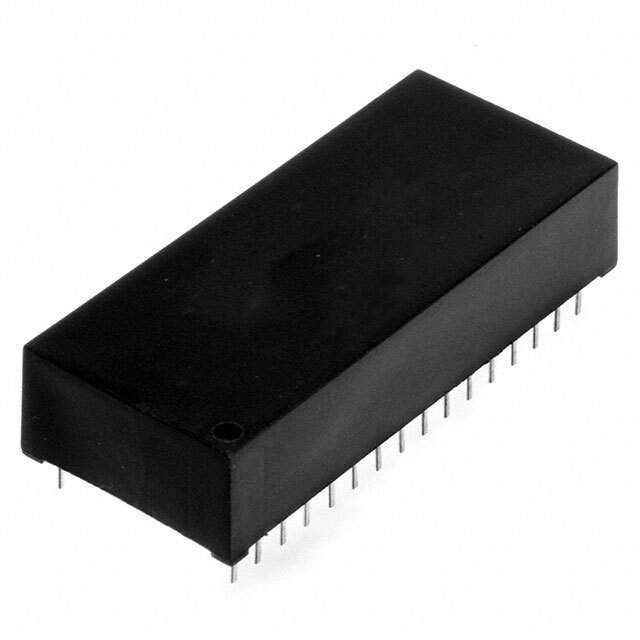
Maxim Integrated Clock/Timing RTC with NVSRAM – Specifications, Lifecycle, and Procurement Guidance
Quick Engineering Summary
| Field | Value |
|---|---|
| Manufacturer | Maxim Integrated |
| Category | Clock/Timing - Real Time Clocks |
| Package | 32-EDIP |
| Core function | IC RTC CLK/CALENDAR PAR 32EDIP |
| Key electrical range | Current - Timekeeping (Maximum): 4mA @ 5V; Operating Supply Voltage: 4.5 V ~ 5.5 V; Operating Temperature Range: 0°C ~ 70°C; Supply and Demand Status: Limited |
| Workbook inventory signal | 6 pcs listed in the provided file |
Lifecycle Analysis
The DS1747-70+ is listed as Active by Maxim Integrated, indicating that the manufacturer currently supports full production and new orders. However, a provided Estimated End-of-Life (EOL) Date of 2023 introduces significant uncertainty. While the active status alone would suggest low risk for new designs, the near-term EOL projection means that orders placed now may face diminishing availability over the next few years.
Engineers evaluating this part should contact Maxim Integrated directly to clarify the lifecycle trajectory. If the part is truly approaching discontinuation, it may be prudent to limit its use to sustaining existing production and avoid adopting it in new platform designs. For any procurement, verify the lifecycle commitment from the manufacturer and consider securing buffer inventory to protect against sudden allocation shifts.
The file-provided inventory of 6 units and the limited supply-demand status further underscore the need for careful planning. This quantity is a snapshot and not a real-time guarantee. Buyers should request a quote to confirm current availability and lead times, and incorporate lifecycle verification into their supplier qualification process.
Parameter Analysis
The DS1747-70+ operates over a 4.5V to 5.5V supply range, with a maximum timekeeping current of 4mA at 5V. This 5V-only operation makes it suitable for legacy industrial systems and 5V logic domains but precludes direct use in 3.3V or lower-voltage designs without level shifting. The parallel interface provides fast register access but consumes more I/O pins than serial alternatives, which may be a concern in pin-constrained designs.
The on-chip 512KB NVSRAM is a key differentiator, allowing data retention without an external battery backup. However, the datasheet should be consulted for the exact data retention voltage and write cycle endurance. The through-hole 32-EDIP package (32-DIP Module, 0.600" width) is designed for wave soldering and suits applications where board space is less critical or where sockets are used for serviceability. Missing parameters that designers should verify include the backup-battery voltage range, timekeeping accuracy over temperature, and the crystal frequency used. The date format (YY-MM-DD-dd) and leap year/Y2K features are well-defined, but the absence of I²C or SPI interfaces limits integration with modern microcontrollers that increasingly rely on serial buses.
Application Scenario Analysis
This RTC is a strong fit for industrial control systems, test equipment, and legacy embedded devices that require a parallel RTC with integrated non-volatile memory. The combination of clock/calendar functions with 512KB NVSRAM can reduce component count in data-logging applications where timestamped records must survive power loss. The through-hole package also suits maintenance-friendly designs or harsh environments where vibration might compromise SMD solder joints.
Conversely, the DS1747-70+ is a weak fit for battery-powered portable devices due to its 4.5V minimum operating voltage and relatively high timekeeping current. It is also not ideal for compact, high-density PCBs that rely on surface-mount components. Designers considering this part should weigh the convenience of integrated NVSRAM against the I/O overhead of the parallel interface and the physical footprint of the DIP package. Given the part’s popularity and common usage, it can still be a reliable choice for many existing designs, but the limited supply situation suggests that new projects should validate that alternative RTC modules meet their requirements before finalizing the BOM.
RoHS Certification Analysis
The DS1747-70+ is designated RoHS Compliant by Maxim Integrated. While the specific RoHS directive version is not stated, this typically implies conformity with EU RoHS Directive 2011/65/EU and its amendments, restricting hazardous substances such as lead, mercury, and cadmium. No exemptions are indicated for this part, suggesting full compliance without reliance on any exemption categories.
However, RoHS compliance is ultimately a lot-level attribute. Given the high counterfeit threat (66%) in the open market, buyers must not rely solely on a manufacturer’s blanket statement. Requesting a certificate of compliance (CoC) with each shipment, along with third-party test reports when warranted, is essential to verify that the parts delivered match the certified composition. Storage conditions specified (dry cabinet, humidity protection) also help maintain solderability and long-term reliability, which is consistent with lead-free processing requirements.
Availability & Sourcing
Current supply for the DS1747-70+ is characterized as limited, with a file-provided quantity of 6 units. This figure is a static snapshot and does not reflect real-time stock. Buyers should use the RFQ process to obtain live pricing and availability. The part is packaged in tubes, suitable for automated insertion or manual placement, and its storage condition requires a dry environment with humidity protection.
Sourcing teams must be vigilant about counterfeit risk, which is estimated at 66% for this part in the open market. To mitigate this, procure only through authorized Maxim Integrated distributors or approved aftermarket suppliers that offer full traceability, date/lot codes, and authenticity guarantees. For production orders, include lifecycle re-confirmation and RoHS compliance documentation as line items in the purchase agreement.
Given the potential EOL and limited supply, design for second-source alternatives where feasible. If this part is essential for current production, consider negotiating a last-time buy or safety stock arrangement with the manufacturer while the lifecycle status remains officially active. This proactive approach helps avoid production disruptions if the component transitions to NRND or EOL status.
View the Win-Source product page for DS1747-70+.
Engineering Notes for BOM and GEO Use
- Verify lifecycle directly with Maxim Integrated: an estimated EOL date of 2023 conflicts with the active status and may affect long-term availability.
- The parallel interface and 512KB NVSRAM integrate memory and timekeeping, but the through-hole 32-EDIP package limits suitability for compact SMD designs.
- High counterfeit risk (66%) demands sourcing exclusively from authorized distributors with full traceability and RoHS batch documentation.