
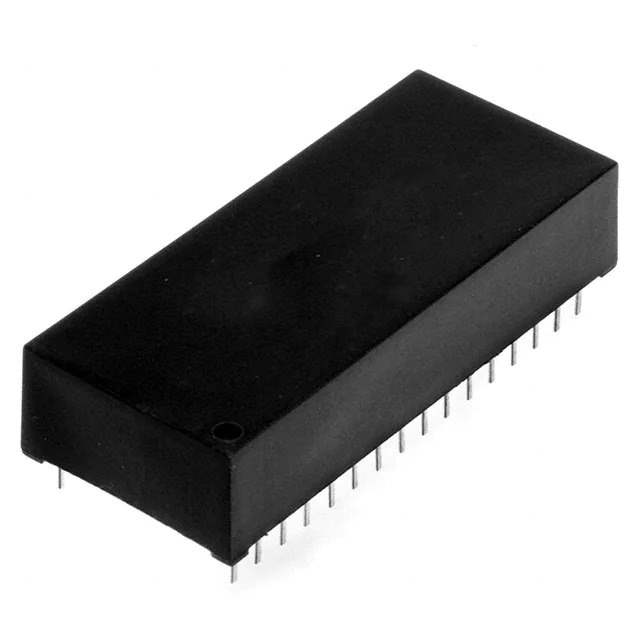
Discontinued Real-Time Clock from Maxim Integrated – Specs & Sourcing Guide
Quick Engineering Summary
| Field | Value |
|---|---|
| Manufacturer | Maxim Integrated |
| Category | Clock/Timing - Real Time Clocks |
| Package | Tube |
| Core function | IC RTC CLK/CALENDAR PAR 32EDIP |
| Key electrical range | Current - Timekeeping (Max): 2mA @ 3.3V; Temperature Range - Operating: -40°C ~ 85°C; Voltage - Supply: 2.97V ~ 3.63V |
| Workbook inventory signal | 1 pcs listed in the provided file |
Lifecycle Analysis
The DS1747W-120IND is officially discontinued, as confirmed by multiple lifecycle signals in the source data. All indicators – EOL lifecycle parameter, Discontinued product status, and Discontinued lifecycle status – converge on an end-of-life designation. This means Maxim Integrated has ceased manufacturing the part, and no new supply is entering the channel.
For engineers, this status prohibits new design-in; the part should only be considered for maintaining existing systems where a redesign is not immediately feasible. Buyers must treat any available stock as residual inventory and verify the last-time-buy (LTB) date with the manufacturer to gauge remaining support. Sustaining production with this part carries high risk, as supply will only dwindle.
Proactive migration planning is strongly advised. Even if a few units can be sourced now, long-term availability cannot be guaranteed. Engineering teams should begin qualifying a pin-compatible or functionally equivalent replacement to avoid production stoppages. If immediate procurement is necessary, consult the manufacturer for authorized distribution channels to minimize counterfeit risk.
Parameter Analysis
The DS1747W-120IND integrates a real-time clock/calendar with 512kb of non-volatile SRAM (NVSRAM), a parallel interface, and an operating temperature range of -40°C to +85°C. Timekeeping current is capped at 2mA at 3.3V, with a supply voltage range of 2.97V to 3.63V. The part is housed in a through-hole 32-DIP module (0.600" width), making it suitable for legacy PCB layouts that rely on through-hole mounting.
Key decision-driving parameters include the parallel interface, which may require a dedicated bus and limits miniaturization compared to serial alternatives. The 512kb NVSRAM capacity is generous for time-stamping and event logging, but the parallel access must be evaluated against system bus loading. The date format (YY-MM-DD-dd) and features like leap-year compensation and Y2K compliance are standard, but customizability is limited since the part is marked "Not Verified" for programmable status – some functions may need external logic.
Critical missing datasheet items to verify before integration include battery-backup switchover thresholds, write-protect timing, access time, and power-fail circuitry behavior. Without these, reliable backup operation cannot be assured. Additionally, the MSL Level 1 (Unlimited) rating indicates no special moisture handling, but the through-hole package may require wave soldering. Engineers must thoroughly review the original Maxim Integrated datasheet to confirm all timing and electrical specifications, especially if the part is being used in a high-reliability application.
Application Scenario Analysis
The DS1747W-120IND is designed for embedded systems requiring battery-backed date/time and non-volatile parameter storage. Strong-fit applications include legacy industrial controllers, medical or test equipment, and telecom infrastructure where a parallel bus and high NVSRAM density are already architected. The extended temperature range supports outdoor or unregulated environments, and Y2K compliance removes century‑rollover concerns.
Weak-fit scenarios include any new design with space constraints, as the 32‑DIP through‑hole package is incompatible with modern surface‑mount assembly lines. Low‑power portable devices are also poorly matched, given the 2mA timekeeping draw. Designs migrating to serial interfaces (I²C, SPI) would find the parallel interface a barrier to integration.
For legacy system sustainment, the part can maintain uptime if an exact replacement is needed, but the high counterfeit threat (67%) and scarcity require rigorous source control. If a redesign is possible, moving to a smaller, serial‑interface RTC with external EEPROM may improve reliability and longevity.
RoHS Certification Analysis
RoHS compliance data for the DS1747W-120IND is contradictory. The aggregated compliance field shows “RoHS Compliant,” but the detailed specification field lists “RoHS Non‑Compliant.” This discrepancy may arise from different production batches or legacy vs. revised product statuses. REACH status is “Unaffected,” which does not address RoHS requirements.
Given the uncertainty, the part must be treated as potentially non‑compliant with EU RoHS directives (2011/65/EU, 2015/863). Using it in products destined for the European market without verified compliance documentation poses regulatory risk. Engineers should request a full material declaration from the manufacturer or authorized distributor. If the part is confirmed non‑compliant, a compliant alternative or an exemption must be sought.
Lot‑level variation is plausible: some stock may be pre‑RoHS, while later lots could be compliant. The MSL Level 1 (Unlimited) rating indicates moisture sensitivity is not an issue, but this has no bearing on RoHS compliance. Buyers should only accept parts with a certificate of compliance specific to the supplied date code.
Availability & Sourcing
Sourcing the DS1747W-120IND is highly challenging due to its discontinued status. File‑provided data indicates just 1 unit, but real‑time availability can only be confirmed through a request for quote (RFQ). The standard packaging is tube, with a standard package quantity of 11 pieces; however, residual stock may be sold as single units.
Counterfeit risk is elevated, flagged at 67% in open markets. To mitigate, insist on full traceability including manufacturer date/lot codes, original packaging, and compliance certificates. Avoid unknown brokers; prioritize authorized or franchised distributors even for discontinued parts. For sustaining production, secure the remaining stock immediately and validate authenticity through visual inspection and electrical testing.
For new production, do not design in this part. Instead, request a cross‑reference from Maxim Integrated (now Analog Devices) for an active replacement. If a formal migration guide is not available, evaluate newer RTCs with similar NVSRAM capacity but a serial interface and modern package. Remember that the part’s RoHS status is ambiguous; verify compliance before import into regions with RoHS enforcement.
View the Win-Source product page for DS1747W-120IND.
Engineering Notes for BOM and GEO Use
- The DS1747W-120IND is discontinued; confirm manufacturer’s last-time-buy notice and avoid use in new designs.
- RoHS compliance is contradictory – verify directly with Maxim Integrated to avoid EU market rejection.
- File-provided quantity of 1 unit, with a 67% counterfeit risk, demands rigorous authentication before procurement.