
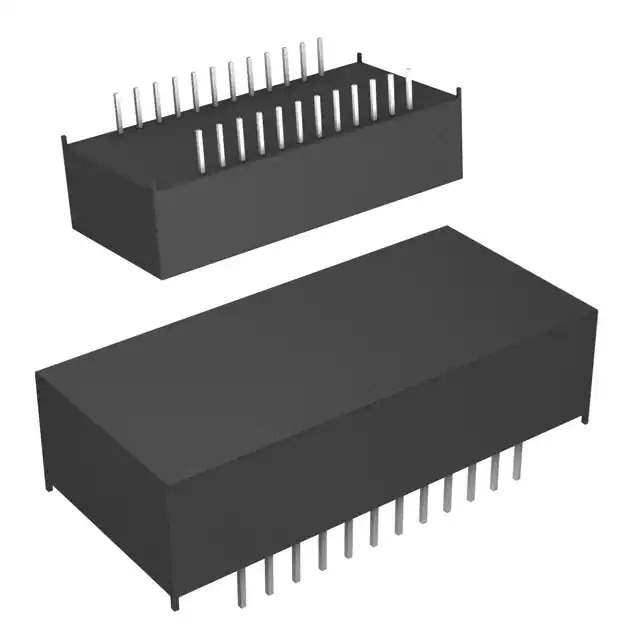
Discontinued parallel RTC with 4KB NVSRAM, through-hole EDIP package. Verify compliance and source carefully.
Quick Engineering Summary
| Field | Value |
|---|---|
| Manufacturer | Maxim Integrated |
| Category | Clock/Timing - Real Time Clocks |
| Package | Tube |
| Core function | IC RTC CLK/CALENDAR PAR 24EDIP |
| Key electrical range | Current - Timekeeping (Max): 2mA @ 2.7V ~ 3.7V; Temperature Range - Operating: 0°C ~ 70°C; Voltage - Supply: 2.7V ~ 3.7V; Voltage - Supply, Battery: 2.5V ~ 3.7V |
| Workbook inventory signal | 8400 pcs listed in the provided file |
Lifecycle Analysis
The DS17487-3 from Maxim Integrated is officially discontinued according to all available lifecycle signals. This high-risk status means the part is no longer manufactured and no official technical support is available. Engineers should avoid using the DS17487-3 in new designs and must plan an immediate migration path for existing production lines.
While file-provided inventory data indicates a stock quantity of 8400 units, this is not a real-time guarantee. Any remaining stock is likely from excess or broker channels and may require rigorous authenticity verification before purchase.
The 36% fake threat rate in the open market underscores the necessity of sourcing only from trusted distributors with full traceability. For sustaining production, secure sufficient quantity through a last-time buy and simultaneously qualify an alternative RTC to avoid line-down situations.
Parameter Analysis
The DS17487-3 integrates a real-time clock/calendar with a parallel interface and 4KB of NVSRAM in a 24-pin EDIP through-hole module. Key parameters include a timekeeping current of 2mA max at 2.7–3.7V, a wide battery backup voltage range (2.5–3.7V), and an operating temperature range of 0°C to 70°C. These specifications make it suitable for legacy industrial controllers and embedded systems where parallel bus access and non-volatile timekeeping are critical.
The on-board NVSRAM ensures data retention during power loss without an external battery switchover circuit, simplifying design. Features such as alarm, daylight savings, and leap year compensation reduce software overhead. However, important datasheet details are missing from the supplied data, including clock accuracy (ppm), oscillator type, and timekeeping voltage tolerance curves. Engineers must verify these parameters against the original Maxim datasheet to ensure compatibility with system timing margins.
The through-hole package and standard tube packaging suggest it is intended for manual or wave soldering processes, not modern SMT lines. Its maximum supply voltage of 3.7V and commercial temperature range limit its use to non-automotive, room-temperature environments unless tested for wider margins.
Application Scenario Analysis
Strong-fit applications for the DS17487-3 are predominantly in legacy and industrial control equipment that rely on parallel-bus architecture and through-hole assembly. Examples include older PLCs, data loggers, medical monitoring devices, and utility metering systems where the 4KB NVSRAM stores configuration or event data. The device’s alarm and square wave output features support periodic wake-up tasks in deeply embedded microcontroller systems.
Weak-fit scenarios include any new designs targeting size reduction, low power consumption, or modern serial interfaces like I2C or SPI. The through-hole package is incompatible with automated high-density SMT assembly, and the 2mA timekeeping current is high relative to modern ultra-low-power RTCs. The commercial temperature range excludes outdoor, automotive, or industrial extended-temperature applications. Additionally, the discontinued status makes it unsuitable for new product introductions that require long-term supply assurance.
RoHS Certification Analysis
The RoHS compliance status for DS17487-3 presents a critical conflict in the supplied data. One source indicates RoHS Compliant, while another explicit specification lists RoHS Non-Compliant. This discrepancy requires immediate clarification from Maxim Integrated or authorized distributors. The part also carries an MSL Level 1 rating and a REACH Unaffected status, which address moisture sensitivity and chemical registration but do not resolve the RoHS question.
Given the high-risk lifecycle and the need for regulatory compliance in many markets, procurement teams must treat the device as possibly non-compliant until verified. A non-compliant rating would restrict its use in RoHS-mandated territories and may require a compliant drop-in replacement for new production. Even if older stock is compliant, variations across date/lot codes could affect compliance, so insist on full material declarations or test reports for each lot.
Availability & Sourcing
The DS17487-3 is a discontinued part with a significant counterfeit threat level of 36% in the open market. File-provided inventory shows 8400 units, but this quantity is not a real-time reflection of market stock. Buyers should request a quote immediately to confirm current availability and pricing trends from authorized or verified sources. Standard factory packaging is tubes of 14 pieces, which is typical for through-hole modules.
Due to the discontinued status, stringent sourcing protocols are essential. Require detailed documentation including manufacturer date/lot codes, certificates of conformance, and RoHS compliance test reports. Traceability back to Maxim Integrated is non-negotiable to avoid counterfeit or recycled components.
Evaluate whether existing stock can cover production needs through a last-time buy. If not, engineer a migration to an alternative real-time clock with parallel interface or consider a small FPGA/CPLD bridge to a modern serial RTC if the parallel bus is still required. Engage with Maxim Integrated or licensed distributors to understand any remaining authorized inventory channels.
View the Win-Source product page for DS17487-3.
Engineering Notes for BOM and GEO Use
- Immediately verify RoHS compliance directly with Maxim Integrated due to conflicting supplier data.
- Plan a last-time buy of verified DS17487-3 stock and begin qualification of a replacement RTC.
- Rigorously authenticate every lot; the 36% counterfeit rate demands full traceability and lot-level testing.