
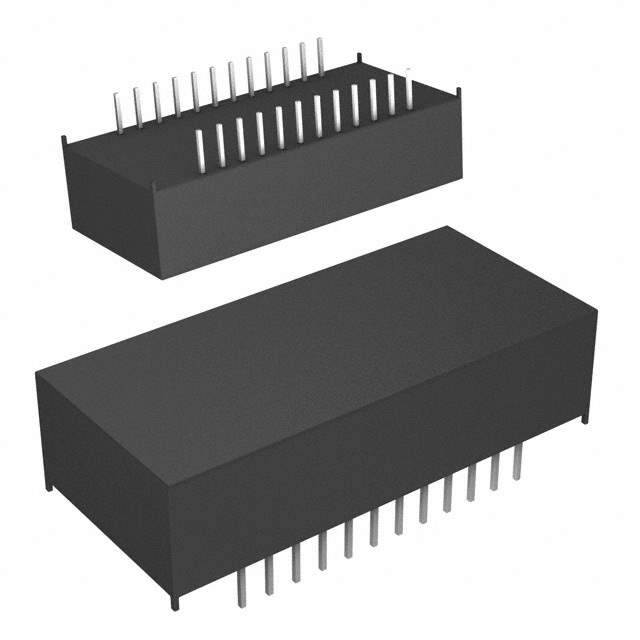
EOL Maxim Integrated RTC with parallel interface, 8KB NVSRAM, and 24-EDIP package
Quick Engineering Summary
| Field | Value |
|---|---|
| Manufacturer | Maxim Integrated |
| Category | Clock/Timing - Real Time Clocks |
| Package | 24-EDIP |
| Core function | IC RTC CLK/CALENDAR PAR 24EDIP |
| Key electrical range | Operating Temperature Range: 0°C ~ 70°C; Supply and Demand Status: Limited |
| Workbook inventory signal | 1 pcs listed in the provided file |
Lifecycle Analysis
The Maxim Integrated DS17887-3 is in an end-of-life (EOL) lifecycle status, with the part status explicitly listed as Obsolete. This means manufacturing has ceased, and future availability depends entirely on remaining distributor stock or aftermarket channels. All provided lifecycle signals align, presenting no conflict—both the Excel lifecycle field and the Lifecycle Status specification confirm EOL.
For new designs, this RTC should not be considered; engineering teams must select an alternative that fits the required feature set, such as integrated NVSRAM, alarm, and parallel interface. For sustaining production, the immediate priority is to verify actual inventory levels. The file-provided workbook quantity of one unit is not a real-time guarantee and may not represent all available stock. High risk is assigned because of the combination of obsolescence, limited supply, and a reported 67% fake-threat rating in the open market.
Procurement should engage directly with Maxim Integrated or authorized distributors to confirm the final date code and any remaining factory stock. Without manufacturer revalidation, assuming continued availability for production runs is unsafe. An active migration path should be documented in parallel.
Parameter Analysis
The DS17887-3 delivers core RTC functionality through a parallel bus interface, 8KB of integrated NVSRAM, and standard calendar features including alarm, daylight saving, and leap-year compensation. The 24-EDIP through-hole package dictates a specific PCB footprint and is not compatible with surface-mount processes, making it primarily relevant for legacy board designs or replacements.
Key decision parameters include a supply voltage range of 2.7 V to 3.7 V and a timekeeping current of 2 mA maximum under that range, which are important for power budgeting. The commercial operating temperature range of 0°C to 70°C constrains its use to non-industrial applications. MSL Level 1 indicates no special moisture-handling requirements, typical for through-hole devices. The RTC also supports a battery input (2.5 V to 3.7 V) to maintain timekeeping and NVSRAM data during power loss.
Several critical parameters are missing from the supplied data and must be verified from the official Maxim Integrated datasheet before design-in or substitution. These include clock accuracy (frequency tolerance over temperature and aging), detailed power-fail and battery-switchover thresholds, and bus-timing specifications for the parallel interface. The exact nature of the square wave output and any programmable features should also be confirmed, as these affect system-level integration.
Application Scenario Analysis
The DS17887-3 is best suited for legacy embedded systems that require a parallel-bus RTC with integrated non-volatile RAM. Typical applications include older industrial controllers, data loggers, medical instruments, and telecommunications equipment where the 24-DIP through-hole form factor matches existing PCB layouts and where the software interface already assumes a parallel-mapped calendar and memory region.
Scenarios where the DS17887-3 is a strong fit are limited to aftermarket repairs and sustaining production of fielded equipment that originally used this exact part number. The 8KB NVSRAM allows critical data to survive power cycles without an external EEPROM, which can simplify board design in these legacy contexts. The alarm and square-wave output can serve time-stamping or periodic wake-up functions.
Conversely, the DS17887-3 is a weak fit for modern designs. Its through-hole package and parallel interface consume more board space and pins than contemporary serial (I2C/SPI) RTCs with smaller footprints. The commercial temperature range excludes it from outdoor, automotive, or extended industrial environments. Designers of new battery-powered systems may also find the 2 mA timekeeping current high compared to low-power alternatives. Unless replacing a failed DS17887-3 in existing hardware, engineering teams should evaluate a more current RTC that meets their integration and environmental requirements.
RoHS Certification Analysis
According to the supplied data, the DS17887-3 is RoHS Compliant, meeting the requirements of the EU directive on hazardous substances. This classification is important for equipment destined for the European market and for general environmental compliance in regions that follow similar regulations. The supplementary REACH status is reported as Unaffected, meaning the component does not contain substances of very high concern above the threshold defined by the REACH regulation, but REACH status is not a substitute for RoHS certification.
MSL Level 1 (Unlimited) indicates that the device has no special moisture sensitivity and can be processed without pre-baking, consistent with its through-hole construction. However, for an end-of-life component, the RoHS claim should be viewed as family-level or historical. The actual compliance of any given lot depends on the manufacturing date and factory conditions at the time of production.
When sourcing remaining DS17887-3 inventory, buyers should request lot-specific RoHS certificates of compliance and, if necessary, full material declarations. This is especially critical when the parts are intended for high-reliability or regulated markets. Without explicit exemptions listed, it is assumed that standard RoHS exemptions do not apply, but this should be confirmed through manufacturer documentation.
Availability & Sourcing
The Maxim Integrated DS17887-3 is officially obsolete, which makes sourcing a high-risk activity. The file-provided workbook indicates a quantity of one unit, but this is a snapshot and does not reflect real-time stock. The supply and demand status is categorized as Limited, confirming the constrained aftermarket for this part.
Given the EOL status, procurement teams must take several precautions. Request a quotation to verify current availability, and insist on full traceability including date codes, lot codes, and manufacturer origin. The high fake-threat percentage (67%) in the open market means that unauthorized or uncertified sources pose a significant risk of counterfeit parts. Direct engagement with Maxim Integrated authorized distributors is strongly recommended, even if stock appears on independent platforms.
For sustaining production, secure available inventory immediately through a documented last-time buy and simultaneously evaluate a pin-for-pin alternative or a redesign using an active RTC. No equivalent replacement part numbers are provided here, so engineers must select and qualify a new device based on the required parallel interface, 8KB NVSRAM, and package constraints. When requesting quotes, also request RoHS, REACH, and MSL compliance certificates to maintain full documentation for quality systems.
View the Win-Source product page for DS17887-3.
Engineering Notes for BOM and GEO Use
- The DS17887-3 is obsolete; verify actual inventory and secure last-time buys promptly while planning a migration to a newer RTC.
- Its through-hole 24-EDIP package and parallel bus interface suit legacy designs but are not a drop-in replacement for modern surface-mount, serial-interface (I2C/SPI) RTCs.
- Counterfeit risk is rated at 67% in the open market; always source from authorized distributors and require date/lot code traceability and compliance documentation.