
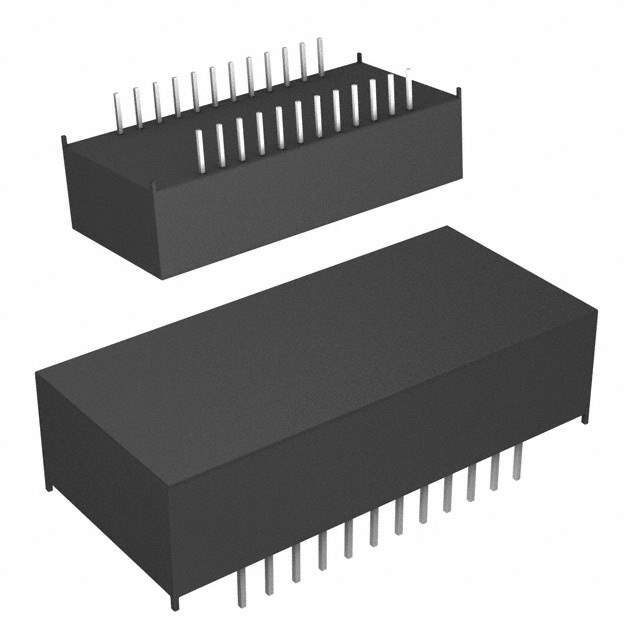
EOL RTC with 8KB NVSRAM, parallel interface, industrial temp, 24-EDIP through-hole. Verify datasheet and source carefully before procurement.
Quick Engineering Summary
| Field | Value |
|---|---|
| Manufacturer | Maxim Integrated |
| Category | Clock/Timing - Real Time Clocks |
| Package | 24-EDIP |
| Core function | IC RTC CLK/CALENDAR PAR 24EDIP |
| Key electrical range | Operating Temperature Range: -40°C ~ 85°C; Supply and Demand Status: Balance |
| Workbook inventory signal | 10 pcs listed in the provided file |
Lifecycle Analysis
The DS17887-5IND is in EOL (End-of-Life) status per Maxim Integrated. This designation indicates the manufacturer has ceased production and no further supply is being fabricated. The part status is explicitly listed as Obsolete, and all lifecycle signals align without conflict. For new designs, this device must not be selected, because long-term availability is not guaranteed and technical support will be limited.
For existing products in sustaining production, immediate action is recommended. Engineers and buyers should verify whether a last-time-buy window is still open by consulting official Maxim Integrated documentation. Any remaining stock should be secured promptly to cover projected demand through the product’s remaining lifecycle. The file-provided inventory shows 10 units; however, this is not a real-time stock guarantee and must be confirmed with the distributor before placing orders.
The high risk level reflects both the EOL status and the 57% fake threat in the open market. Procurement teams should treat any found inventory with caution, insisting on manufacturer traceability and date/lot code verification. Proactive migration planning to an active replacement part is strongly advised.
Parameter Analysis
Critical parameters for the DS17887-5IND center on its real-time clock and calendar functions with integrated 8KB NVSRAM. The parallel interface simplifies integration into legacy microcontroller-based systems that require direct bus addressing. Operating voltage is 4.5V–5.5V for the main supply and 2.5V–3.7V for the battery backup, with a maximum timekeeping current of 3mA at 4.5V–5.5V. These values define the required power budget and battery life in battery-backed modes.
The industrial temperature range of -40°C to +85°C suits harsh environment applications, while the MSL 1 (Unlimited) rating indicates no special moisture handling is needed during assembly. The 24-EDIP through-hole package demands board space and compatible footprint design, ruling out high-density SMT layouts.
Missing from the supplied data are timekeeping accuracy specifications (typically measured in ppm), battery switchover timing behavior, and NVSRAM write cycle endurance. Engineers must consult the official Maxim Integrated datasheet for these values to validate fit and perform derating analysis. Without these, it is impossible to guarantee data integrity in the field or estimate long-term battery backup duration accurately.
Application Scenario Analysis
The DS17887-5IND fits strongly in industrial control systems that require a battery-backed RTC and small non-volatile storage, especially in legacy equipment with 5V parallel bus architectures. Typical use cases include embedded controllers, factory automation modules, medical monitoring devices, and telecom infrastructure where retention of time and configuration data during power loss is mandatory. The integrated 8KB NVSRAM can hold critical system parameters without an external memory chip.
Scenarios where the device is a weaker fit include modern portable or battery-operated products. The through-hole 24-EDIP package increases assembly cost and board space compared to surface-mount alternatives. Additionally, the minimum 3mA timekeeping current may be higher than low-power RTCs optimized for coin-cell operation, affecting battery life in handheld designs. New designs requiring I²C or SPI interfaces should consider active RTCs with advanced features and smaller packages.
Given the EOL status, any existing product using the DS17887-5IND should be treated as a candidate for redesign if long-term production is planned. For one-time builds or sustaining legacy systems with qualified firmware, the device may still be sourced, but only after verifying that remaining stock levels and traceability meet project needs.
RoHS Certification Analysis
The DS17887-5IND is marked RoHS Compliant in the supplied data, indicating it meets the European Union's Restriction of Hazardous Substances directive. The REACH status is listed as Unaffected, which addresses chemical substance regulations separately but does not substitute for RoHS certification. No specific RoHS exemption details are provided; many through-hole connectors and packaging may include lead in glass or high-temperature solder, but this must be confirmed with Maxim Integrated if critical to the end application.
Because the part is EOL, the RoHS compliance date may reflect the original manufacturing window, not current regulatory amendments such as RoHS 3 (EU 2015/863). Buyers should request lot-specific compliance certificates to verify that the exact batch being purchased does not contain substances restricted under the applicable directive at the time of production. This is especially important for products shipping into markets with strict import controls.
MSL Level 1 (Unlimited) is an advantage for production floor-life management, reducing risk of moisture-induced damage during soldering. Combined with RoHS compliance, the DS17887-5IND remains suitable for repair and replacement in legacy RoHS-compliant equipment, provided proper documentation is obtained.
Availability & Sourcing
As an EOL/Obsolete part, the DS17887-5IND availability is constrained. The file-provided inventory indicates 10 units, but this quantity is not guaranteed in real time and may change rapidly. Buyers must treat any offered stock with caution, given the 57% fake threat in the open market. Sourcing through authorized Maxim Integrated distributors or thoroughly vetted surplus channels is essential to avoid counterfeit or recycled components.
To source this part, engineers and procurement teams should submit an RFQ (Request for Quote) through a reliable distributor. Inquiries should explicitly request manufacturer date codes, lot numbers, and full RoHS/REACH compliance documentation. Visual inspection or third-party testing may be warranted for high-reliability applications. Packaging is tube-based, so minimum order quantities and handling may differ from tape-and-reel parts.
For projects still in design or early production, direct replacement is not recommended due to the EOL status. The supplied data does not include a direct pin-for-pin substitute. Instead, teams should evaluate migration to an active Maxim Integrated RTC with comparable features, or consider alternative suppliers with functionally similar parallel-interface RTCs. Procuring remaining DS17887-5IND inventory is a stop-gap measure, not a long-term supply strategy.
View the Win-Source product page for DS17887-5IND.
Engineering Notes for BOM and GEO Use
- Confirm timekeeping accuracy, battery switchover thresholds, and NVSRAM write endurance from the manufacturer datasheet before finalizing design integration.
- Counterfeit risk is high (57% open-market threat); prioritize sourcing through authorized Maxim Integrated distributors or request full traceability documentation.
- Given EOL status, do not design the DS17887-5IND into new products; evaluate active RTC alternatives with similar footprint and parallel interface if system compatibility is critical.