
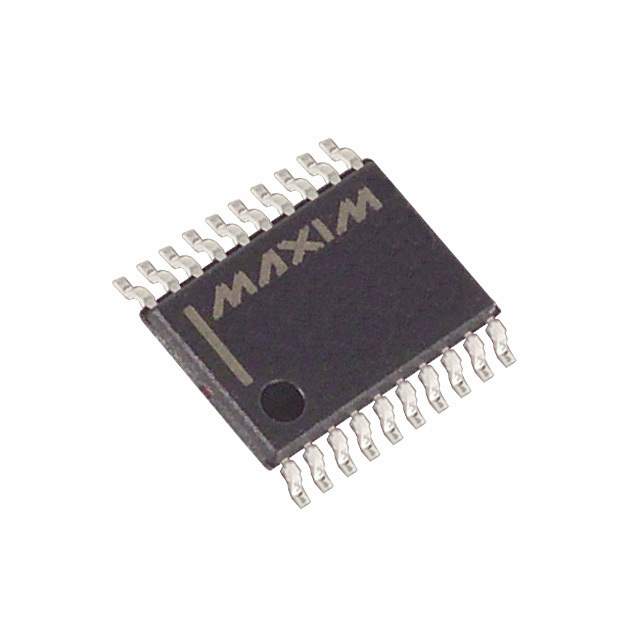
Active 6‑Channel, 64‑Tap Digital Potentiometer from Maxim Integrated
Quick Engineering Summary
| Field | Value |
|---|---|
| Manufacturer | Maxim Integrated |
| Category | Data Acquisition - Digital Potentiometers |
| Package | 20-TSSOP |
| Core function | IC DGT POT 100KOHM 64TAP 20TSSOP |
| Key electrical range | Operating Supply Voltage: 2.7 V ~ 5.5 V; Operating Temperature Range: -40°C ~ 85°C; Resistance (Ohms): 100k; Resistance - Wiper (Ohms) (Typ): 400 |
| Workbook inventory signal | 1 pcs listed in the provided file |
Lifecycle Analysis
The DS1806E-100+ is officially in active production, confirmed by Maxim Integrated’s lifecycle status and supported by an Excel‑derived signal. The risk level remains low, indicating continued manufacturer support and availability for new designs. However, an estimated end‑of‑life date of 2026 appears in the supplied data. While this estimate is not an official notice, it introduces a medium‑term planning horizon that design and procurement teams should not ignore. If the DS1806E-100+ is targeted for a product with a lifecycle extending beyond 2026, it is prudent to engage the manufacturer (now Analog Devices) early to validate the projection and explore possible migration paths. The file‑provided workbook quantity of 1 is not a live inventory indicator and should only be interpreted as a snapshot; actual market availability may vary. Given the active status, typical lead times and factory stock can be expected, but the limited supply and demand status suggests that spot shortages could occur during high demand periods. Engineers should incorporate a re‑verification step with authorized distributors before finalizing BOMs, especially for production volumes.
Parameter Analysis
Key parameters define the DS1806E-100+’s fit in a design. The six independent potentiometer channels, each offering 64 taps, allow multi‑channel trimming without external multiplexing. The 100kΩ end‑to‑end resistance and ±20% tolerance directly affect circuit gain and offset accuracy; designers must assess whether this tolerance meets their system’s trimming resolution needs. Operating across 2.7V to 5.5V, the part is compatible with both 3.3V and 5V logic systems, but supply rejection and digital interface levels should be reviewed in the datasheet. The serial interface (3‑wire) reduces pin count, and the cascade pin enables daisy‑chaining multiple DS1806E‑100+ devices on a single bus. A typical wiper resistance of 400Ω introduces series resistance that can influence load‑dependent attenuator circuits. The 750 ppm/°C temperature coefficient is relatively high; for applications spanning the full –40°C to 85°C range, the resistance can shift by more than 10% worst‑case, which may require periodic calibration or temperature monitoring. Memory type is volatile: all wiper positions reset at power‑off, so the host must re‑program settings after every power cycle. Critical missing parameters include wiper current limit, bandwidth, and total power dissipation; these must be extracted from the official Maxim Integrated datasheet to avoid overstress and to confirm signal integrity in dynamic applications.
Application Scenario Analysis
The DS1806E-100+ is well‑suited to applications requiring multiple digital adjustment points in a single package. Multi‑channel sensor calibration, programmable gain amplifiers, LCD contrast control, and bias voltage generation in test and measurement equipment are strong fits. The cascade feature makes it attractive for systems needing more than six channels, such as automated test racks where dozens of setpoints are controlled via one serial bus. However, the volatile memory is a critical constraint: any design that must retain wiper positions through power cycles without re‑initialization (e.g., a preset calibration stored permanently) is a weak fit unless a non‑volatile host stores the settings externally. The ±20% tolerance and 750 ppm/°C tempo make the DS1806E‑100+ less ideal for precision analog circuits that demand tight absolute resistance or minimal drift. In audio volume control, the linear taper may not meet human‑perception requirements; a logarithmic taper potentiometer would be more appropriate. Industrial environments with wide temperature swings should assess whether the drift can be tolerated or compensated via closed‑loop calibration. For battery‑powered designs, the supply voltage range is adequate, but the datasheet must be checked for quiescent current and standby consumption if power budget is tight.
RoHS Certification Analysis
According to the supplied data, the DS1806E-100+ is RoHS Compliant and halogen free compliant. This indicates conformity with the EU Restriction of Hazardous Substances Directive (2015/863, i.e., RoHS 3) and additional restrictions on bromine and chlorine flame retardants. No specific exemptions are listed, suggesting that the part meets the directive without relying on any material‑specific exemption. However, the data does not include a detailed REACH SVHC declaration; engineers requiring REACH documentation should request it separately from the distributor. The RoHS status is typically assigned at the part‑family level, and variations across production lots are uncommon but possible. For high‑reliability sectors (automotive, medical, aerospace), lot‑level certificates of compliance should be part of the incoming inspection process. Because the DS1806E-100+ is a mature part (introduced in 1999), its RoHS compliance likely reflects a lead‑free conversion that occurred many years ago; nevertheless, periodic re‑verification is advised when sourcing from secondary channels. The halogen‑free claim further supports use in eco‑design and restricted‑substance environments.
Availability & Sourcing
File‑provided inventory shows only 1 unit of the DS1806E-100+, but this is not a guarantee of real‑time stock. The part is supplied in tubes (20‑TSSOP), and the supply and demand status is listed as limited, indicating that market availability can fluctuate. Buyers should request a quote to obtain current lead times, pricing, and minimum order quantities. With a 51% assessed fake threat in the open market, sourcing through authorized Maxim Integrated (now Analog Devices) distributors is essential to ensure authenticity and traceability. The active lifecycle status means that factory production continues, but the 2026 EOL estimate suggests that the part may enter a NRND phase in the next few years. For long‑term programs, it is advisable to negotiate a non‑cancellable, non‑returnable (NCNR) last‑time buy or a contractual supply agreement now. When procuring, specify that full date/lot codes and manufacturer certificates of conformance (CoC) are included. Because the DS1806E‑100+ is RoHS and halogen‑free compliant, ensure that the supplier provides the appropriate environmental declarations. Verify that the operating temperature range and tape‑and‑reel or tray packaging options meet your assembly process requirements. A formal RFQ process will clarify current inventory, lead time, and any upcoming lifecycle changes.
View the Win-Source product page for DS1806E-100+.
Engineering Notes for BOM and GEO Use
- The DS1806E-100+ features volatile memory; wiper positions are lost at power‑down, requiring re‑initialization in every power cycle.
- A typical temperature coefficient of 750 ppm/°C can introduce significant drift across the –40°C to +85°C range, warranting thermal compensation in precision circuits.
- With a 51% assessed fake threat in the open market, procurement through authorized channels is essential to avoid counterfeit DS1806E-100+ parts.