
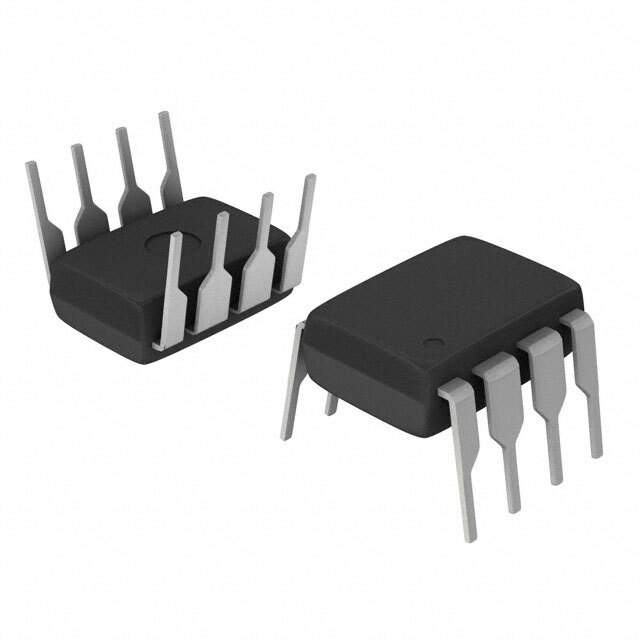
10kΩ Digital Pot, 8 Taps, Logarithmic Taper, Parallel Interface
Quick Engineering Summary
| Field | Value |
|---|---|
| Manufacturer | Maxim Integrated |
| Category | Data Acquisition - Digital Potentiometers |
| Package | 8-PDIP |
| Core function | IC DGTL POT 10KOHM 8TAP 8DIP |
| Key electrical range | Operating Supply Voltage: 2.7 V ~ 5.5 V; Operating Temperature Range: -40°C ~ 85°C; Resistance (Ohms): 10k; Resistance - Wiper (Ohms) (Typ): 400 |
| Workbook inventory signal | 1 pcs listed in the provided file |
Lifecycle Analysis
The DS1866+ from Maxim Integrated is officially EOL (end of life), with all available lifecycle signals confirming this status. No new production is planned, meaning procurement depends entirely on existing distributor inventory or aftermarket stock. This status carries a high risk for production designs; last-time buy windows have likely closed, and long-term availability cannot be assured. Engineers should avoid using the DS1866+ in new designs and instead evaluate migration to an active digital potentiometer with similar or improved specifications.
For sustaining existing systems, immediate action is required: verify with Maxim Integrated or Analog Devices (which acquired Maxim) the last-time buy date and any remaining authorized stock. The file-provided inventory shows only one unit, which is not a real-time availability guarantee. Any purchased parts should be scrutinized for authenticity, given the high counterfeit threat level (54%) and the device's age. Consider a formal obsolescence management plan, including redesign to a current-generation part if continued production is necessary.
Parameter Analysis
The DS1866+ is a single-channel digital potentiometer with a 10kΩ nominal resistance and 8 tap points, yielding a resolution of approximately 1.25kΩ per step. Its logarithmic taper makes it particularly suited for applications requiring exponential response, such as audio volume control. The parallel interface allows direct microprocessor control, but the volatile memory means the wiper position resets at power-off, requiring software initialization on startup.
Key electrical parameters include an operating voltage range of 2.7V to 5.5V and a temperature range of -40°C to 85°C. The typical wiper resistance is 400Ω, and the temperature coefficient is 750 ppm/°C, which may introduce noticeable drift in precision circuits. The resistance tolerance of ±20% is wide; designers should consider end-of-line calibration if exact values are needed. Missing but important datasheet details to verify include the –3 dB bandwidth, power-up wiper settling time, digital input logic levels, and maximum current through the resistor terminals. Also confirm the full-scale error and linearity, which are not provided in the source data. For audio applications, the THD+N and crosstalk figures should be pulled from the manufacturer datasheet if signal integrity is critical.
Application Scenario Analysis
The DS1866+ digital potentiometer fits legacy applications where a simple parallel-controlled, logarithmic-taper variable resistor is needed. Its strongest fit is in audio equipment—volume controls, balance adjustments, or tone circuits—where the log taper matches human hearing perception. The 8-tap resolution suits basic level adjustment but not fine-gain control; avoid using it in motor servo loops or instrumentation where high resolution and low tempco are required.
Other feasible but weak-fit scenarios include LCD contrast adjustment, sensor trimming, or programmable biasing in older industrial controllers, provided the 10kΩ resistance range and ±20% tolerance are acceptable. The volatile memory and parallel interface are consistent with microcontroller-based systems that can re-load the wiper setting on boot. However, the EOL status and limited availability make it unsuitable for new production. It may serve as a maintenance part for field repairs of legacy equipment where a direct replacement is mandatory and no form-fit-function alternative exists. Engineers should not design-in this part for any new project due to obsolescence and high counterfeit risk.
RoHS Certification Analysis
The DS1866+ is listed as RoHS Compliant, which under the EU directive usually means it meets RoHS 3 (2015/863) requirements for hazardous substance restrictions. Additionally, the source data indicates Halogen Free compliance, further aligning with modern environmental standards. The device is packaged in an 8-pin PDIP tube, a format still used in many industrial environments, and the storage recommendation (dry storage cabinet with humidity protection) suggests compliance with MSL guidelines even if an explicit MSL level is not provided.
While the RoHS status is noted as compliant, this attribute is often assigned at the component family level. For high-reliability or regulated industries, engineers should request lot-specific RoHS certificates from the distributor or manufacturer. No REACH data is supplied; note that REACH and RoHS are separate regulations, so compliance with one does not guarantee the other. If REACH declarations are needed, obtain them from Maxim Integrated (now Analog Devices) directly. The age of the part (introduced in 1999) predates many modern RoHS exemptions; verify that any tin‑lead finishes or other exempt materials in the actual lot do not conflict with end-product requirements.
Availability & Sourcing
Sourcing the DS1866+ is challenging due to its EOL status and high counterfeit risk (54%). The file-provided inventory indicates only one unit, which is not a guaranteed real-time count. As an obsolete part, it is no longer in active production, and any available stock is likely from old distributor inventories or excess channels. Engineers should request a quote from specialized distributors that handle end-of-life parts and demand full traceability, including original manufacturer’s date/lot codes and proof of storage conditions.
When procuring, explicitly require RoHS compliance certification and, if possible, third-party authenticity testing given the high fake threat. Packaging is tube (8-PDIP), so verify that parts are sealed and stored per dry-pack guidelines to avoid solderability issues. For production continuity, secure enough units to cover the remaining product lifecycle and plan a redesign to an active digital potentiometer. Because this is an EOL part, the call to action is to source with extreme care, verify manufacturer notices for any last-time buy opportunities that may still be honored, and avoid committing to new production runs dependent on this component.
View the Win-Source product page for DS1866+.
Engineering Notes for BOM and GEO Use
- Verify EOL status with manufacturer; last-time buy may have passed, and remaining stock is not guaranteed.
- High counterfeit risk (54%) demands sourcing only from authorized distributors with traceable lot and date codes.
- Logarithmic taper is ideal for audio volume control; confirm wiper resistance (typ. 400Ω) and ±20% tolerance fit the application.