
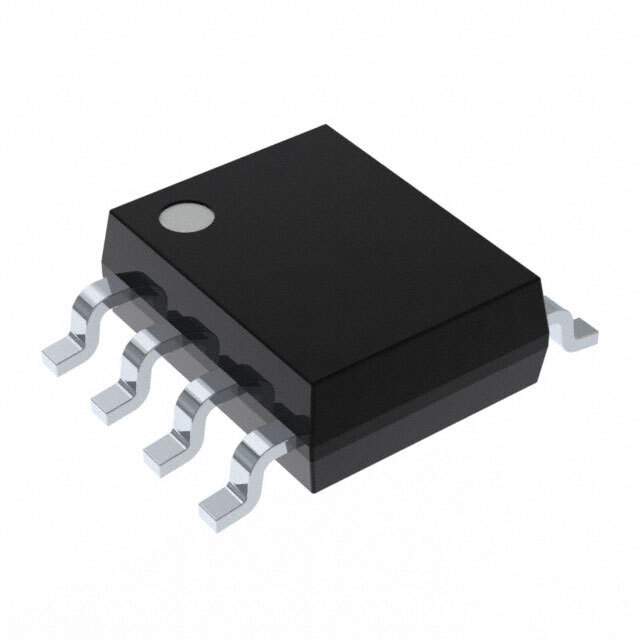
EOL Logarithmic 10kΩ 8-Tap Digital Potentiometer with Parallel Interface
Quick Engineering Summary
| Field | Value |
|---|---|
| Manufacturer | Maxim Integrated |
| Category | Data Acquisition - Digital Potentiometers |
| Package | 8-SOIC |
| Core function | IC DGTL POT 10KOHM 8TAP 8SOIC |
| Key electrical range | Resistance (Ohms): 10k; Resistance - Wiper (Ohms) (Typ): 400; Supply and Demand Status: Limited; Supply Voltage (V): 2.7V ~ 5.5V |
| Workbook inventory signal | 1 pcs listed in the provided file |
Lifecycle Analysis
The DS1866Z is in End-of-Life (EOL) status, confirmed by multiple independent lifecycle signals. This means Maxim Integrated has discontinued manufacturing, and no further technical support or errata updates should be expected. For new designs, this part is not recommended; the risk of last-time-buy windows closing and supply exhaustion is high. For sustaining production, immediate action is required to secure any available inventory.
The supplied inventory quantity in the workbook is only 1 unit, which is file-provided data and not a real-time stock guarantee. Actual availability may be zero. The open market counterfeit threat is reported at 41%, making unauthorized sourcing extremely risky. Any procurement must include thorough visual inspection, electrical testing, and traceability verification to guard against non-conforming parts.
Engineering teams should evaluate functionally compatible alternatives with similar resistance range, taper, and interface (e.g., newer Maxim Integrated or other vendors' digital potentiometers) and plan qualification cycles accordingly. Do not design the DS1866Z into any new product.
Parameter Analysis
The most decision-relevant parameters for the DS1866Z are its 10kΩ end-to-end resistance, 8-tap resolution, logarithmic taper, and parallel interface. With only 8 taps, the adjustment granularity is coarse; this limits use to applications where precise resistance tuning is unnecessary. The logarithmic taper suits audio and human-interface volume control, where a pseudo-log response is desired.
The wiper resistance is 400Ω typical, which introduces a non-negligible error in low-resistance settings. Combined with a ±20% tolerance, the effective accuracy at any tap position can vary significantly between devices. The 750ppm/°C temperature coefficient implies a resistance drift of up to 75Ω over the full temperature range for a 10kΩ nominal, adding up to 0.75% error per 10°C change. Designers must factor this into thermal margins.
Supply voltage from 2.7V to 5.5V allows interfacing with both 3.3V and 5V logic, but the parallel interface consumes multiple MCU pins. The 8-SOIC package is standard for prototyping but demands footprint verification for automated assembly. Missing datasheet parameters to verify include power-on reset behavior, wiper current limits, and noise performance, which are critical for analog signal paths.
Application Scenario Analysis
Strong-fit scenarios for the DS1866Z include low-cost, manually adjustable analog circuits where a stepped logarithmic response is acceptable. Examples are basic audio volume controls, brightness dimming with non-critical thresholds, or simple sensor calibration where 8 steps provide enough granularity. The parallel interface simplifies integration with microcontrollers lacking serial buses but with spare GPIO.
Weak-fit scenarios involve precision instrumentation, motor control feedback, or any loop requiring fine adjustment, monotonicity, and low wiper resistance. The 8-tap resolution and large tolerance preclude use in precision dividers. High-reliability environments (avionics, medical) are incompatible due to the EOL status and high counterfeit risk. Battery-powered designs may suffer from the typical 400Ω wiper resistance introducing voltage drops.
The logarithmic taper is not inherently a weakness but must match the application's transfer function. If a linear response is needed, this part is unsuitable. Engineers should also confirm that the parallel interface does not conflict with existing pin mappings and that the voltage range covers the system rails with margin.
RoHS Certification Analysis
The DS1866Z presents a compliance conflict: one source states RoHS Compliant (likely a database abstraction), while the detailed specification field lists RoHS Non-Compliant. This discrepancy is critical for global distribution. It could indicate that early production was RoHS compliant but later lots may contain non-compliant materials, or that the part number itself was not uniformly compliant. Without lot-specific certificates from the manufacturer, the default assumption must be non-compliance.
Buyers must request a full material declaration or Certificate of Compliance per EU RoHS 3 (2015/863) for the specific date/lot codes being procured. If the part is truly non-compliant, it cannot be imported into EU/UK markets except under exemptions, which are not noted in the supplied data. Additionally, REACH status is not provided; engineers should not assume REACH compliance based on RoHS claims alone.
The MSL level is 1 (unlimited), indicating no special moisture handling, but this does not relate to RoHS. Procurement teams must treat the DS1866Z as a high-risk item for environmental compliance and verify each shipment individually.
Availability & Sourcing
The DS1866Z is officially obsolete, and real-time market availability is virtually nonexistent. The workbook indicates an internal quantity of 1 unit, which is a file snapshot and not a live inventory promise. Distribution channels are closed; any remaining stock resides with niche independent brokers or excess inventory aggregators.
Given the 41% open market fake threat, any purchase must go through a rigorous Request for Quote (RFQ) process emphasizing traceability, date/lot code documentation, and full visual/electrical inspection. Buyers should insist on third-party authenticity testing (X-ray, decapsulation, or electrical curve-trace) before acceptance. Packaging is tube, which simplifies inspection but increases the risk of re-labeled or remarked devices.
For sustaining production, secure any verified stock immediately and allocate it strictly as a bridge to a redesign. For new designs, do not commit to the DS1866Z. The recommended CTA is to visit the product page and request a quote for current availability, with an explicit requirement for compliance and lifecycle status verification. No pricing or cost estimates are provided; the only reliable next step is a vetted quote through authorized channels.
View the Win-Source product page for DS1866Z.
Engineering Notes for BOM and GEO Use
- Verify RoHS compliance directly with manufacturer due to conflicting status indicators.
- Initiate redesign activity: the DS1866Z is EOL with limited stock and high counterfeit risk.
- Authenticate every lot through authorized distribution or accredited test labs to mitigate 41% fake threat.