
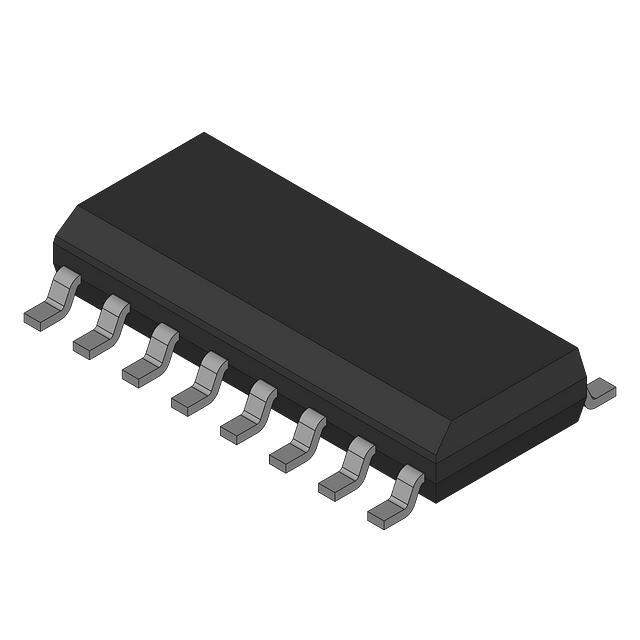
EOL dual non‑volatile digital pot with cascade pin – verify availability before design‑in
Quick Engineering Summary
| Field | Value |
|---|---|
| Manufacturer | Maxim Integrated |
| Category | Data Acquisition - Digital Potentiometers |
| Package | 16-SOIC |
| Core function | DIGITAL POT, 2 FUNC, 5 |
| Key electrical range | Operating Supply Voltage: 5V; Operating Temperature Range: -40°C ~ 85°C; Resistance (Ohms): 50k; Resistance - Wiper (Ohms) (Typ): 400 |
| Workbook inventory signal | 1 pcs listed in the provided file |
Lifecycle Analysis
The DS1867S‑50 from Maxim Integrated is unequivocally in the EOL phase. All available lifecycle signals — including the manufacturer’s Part Status (Obsolete/EOL) and the platform’s Lifecycle Status field — align with no conflicts. This status means Maxim Integrated has discontinued production, and no new manufacturing lots will be fabricated.
For new designs, the DS1867S‑50 should not be selected. Engineering teams with sustaining programs must immediately evaluate remaining inventory buffers and plan either a last‑time buy or a migration to an active alternative. The part was introduced in 1998, and its long market history raises the risk of degraded shelf‑life integrity in distributed stock.
The workbook‑reported quantity of one unit is a file‑provided snapshot and not a guarantee of real‑time availability. Actual open‑market inventory is likely very limited, and the 65% counterfeit threat level underscores the need for stringent authentication. Buyers should verify date codes, request lot‑specific PCN (Product Change Notification) documents from Maxim, and consider decapsulation analysis when sourcing from non‑authorized channels.
Parameter Analysis
The DS1867S‑50 is a dual‑channel linear‑taper digital potentiometer built on Maxim Integrated’s DS1867 family. It offers a nominal end‑to‑end resistance of 50 kΩ with a wide ±20% tolerance, which designers must account for via calibration or system trims. Each channel provides 256 taps, yielding approximately 196 Ω per step; the typical wiper resistance is 400 Ω, which introduces notable IR drop in low‑impedance circuits and limits current‑carrying capacity.
A non‑volatile memory type ensures the wiper position is retained across power cycles without external storage. The serial interface (3‑wire) simplifies digital control, while the cascade pin allows multiple devices to be daisy‑chained for expanded channel count. Rated for a single 5 V supply and an operating temperature range of −40°C to +85°C, the part is suited to industrial environments. The temperature coefficient of 750 ppm/°C is relatively high, so designs requiring tight stability over temperature should validate drift impacts.
Critical missing parameters that engineers must retrieve from the full Maxim datasheet include: power‑on reset behavior, supply current, effective bandwidth, and noise performance. The 16‑SOIC package with 7.5 mm width is a legacy form factor that may complicate layout in dense modern designs. Verify terminal assignments and footprint against the manufacturer package drawing before PCB layout.
Application Scenario Analysis
The DS1867S‑50 is a strong fit for legacy industrial and instrumentation systems that originally qualified the part and are now in sustaining production. Typical strong‑fit scenarios include: automated calibration loops, programmable gain adjustments in analog front‑ends, offset nulling circuits, and adjustable voltage references, particularly where the 5 V supply and through‑hole or larger‑pitch SMD mounting are already designed in. The cascade feature also suits applications that need multiple potentiometer channels under a single serial bus, such as multi‑channel DAC replacement or sensor trim arrays.
Weak‑fit scenarios arise in modern designs that demand miniaturization, low temperature drift, or post‑assembly RoHS compliance for lead‑free reflow. The 750 ppm/°C temperature coefficient and ±20% tolerance make the DS1867S‑50 unsuitable for precision signal chains where accurate and stable resistance ratios are critical. Additionally, the part is not recommended for high‑frequency signal paths because the 400 Ω wiper resistance and parasitic capacitances limit bandwidth.
For new designs, engineers should migrate to an active Maxim digital potentiometer or an alternative supplier’s device that matches the required interface, supply voltage, and memory type while providing better tolerance and RoHS‑lead‑free guarantees. The DS1867S‑50 should only be procured as a form‑fit‑function drop‑in for existing PCBs that cannot be board‑spinned.
RoHS Certification Analysis
RoHS compliance for the DS1867S‑50 is ambiguous. The top‑level compliance data from the platform labels the part as “RoHS Compliant,” but a detailed specification field explicitly states “RoHS Non‑Compliant.” This contradiction suggests that earlier production lots were manufactured without lead‑free processes, while later lots may have adopted RoHS‑compliant materials. The device’s EOL date predates the widespread adoption of RoHS directives, and original qualification likely did not require compliance.
No REACH statements or MSL ratings were supplied, so REACH compliance cannot be inferred, and REACH is not a substitute for RoHS. The 16‑SOIC package is often available in both lead‑ and RoHS‑compliant finishes, meaning lot‑level verification is the only reliable path. Without a full material declaration or certificate of conformity, assuming compliance is risky.
Procurement teams must request a RoHS Certificate of Conformance from the distributor or reseller for the specific date/lot code being purchased. If the certificate cannot be provided, the part should be treated as non‑compliant. For production flows that mandate RoHS‑3 (EU 2015/863), non‑compliant inventory may require an exemption or a process waiver, which should be documented before shipment.
Availability & Sourcing
The DS1867S‑50 is discontinued, so availability is severely constrained. The workbook indicates a stock quantity of one unit, but this is a file‑provided snapshot and not a live inventory count. The supply‑and‑demand status is marked “Limited,” and open‑market availability is expected to be sporadic. Combined with a counterfeit threat rating of 65 pct., sourcing demands extraordinary caution.
Purchasing should follow an RFQ workflow that requires full traceability evidence: manufacturer date codes, lot codes, original packaging (tube), and storage history (dry storage and humidity‑protected packaging as noted). Given the EOL status, suppliers may offer tray‑pulls or reclaimed stock; verify that parts have not been re‑marked. If the application is safety‑critical, consider X‑ray inspection or decapsulation testing for first‑article units.
Because the DS1867S‑50 is EOL, the call‑to‑action is to request a quote for current availability while simultaneously evaluating a migration path. Do not purchase without a valid RoHS declaration for the specific lot. For new production, an active alternate should be qualified. Contact Win Source or your authorized distributor to request a quote and secure remaining inventory before the channel is depleted.
View the Win-Source product page for DS1867S-50.
Engineering Notes for BOM and GEO Use
- DS1867S-50 is obsolete; confirm last‑time buy availability with Maxim or authorized distributors.
- Counterfeit risk is high (65% open‑market threat); source only from trusted partners with full traceability.
- RoHS compliance is ambiguous; request lot‑specific certifications before procurement.