
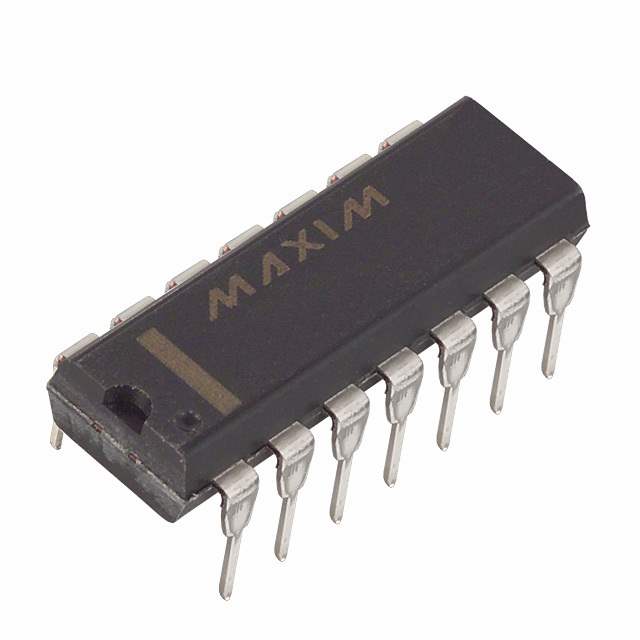
EOL 100kOhm dual digital potentiometer, 14-PDIP, 256 taps, volatile memory, Maxim Integrated.
Quick Engineering Summary
| Field | Value |
|---|---|
| Manufacturer | Maxim Integrated |
| Category | Data Acquisition - Digital Potentiometers |
| Package | 14-PDIP |
| Core function | IC DGT POT 100KOHM 256TAP 14DIP |
| Key electrical range | Resistance (Ohms): 100k; Resistance - Wiper (Ohms) (Typ): 400; Supply and Demand Status: Limited; Supply Voltage - Operating: 2.7 V to 3.3 V, 5V |
| Workbook inventory signal | 1 pcs listed in the provided file |
Lifecycle Analysis
The DS1868-100 from Maxim Integrated is classified as End-of-Life (EOL). All available lifecycle signals confirm this status, with no conflicting data. For new designs, this part should not be considered; engineers must select an alternative device with a long-term availability commitment. For sustaining production, immediate action is required to secure last-time buy quantities based on projected lifetime demand.
EOL parts carry elevated risk, including diminishing stock, potential counterfeits, and loss of manufacturer support. The provided inventory shows only one unit in file, which is not a real-time guarantee. Buyers should verify actual availability with authorized distributors and plan for a lifetime buy. Manufacturers typically issue a product discontinuance notice detailing key dates; verify this notice to align procurement with production schedules.
Parameter Analysis
The DS1868-100 is a dual-channel digital potentiometer with 256 tap points and a full-scale resistance of 100kΩ. Tolerance is rated at ±20%, while the typical wiper resistance is 400Ω, a parameter that introduces series impedance in the signal path and must be accounted for in precision applications. The temperature coefficient of 750 ppm/°C indicates significant drift over temperature, requiring designers to evaluate worst-case variation in their circuits. The device operates over a supply voltage range of 2.7 V to 3.3 V or 5 V, supporting both low-voltage and traditional logic rails, and its operating temperature range of −40°C to +85°C suits industrial environments.
The memory type is volatile, meaning that upon power loss, register values are lost and must be reloaded on startup. The linear taper ensures uniform step increments, which is standard for most adjustment applications. The package is a 14-pin PDIP, suitable for through-hole mounting or prototyping. Key missing datasheet details include the interface protocol (serial type, clock frequency), bandwidth, and noise performance. Before designing in this EOL part for a legacy build, engineers must confirm these parameters directly from the manufacturer’s datasheet.
Application Scenario Analysis
As a dual 100kΩ linear digital potentiometer, the DS1868-100 can replace two mechanical potentiometers in applications such as analog gain control, offset adjustment, sensor calibration, and volume control. Its volatile memory means it must be re-initialized after each power cycle, making it suitable for systems with a host microcontroller that can reload settings on boot. The cascade pin feature enables daisy-chaining multiple devices, reducing pin count on the host controller.
However, the EOL status restricts its use to legacy maintenance and repairs; it is not recommended for new production designs. The through-hole PDIP package also limits its use in modern high-density surface-mount assemblies. Additionally, the high temperature coefficient and ±20% tolerance make it less suitable for precision instrumentation without calibration. With a 44 pct. fake threat in the open market, buyers must source through trusted channels to avoid counterfeit parts that could compromise system performance.
RoHS Certification Analysis
The RoHS compliance status of the DS1868-100 presents a conflict: one data field indicates “RoHS Compliant,” while another specifies “RoHS Non-Compliant.” This discrepancy may arise from generic family-level assignments or changes over production life. As an EOL component, the compliance status could vary by date code or assembly site. Engineers and buyers must not rely on a blanket statement and should request the manufacturer’s RoHS certificate of compliance for the exact lot intended for purchase.
For EU market access, compliance with RoHS 3 (EU 2015/863) is typically required, including restricted substances such as lead and phthalates. If the part is non-compliant, an exemption under the directive may apply, but this must be documented. Given the EOL nature, seeking a compliant alternative is advisable for new designs. Always verify compliance through analytical testing if documentation is unavailable, especially when the supply chain includes non-authorized distributors.
Availability & Sourcing
The DS1868-100 is an EOL component with extremely limited availability; the file-provided stock quantity is only one unit. This figure is not real-time and may not reflect current inventory at distributors. Procurement teams should immediately request a quote to verify actual stock levels, lead times, and packaging—the part is supplied in tubes. Given the high risk of counterfeits (44 pct. fake threat), all purchases must be sourced from authorized or trusted suppliers with full traceability, including date and lot codes.
For buyers, the priority should be to authenticate the remaining stock and evaluate whether a last-time buy is necessary or if a drop-in replacement exists. Before committing to a purchase, confirm the lifecycle status directly with Maxim Integrated (now Analog Devices) and obtain compliance documentation. If no stock is available, consider speaking with the manufacturer about possible approved substitutes. Due diligence on RoHS and authenticity is critical to avoid production disruptions.
View the Win-Source product page for DS1868-100.
Engineering Notes for BOM and GEO Use
- Verify RoHS compliance directly with the supplier due to conflicting data; non-compliant parts may restrict market access.
- Account for ±20% resistance tolerance and 400 Ω wiper resistance in your analog signal chain design.
- Secure remaining stock immediately via authorized channels to support legacy systems; this EOL part carries a high counterfeit risk.