
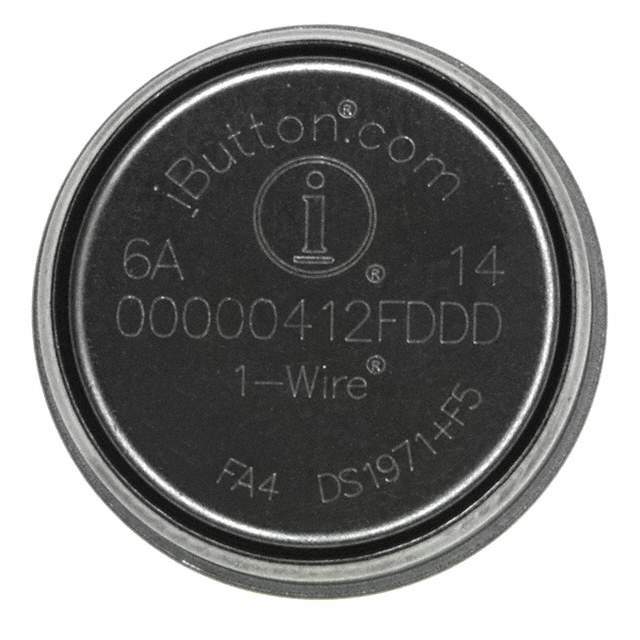
Active 256-bit EEPROM iButton from Maxim Integrated for Authentication Applications
Quick Engineering Summary
| Field | Value |
|---|---|
| Manufacturer | Maxim Integrated |
| Category | Specialized |
| Package | Not available in supplied data |
| Core function | IBUTTON EEPROM 256BIT F5 |
| Key electrical range | Supply and Demand Status: Balance |
| Workbook inventory signal | 10 pcs listed in the provided file |
Lifecycle Analysis
The DS1971-F5+ is currently listed as Active by Maxim Integrated, with all available lifecycle signals aligning to indicate low risk for ongoing procurement. This status supports both new design starts and sustaining production, but engineers should note that an estimated EOL date of 2025 appears in the supplied data. While the component remains Active, a planned end-of-life within a few years introduces medium-term planning considerations for high-volume programs.
No lifecycle conflicts are present among the provided sources, which strengthens confidence in the Active designation. Nonetheless, direct revalidation with the manufacturer or authorized distributors is recommended before committing to designs with long qualification cycles. The file-provided inventory quantity of 10 units is a static snapshot and does not guarantee real-time availability.
For risk-sensitive applications, establish a procurement roadmap that accounts for the projected 2025 EOL. Verify alternative sources or compatible iButton devices early in the design phase, and monitor official product change notifications (PCNs) from Maxim Integrated to avoid supply disruptions.
Parameter Analysis
The DS1971-F5+ integrates a 256-bit (32-byte) EEPROM organized for authentication and small data storage within the robust iButton F5 stainless steel package. The memory size, while modest, is adequate for unique serial numbers, calibration constants, or access credentials typical in 1-Wire applications. The EEPROM technology provides non-volatile storage with byte-level writability, but endurance and data retention specifications must be confirmed in the full datasheet, as they are critical for high-cycle authentication systems.
The operating temperature range of -40°C to +85°C enables deployment in outdoor and industrial environments. The F5 package offers physical durability and resistance to moisture, dust, and mechanical shock, but mating contact reliability should be evaluated per the intended reader design. Key missing parameters from available data include 1-Wire protocol timing, supply voltage, active/sleep current, and ESD immunity—all essential for integration and EMC compliance. Engineers should obtain the official Maxim Integrated datasheet to verify these values and assess derating margins for extended temperature extremes or noisy power rails.
Application Scenario Analysis
DS1971-F5+ is designed for user and product authentication scenarios where a compact, physically robust memory token is required. Strong-fit applications include equipment access control, medical consumable validation, tool and battery authentication, and asset tagging. The iButton form factor allows installation on key fobs, handheld readers, or embedded panels, and the 1-Wire interface simplifies connection with only two contacts.
This part is less suited for data-intensive tasks due to its 32-byte capacity. Weak-fit scenarios would include firmware storage, large sensor data logging, or applications needing high-speed memory access. The device's memory is insufficient for storing certificates or complex payloads without external processing. Additionally, while the temperature range is wide, systems requiring automated reading at extreme temperatures should verify reader-side compatibility and contact integrity.
When evaluating the DS1971-F5+ for a new design, consider the counterfeit risk (63% reported in open market) and lifecycle transition timeline. Its role is best confined to simple identification or low-data authentication functions, with complementary components handling security algorithms if needed.
RoHS Certification Analysis
The DS1971-F5+ is designated as RoHS Compliant in the supplied data. While this indicates adherence to EU hazardous substance restrictions, the data does not specify the exact directive revision (e.g., EU 2015/863) or list any applicable exemptions. For rigorous compliance documentation, request a certificate of conformity from Maxim Integrated or an authorized distributor, as RoHS compliance can vary by production lot and packaging variant.
No REACH declarations are provided, so separate verification may be necessary for EU market integration. The RoHS Compliant label should be considered indicative until validated with current certification documents. For high-reliability or regulated industries, confirm that the solderability and lead-free finish align with your assembly processes and that the F5 package meets any additional environmental requirements such as halogen-free or low-halogen standards.
Availability & Sourcing
The DS1971-F5+ is an Active part, but market dynamics such as a 63% counterfeit threat and a projected EOL in 2025 require careful sourcing. File-provided inventory shows a quantity of 10 units, yet this is not a guarantee of real-time stock. Actual availability should be confirmed through authorized channels via request for quote (RFQ), with explicit verification of date/lot codes and distributor certifications to mitigate counterfeit risk.
Packaging specifics indicate dry storage and humidity protection; ensure that received units have maintained proper storage conditions. Given the medium popularity and balanced supply-demand status, lead times may be stable, but long‑term procurement should incorporate the estimated EOL date. Request the manufacturer’s PCN subscription to stay informed of any lifecycle changes. In your RFQ, ask for RoHS certificates, full traceability documentation, and confirmation that the components are factory‑fresh to reduce reliability risks in critical authentication systems.
View the Win-Source product page for DS1971-F5+.
Engineering Notes for BOM and GEO Use
- Verify estimated EOL date (2025) with Maxim Integrated before committing to high-volume production designs; the component is currently Active but may transition.
- Given the 63% counterfeit risk in the open market, insist on authorized distribution and full traceability documentation, including date/lot codes.
- The 32-byte EEPROM operates from -40°C to +85°C, making it suitable for outdoor authentication terminals; ensure thermal margins are met in your enclosure design.