
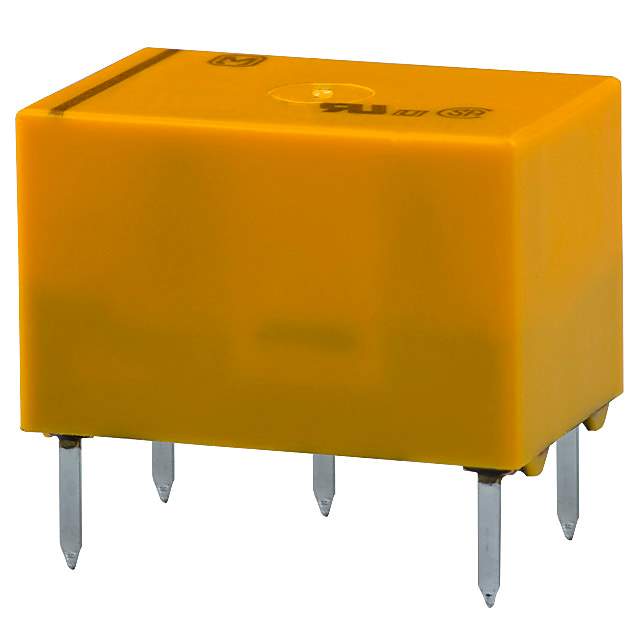
Panasonic general purpose SPDT relay with 2A contact rating and 3VDC coil – technical parameters and availability insights.
Quick Engineering Summary
| Field | Value |
|---|---|
| Manufacturer | Panasonic |
| Category | Signal Relays, Up to 2 Amps |
| Package | Tube |
| Core function | RELAY GENERAL PURPOSE SPDT 2A 3V |
| Key electrical range | Coil Current: 66.7 mA; Coil Resistance: 45 Ohms; Coil Voltage: 3VDC; Contact Rating (Current): 2 A |
| Workbook inventory signal | 6073 pcs listed in the provided file |
Lifecycle Analysis
The DS1E-S-DC3V signal relay by Panasonic has an unknown lifecycle status, as no official active, NRND, or EOL notifications are present in the supplied data. This status carries a medium risk level for procurement, especially for new designs. Without confirmed production intent, engineers should not assume long-term availability, and any new design-in should be preceded by direct communication with Panasonic or its authorized distributors.
File-provided inventory shows 6073 units, which may support immediate needs, but this cannot be considered a guarantee of ongoing supply. In a sustaining production environment, buyers might utilize existing stock, but they should still verify that the part has not been quietly discontinued. If Panasonic cannot confirm active status, a lifecycle buffer plan should be developed, potentially including an alternative relay with similar pinout and specifications.
Procurement teams should treat this part with caution: it could be a mature product gradually phasing out, or a legacy part with sporadic availability. For designs with extended qualification cycles, it is prudent to evaluate proven replacements early. The DS series from Panasonic includes multiple variants, but no direct pin-compatible replacement is specified here, so any migration would require electrical and mechanical re-validation.
Parameter Analysis
The DS1E-S-DC3V is a 3VDC non-latching SPDT relay rated for 2A continuous current. Its coil parameters—66.7 mA current at 45 Ohms resistance—are typical for a low-power signal relay, enabling use in power-sensitive circuits. The coil must operate at 2.4 VDC minimum and release at 0.3 VDC, providing defined logic-level switching margins. These thresholds are critical for reliable actuation under variable supply conditions.
The relay’s switching voltage rating of 250VAC/220VDC max allows it to handle line-voltage applications, but thermal and creepage constraints must be evaluated against PCB layout standards. Contact material is silver with gold overlay, suitable for both low-level (dry circuit) and moderate current loads, minimizing contact resistance drift over time. Operate and release times of 10 ms and 5 ms, respectively, are adequate for most general-purpose control and signaling tasks.
Key missing datasheet items include dielectric strength (coil-to-contact, contact-to-contact), insulation resistance, and mechanical endurance ratings. These should be obtained from Panasonic’s official DS series datasheet to assess long-term reliability and isolation requirements. The through-hole mounting, fully sealed construction, and commercial temperature range of -40°C to 70°C support use in moderately harsh environments, but demanding applications may require additional testing.
Application Scenario Analysis
As a general-purpose signal relay in the Panasonic DS series, the DS1E-S-DC3V fits well in applications requiring low-current signal routing and isolation. Its SPDT contact arrangement is commonly used for selecting between two signal paths or controlling a single load. Typical strong-fit scenarios include telecommunication line switching, test and measurement instrument signal multiplexing, PLC I/O modules, and security system controls. The 3VDC coil voltage aligns with many logic supply rails, simplifying integration.
The through-hole package with PC pin termination is suitable for wave-soldered PCB assemblies in industrial or commercial equipment. Its fully sealed construction offers protection against flux and dust ingress, enhancing reliability in less-controlled environments. However, the 2A contact rating restricts its use to signal-level loads; inductive loads may require external suppression to prevent contact arcing.
Weak-fit or inappropriate applications include high inrush current switching, safety-critical circuits without redundancy, or automotive under-hood environments despite the temperature range, as vibration and thermal shock specs are not provided. Engineers should also note that the relay’s contact rating may degrade at elevated temperatures, so derating is advised for ambient temperatures above 50°C. For applications requiring higher currents or hermetically sealed packages, alternative series such as Panasonic’s TX-S or JW relays might be more appropriate, but no direct substitute is verified here.
RoHS Certification Analysis
The DS1E-S-DC3V is declared RoHS Compliant by Panasonic, meeting the substance restrictions of the European Union’s Restriction of Hazardous Substances directive. While the exact directive version (e.g., 2011/65/EU with amendments) is not specified, the classification is typically sufficient for products sold into the EU market. The absence of explicit exemption data suggests that the relay does not rely on any category-specific exemptions.
The part also carries an MSL Level 1 (Unlimited) rating, indicating no special handling is required for moisture sensitivity during assembly—this is consistent with the through-hole technology and sealed package. However, REACH compliance is not mentioned in the supplied data; purchasers needing full REACH certification should request a declaration from Panasonic or the distributor.
For procurement traceability, obtaining a lot-level RoHS certificate of compliance is recommended, especially when sourcing from non-franchised channels. Compliance at the component level does not automatically guarantee end-product RoHS conformity, so system-level assessments remain essential. Panasonic’s reputation for consistent materials declarations provides a degree of confidence, but downstream manufacturing processes must also be evaluated to avoid contamination.
Availability & Sourcing
Sourcing the Panasonic DS1E-S-DC3V requires careful attention due to its unknown lifecycle status and a reported 50% fake threat rate in the open market. File-provided inventory shows 6073 pieces available through Win Source, but real-time availability and pricing must be confirmed through a request for quote (RFQ). The relay is packaged in tubes of 50, and through-hole parts typically have stable logistics, yet lead times may vary.
Buyers should prioritize purchases from authorized Panasonic distributors to ensure traceability and authenticity. When sourcing from independent distributors, verifying date/lot codes and requesting photographic evidence can mitigate counterfeit risks. The MSL Level 1 rating simplifies storage, but electrostatic precautions should still be observed.
For new production use, we recommend obtaining a written lifecycle confirmation from Panasonic before committing to the part. If the relay is found to be NRND or discontinued, securing a last-time-buy volume might be necessary. Engineers should evaluate alternative relays from the Panasonic DS series, though no direct cross-reference is provided here. To proceed, contact Win Source or other suppliers for a current quotation and stock validation.
View the Win-Source product page for DS1E-S-DC3V.
Engineering Notes for BOM and GEO Use
- Verify coil voltage tolerance under worst-case temperature conditions before design lock-in.
- Request lot-specific RoHS and MSL certifications from the distributor to ensure compliance continuity.
- Due to a 50% fake threat rate in the open market, source only from authorized channels and perform visual and parametric testing upon receipt.