
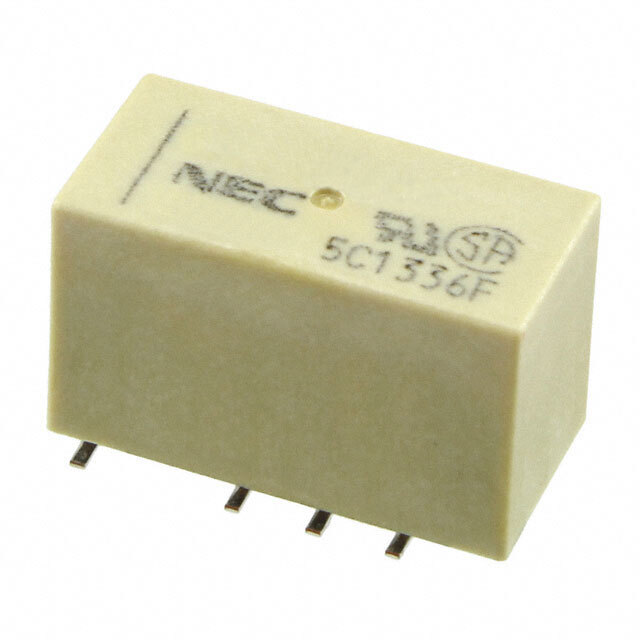
Latching SPDT 2A 24VDC Through-Hole Signal Relay
Quick Engineering Summary
| Field | Value |
|---|---|
| Manufacturer | Panasonic |
| Category | Signal Relays, Up to 2 Amps |
| Package | Box |
| Core function | RELAY GEN PURPOSE SPDT 2A 24V |
| Key electrical range | Coil Current: 3.8 mA; Coil Voltage: 24VDC; Contact Rating (Current): 2 A; Must Operate Voltage: 19.2 VDC |
| Workbook inventory signal | 44 pcs listed in the provided file |
Lifecycle Analysis
The DS1E-SL-DC24V from Panasonic is listed as Active in all supplied lifecycle data, indicating full production and availability for new designs. No conflicting NRND or EOL signals are present, giving it a low risk profile for procurement.
An active lifecycle means the relay is fully supported with ongoing manufacturing, technical documentation, and typical lead times. However, even active parts can be subject to change notifications, so it is prudent to revalidate lifecycle status directly with Panasonic or authorized distributors before committing to large-volume or long-lifecycle programs.
The file-provided inventory shows a quantity of 44 units, but this is a snapshot and not a real-time guarantee. For production orders, always confirm current stock and lead times. In sustaining production, ensure your bill of materials includes the manufacturer’s full part number and any orderable suffix to avoid delivery of similar but non‑identical variants.
Parameter Analysis
Key specifications for DS1E-SL-DC24V include a 24VDC latching single-coil, SPDT contact configuration rated for 2A. The latching mechanism is critical for energy‑sensitive designs because it consumes power only during state changes, eliminating steady‑state coil dissipation. This reduces thermal load and power supply demands.
Contact material is silver with gold overlay, offering a balance of conductivity and resistance to oxidation, suited for low-level signals. The relay is fully sealed, protecting it from dust and flux, and enabling use in moderately harsh environments. Maximum switching ratings are 250VAC/220VDC, with load limits of 500VA/440W. Fast operate and release times of 10ms and 5ms respectively support applications requiring responsive control.
Missing from this dataset are coil resistance, insulation resistance, dielectric strength, and mechanical/electrical endurance. These parameters are essential for relay driver design, safety compliance, and reliability predictions. Engineers should obtain the full Panasonic datasheet to validate these values and ensure proper derating for the target operating temperature range of -40°C to 70°C.
Application Scenario Analysis
As a general purpose signal relay, DS1E-SL-DC24V is a strong fit for low‑power switching in control circuits, automation equipment, telecommunications, and security systems. Its SPDT contact provides flexibility for both normally open and normally closed routing, and the latching feature is ideal where continuous coil power is undesirable, such as in battery‑operated or energy‑harvesting devices.
It is well suited for switching resistive loads, small motors, solenoids, and lamps within the 2A rating. The fully sealed construction makes it usable in industrial environments with moderate contamination. Through‑hole mounting and standard PC pin footprint ease integration into legacy designs and prototyping.
However, it is not recommended for applications exceeding the rated switching voltage or current, particularly high inrush capacitive loads or heavy inductive loads without proper snubbing. The 500VA/440W limit should be carefully derated for high cycle‑rate scenarios. For high‑reliability or safety‑critical functions, additional verification of contact endurance and failure modes beyond the supplied data is necessary.
RoHS Certification Analysis
DS1E-SL-DC24V is marked as RoHS Compliant in the provided data, aligning with EU RoHS requirements. This compliance is typically assessed at the product family level and covers restricted substances like lead, mercury, and cadmium.
The supplied information does not detail specific exemptions or third‑party certification, but given Panasonic’s documentation practices, full compliance is expected. For regulated industries, it is advisable to request a formal RoHS certificate from the distributor or manufacturer, as lot‑level or date‑code‑specific certificates may be required for compliance audits.
No REACH, halogen‑free, or moisture sensitivity level (MSL) data is included in this set. If these are relevant to the end product, particularly for European market access or to meet internal corporate standards, they should be verified directly with Panasonic. In general, a fully sealed signal relay of this class is unlikely to contain MSL‑sensitive components, but confirmation is prudent.
Availability & Sourcing
With an active lifecycle, DS1E-SL-DC24V should be widely available through Panasonic’s distribution network. The file‑based quantity of 44 units provides an indicative snapshot only; real‑time stock and lead times must be confirmed via quotation.
Engineers and buyers should request a quote that includes date/lot code traceability, packaging (box), and full compliance documentation (RoHS certificate). For production, verify that the manufacturer’s lifecycle status remains active and that no end‑of‑life notices or PCNs affect the ordered revision.
Given the relay’s through‑hole PC pin termination and box packaging, it is typically sold in tube or tray format; confirm the exact packaging type to align with your assembly process. For emergency procurement or low‑stock situations, consider authorized distributors or factory direct channels to avoid risk of counterfeit or diminished freshness. A standard RFQ process will ensure you receive current availability, pricing, and delivery terms.
View the Win-Source product page for DS1E-SL-DC24V.
Engineering Notes for BOM and GEO Use
- Verify coil resistance and power consumption from the official datasheet to ensure compatibility with driver circuits.
- The latching coil design eliminates steady-state current draw, reducing thermal load and power supply demands.
- Check maximum switching cycles and mechanical endurance for high-reliability applications where frequent operation is expected.