
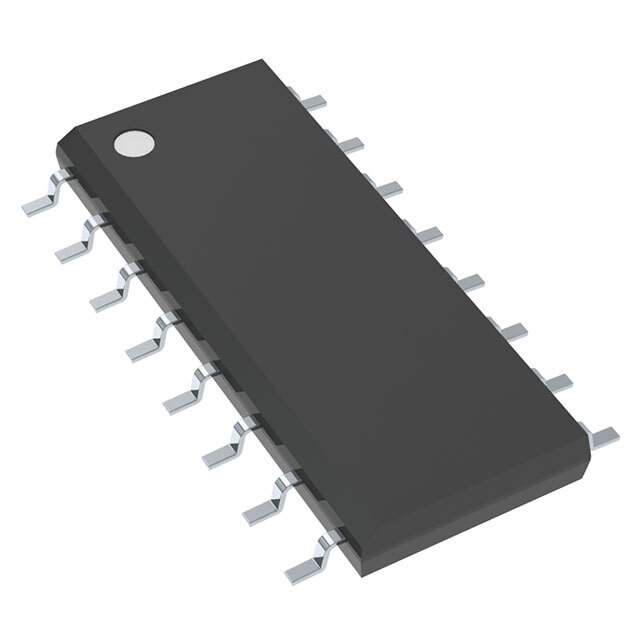
EOL 6/0 driver array, 16-SOIC, 5V supply — verify availability before committing to production use.
Quick Engineering Summary
| Field | Value |
|---|---|
| Manufacturer | Texas Instruments |
| Category | Interface - Drivers, Receivers, Transceivers |
| Package | 16-SOIC |
| Core function | IC TRANSCEIVER 6/0 16SOIC |
| Key electrical range | Supply and Demand Status: Limited; Supply Voltage - Operating: 5V; Temperature Range - Operating: -40°C to 85°C |
| Workbook inventory signal | 1969 pcs listed in the provided file |
Lifecycle Analysis
The DS2003CM from Texas Instruments is designated End-of-Life (EOL), a status confirmed by all lifecycle signals in the provided data. EOL means the manufacturer has ceased or announced cessation of production, and no new design activity should be based on this part. Supply is limited to remaining distributor stock or aftermarket channels.
For sustaining production, procurement teams must immediately assess inventory sufficiency and explore last-time-buy opportunities. The risk level is high, and lead times are unreliable. Texas Instruments may issue a Product Discontinuance Notice (PDN) with final order dates; if not already passed, urgent action is required.
Designs currently using the DS2003CM should plan a migration to a newer alternative. Verify with TI directly for any recommended replacement part numbers, as none are indicated in this dataset. The file-provided inventory quantity (1969 units) is not a real-time guarantee and should be confirmed with a formal RFQ.
Parameter Analysis
The DS2003CM is specified as a 6/0 driver/receiver IC, meaning it contains six drivers and zero receivers, functioning essentially as a hex non-inverting buffer array. Key parameters from the available data include a 5V supply voltage, an operating temperature range of -40°C to 85°C, and a 16-SOIC surface-mount package. These attributes make it suitable for general-purpose TTL/CMOS-level driving in moderate environments.
Critical decision-driving specifications are absent from the provided dataset. Engineers must obtain the full manufacturer datasheet to determine output drive current (sink/source), propagation delay, maximum data rate, input logic thresholds, and power dissipation. These values directly affect interfacing with downstream devices, thermal management, and signal integrity. Without them, a proper derating analysis is impossible.
Additionally, the packaging format is reel (TR) with 48 units per reel, which may influence handling and assembly processes. The mounting is SMD (SMT), compatible with standard reflow profiles. For design qualification, verify pinout, ESD rating, and any application notes related to load drive capability, as the lack of detailed electrical characteristics demands careful bench validation.
Application Scenario Analysis
Given its 6-channel driver architecture and 5V supply, the DS2003CM is a strong fit for legacy industrial control systems, bus backplane driving, LED indicator arrays, relay solenoids, or logic-level buffering in environments where 5V CMOS/TTL signals must be distributed. The extended temperature range supports automotive or outdoor equipment, though the lack of AEC-Q100 qualification should be noted.
It is a weak fit for modern low-voltage, high-speed designs requiring sub-1.8V operation or data rates above a few megahertz, as the device's speed and output drive characteristics (not provided) are likely modest. Similarly, battery-powered portable applications may be unsuitable due to the 5V rail requirement and potential quiescent current.
As an EOL part, its use should be confined to sustaining existing products with no path to redesign, or for repair/maintenance operations. New designs should avoid the DS2003CM unless a guaranteed long-term aftermarket source is secured and the risk of obsolescence is acceptable. Evaluate the market's 34% counterfeit threat when sourcing from non-franchised channels.
RoHS Certification Analysis
The DS2003CM is listed as RoHS Compliant, indicating compliance with the EU Restriction of Hazardous Substances directive. The exact directive revision is not specified, but it is generally assumed to meet RoHS 2 (2011/65/EU) or RoHS 3 (EU 2015/863) requirements for lead-free, mercury-free, and related substance restrictions. No exemptions are mentioned in the source data.
Because this is an EOL component, there is a risk that older date codes may not meet current RoHS standards, especially if inventory includes pre-transition stock. Lot-level certificates of compliance should be requested from the supplier to verify RoHS status for each shipment. Without such documentation, acceptance into EU markets could be compromised.
Additionally, REACH status is not provided; if required, it should be confirmed separately. The RoHS compliance statement does not automatically cover halogen-free or other extended requirements. For high-reliability sectors, consider additional testing to ensure no non-compliant substances are present.
Availability & Sourcing
The DS2003CM is in EOL status with limited and fluctuating availability. The file indicates a stock quantity of 1969 units, but this figure is not real-time and must be validated through a formal request for quote (RFQ). As an EOL part, procurement should focus on last-time-buy opportunities and verified excess inventory from authorized sources.
Sourcing requires diligence: request date codes, lot codes, and traceability documentation to avoid the 34% fake threat in the open market. Packaging is reel (TR) with 48 parts per reel, which may necessitate full-reel purchases. Verify storage conditions (indicated as dry storage with humidity protection) to ensure component integrity upon receipt.
To proceed, contact qualified distributors with a detailed RFQ specifying the part number, desired quantity, and compliance documentation needs. Given the EOL status, secure inventory only after confirming manufacturer’s final discontinuance notices and assessing the viability of a redesign for future production runs.
View the Win-Source product page for DS2003CM.
Engineering Notes for BOM and GEO Use
- Verify alternate source or drop-in replacement for production continuity.
- Consult the official datasheet for maximum output current and propagation delay, which are not provided in the summary specs.
- Obtain lot-specific RoHS and traceability documentation before procurement to mitigate counterfeiting risk (market threat 34%).