
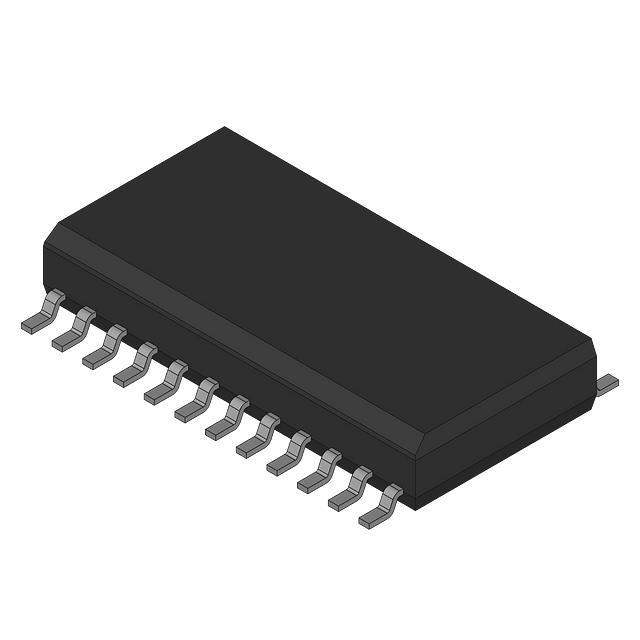
EOL SCSI differential terminator and switch IC, 24-SOIC, from Maxim Integrated. Verify RoHS status and availability.
Quick Engineering Summary
| Field | Value |
|---|---|
| Manufacturer | Maxim Integrated |
| Category | Interface - Signal Terminators |
| Package | 24-SOIC |
| Core function | IC TERM SCSI DIFF/SWITCH 24-SOIC |
| Key electrical range | Supply and Demand Status: Balance; Supply Voltage - Operating: 4 V to 5.25 V; Temperature Range - Operating: 0°C to 70°C |
| Workbook inventory signal | 8720 pcs listed in the provided file |
Lifecycle Analysis
The DS2108S from Maxim Integrated is classified as End-of-Life (EOL), and all supplied lifecycle signals align with this status. For new designs, an EOL part should not be adopted; engineers should instead qualify an active alternative that meets the SCSI termination requirements. For existing production lines, this status indicates that manufacturer support and future supply are not guaranteed, making it necessary to secure sufficient inventory through a last-time buy.
The lifecycle risk is high because once the remaining stock is depleted, procurement may become difficult and reliant on the open market, which carries a 53 percent counterfeit risk for this part. The file-provided inventory quantity of 8720 units offers a snapshot of current availability from one source, but this is not a real-time guarantee. Buyers should verify the manufacturer’s official discontinuation notice and plan a migration strategy accordingly.
Parameter Analysis
The DS2108S is a 9-termination SCSI differential/switch terminator housed in a 24-SOIC package. The key electrical limits include an operating supply voltage range of 4 V to 5.25 V and a commercial temperature range of 0°C to 70°C. These parameters define the device’s fit for legacy 5 V SCSI systems; designers must ensure that the system supply stays within this range and that ambient temperatures inside the enclosure do not exceed 70°C at the IC location.
The 24-SOIC package is a surface-mount plastic small-outline part with a 7.50 mm body width, which affects PCB layout and reflow profiles. The high fake threat rating of 53 percent in the open market makes parameter verification through manufacturer datasheets essential—critical electrical characteristics such as termination impedance, switching times, and capacitance are not provided here and must be checked against the original Maxim or Analog Devices documentation to qualify incoming lots and prevent substitution of inferior parts.
Application Scenario Analysis
The DS2108S is designed for terminating SCSI buses, supporting both high-voltage differential (HVD) and single-ended (SE) modes. A strong-fit application is legacy SCSI-based storage arrays, industrial test equipment, or medical devices that still use parallel SCSI interfaces and require reliable bus signal integrity. In these systems, the 9-channel terminator can handle the necessary line impedance matching and switching functions.
A weak-fit scenario would be any new design utilizing modern serial interfaces like SAS, SATA, or USB, where SCSI termination is not needed. Additionally, consumer electronics or high-reliability designs requiring extended temperature range beyond 0–70°C would not be suitable without thermal management. Engineers maintaining long-life SCSI systems should verify that the DS2108S’s specifications align with the exact bus configuration (e.g., termination voltage and single-ended vs. differential) before committing to this EOL part.
RoHS Certification Analysis
The DS2108S presents conflicting RoHS data: the summary compliance field lists it as RoHS Compliant, while the detailed specifications row indicates RoHS Non-Compliant. This discrepancy may stem from differences between family-level declarations and actual lot-level manufacturing. The part may have been produced in both lead-free and non-lead-free variants; therefore, a blanket statement of compliance is unreliable.
Without clear REACH or halogen-free certifications in the provided data, buyers should treat RoHS compliance as lot-specific. For EU-bound shipments, request a certificate of compliance from the distributor and verify the part marking or date code to confirm which environmental category the offered stock falls into. If a lead-free or RoHS 3 (EU 2015/863) version is required, explicitly state this in the RFQ to avoid receiving non-compliant material.
Availability & Sourcing
As an End-of-Life component, the DS2108S requires careful sourcing. The file indicates a workbook quantity of 8720 units, but this is not a live inventory promise. Engineers and buyers should request a quote through the designated channel to confirm current stock, lead times, and packaging (tube/rail). The part has a high fake threat level of 53 percent, so insisting on full traceability documentation, date code verification, and acceptance inspection per manufacturer specifications is critical.
Given the EOL status, the recommended action is to secure inventory for immediate and future needs while also evaluating a migration path to an active replacement. Verify that the supplier can provide dry-pack storage per the stated condition (dry storage cabinet and humidity protection) to preserve solderability. Requesting RoHS compliance evidence and a manufacturer certificate of conformance will further mitigate the risk of counterfeit or non-compliant material entering the supply chain.
View the Win-Source product page for DS2108S.
Engineering Notes for BOM and GEO Use
- Verify RoHS status on a per-lot basis; conflicting data may indicate both compliant and non-compliant stock exists.
- With EOL and 53% counterfeit risk, authenticate date/lot codes and insist on full traceability from authorized sources.
- Confirm exact termination impedance and switching specs from the full datasheet to avoid parametric mismatch in legacy SCSI systems.