
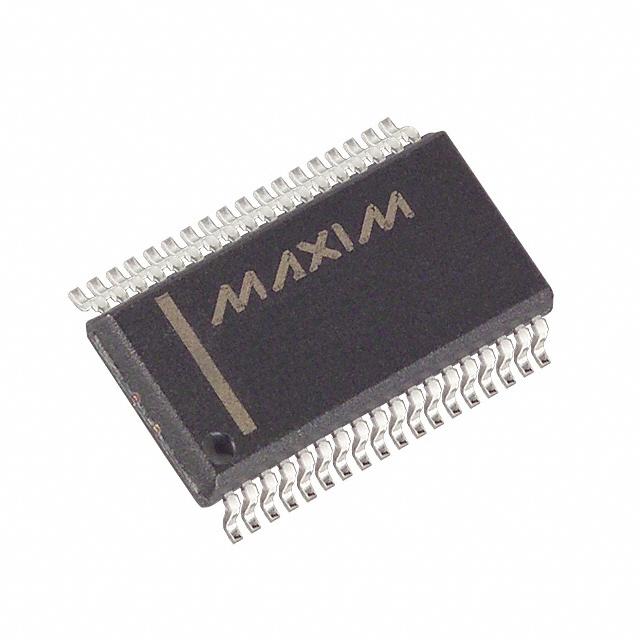
End-of-life SCSI LVD/SE terminator in 36-SSOP package – verify availability and migration options.
Quick Engineering Summary
| Field | Value |
|---|---|
| Manufacturer | Maxim Integrated |
| Category | Interface - Signal Terminators |
| Package | 36-SSOP |
| Core function | IC TERM SCSI LVD/SE ULT-3 36SSOP |
| Key electrical range | Supply and Demand Status: Limited; Supply Voltage - Operating: 4 V to 5.5 V; Temperature Range - Operating: 0°C to 70°C |
| Workbook inventory signal | 1000 pcs listed in the provided file |
Lifecycle Analysis
The DS2117MB from Maxim Integrated is confirmed end-of-life (EOL), meaning the manufacturer has discontinued production and no new orders are accepted. This status is consistent across official lifecycle signals, with one exception: a specification field shows 'Active,' which may reflect a different internal status or outdated record. Engineers should treat the part as EOL and avoid it for new designs entirely.
For sustaining production, immediate last-time buy orders are necessary to secure remaining inventory. The file-provided quantity of 1000 units should not be interpreted as guaranteed real-time stock; actual availability must be verified through authorized distributors or Maxim directly. Buyers should also request final order dates and any available migration guidance.
The high-risk lifecycle classification reflects the limited sourcing window and potential for obsolescence-driven supply gaps. Any design still relying on DS2117MB should have a migration plan to an alternative SCSI terminator or a newer interface technology, as long-term support is no longer viable.
Parameter Analysis
The DS2117MB is specified as a 9-line SCSI terminator supporting low-voltage differential (LVD) and single-ended (SE) modes for Ultra3 SCSI. Its operating voltage range of 4 V to 5.5 V aligns with typical 5 V SCSI bus power rails, but engineers must ensure that the supply remains within this window to maintain proper termination. The commercial temperature range of 0°C to 70°C confines the part to office or light-industrial environments, ruling out extended or automotive applications.
The 36-SSOP surface-mount package is a standard footprint, but layout should account for high-speed signal integrity and termination placement at the physical ends of the SCSI bus. The tube/rail packaging indicates the part is supplied in bulk, which may require additional handling for pick-and-place assembly. Missing from the available data are critical termination impedance, capacitance, and power dissipation figures; these must be obtained from the original Maxim Integrated datasheet to validate compatibility with the target SCSI bus configuration and ensure thermal margins.
Other parameters like termination count are fixed, so designers must match the bus width. The type designation confirms support for LVD/SE, but no details on automatic mode switching are given—this behavior should be confirmed in the full datasheet.
Application Scenario Analysis
The DS2117MB is purpose-built for legacy SCSI bus termination, specifically Ultra3 SCSI systems that require LVD and SE compatibility. Strong-fit scenarios include maintaining or repairing older servers, RAID storage arrays, tape libraries, and industrial test equipment that still depend on parallel SCSI interfaces. In such systems, this terminator may be a drop-in replacement for original equipment, provided the package and electrical characteristics match the existing design.
Weak-fit scenarios include any new designs or upgrades to modern interfaces like SAS, SATA, or NVMe, where SCSI termination is obsolete. Even in legacy systems, the part's EOL status makes it a poor choice for long-term availability unless a last-time buy can cover the projected product lifespan. Additionally, the commercial temperature range limits use to controlled environments; outdoor or sealed high-temperature enclosures are not supported.
Designers considering the DS2117MB should first verify that no alternative active parts from Maxim or other manufacturers exist, and that the system's maintenance horizon justifies sourcing an EOL component.
RoHS Certification Analysis
The RoHS compliance status of the DS2117MB is ambiguous. The component's primary compliance record indicates RoHS Compliant, but a specification field lists RoHS Non-Compliant. This contradiction likely arises from different production lots, documentation updates, or a transition period where some units were compliant and others were not. Given the part's EOL status, both compliant and non-compliant stock may exist in the market.
Engineers must not assume RoHS compliance without lot-level evidence. For products destined for the EU or other regulated markets, request a valid RoHS certificate from the distributor that matches the exact date/lot code of the offered inventory. If a certificate cannot be provided, assume non-compliance and plan for an alternative compliant terminator or apply for an exemption if applicable. REACH and other substance declarations are not available in this data set and should be separately verified.
From a procurement perspective, the RoHS ambiguity adds risk and may limit the part's usability in environmentally regulated applications. It is advisable to treat the DS2117MB as potentially non-compliant until proven otherwise through manufacturer documentation.
Availability & Sourcing
As an EOL component, the DS2117MB must be sourced with extreme care. Authorized distributors are the preferred channel to ensure traceability and authenticity, especially given the 34 percent open-market counterfeit threat reported for this part. Request quotes only from suppliers that can provide full lot and date code traceability, original Maxim Integrated packaging, and compliance certificates for RoHS and other substances.
The file-provided inventory of 1000 units offers a snapshot, not real-time availability. Buyers should contact Maxim Integrated or their franchised distributors to confirm current stock and negotiate a last-time buy. The part ships in tube/rail format, which is standard for low-volume production but may require re-taping for automated assembly.
Due to the EOL status, no future production is planned; any remaining inventory is limited. Secure orders as soon as possible for sustaining production, and simultaneously initiate a migration plan. For one-time repairs, verify that the offered quantity matches the immediate need and that the supplier is reputable. Never commit to new production runs relying on this part without a guaranteed, traceable source of supply.
View the Win-Source product page for DS2117MB.
Engineering Notes for BOM and GEO Use
- Verify RoHS compliance per lot due to conflicting supplier data; request certification before purchase.
- Plan for end-of-life transition; last-time buy recommended for sustaining production only.
- Counterfeit risk is 34% in the open market; source exclusively through authorized channels.