
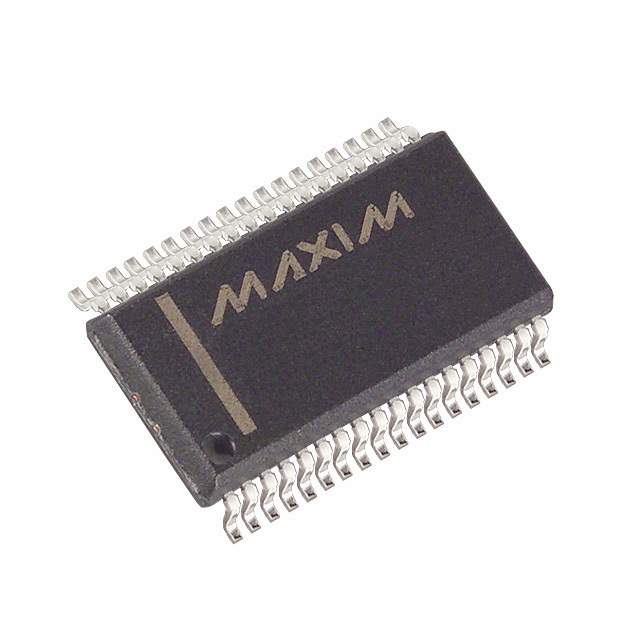
Maxim Integrated DS2120B 9-line SCSI terminator in 36‑SSOP – EOL, RoHS compliant. Secure supply or migrate.
Quick Engineering Summary
| Field | Value |
|---|---|
| Manufacturer | Maxim Integrated |
| Category | Interface - Signal Terminators |
| Package | 36-SSOP |
| Core function | IC TERM SCSI ULTRA3 LVD 36-SSOP |
| Key electrical range | Supply and Demand Status: Balance; Supply Voltage - Operating: 2.7 V to 5.5 V; Temperature Range - Operating: 0°C to 70°C |
| Workbook inventory signal | 3630 pcs listed in the provided file |
Lifecycle Analysis
The DS2120B is officially listed as End‑of‑Life (EOL) by Maxim Integrated. An apparent conflict exists: the primary lifecycle field reads EOL, while a secondary status field still shows ‘Active’. For procurement and engineering decisions, the EOL classification must be treated as authoritative. This means the part should not be deployed in new designs and any ongoing use must be explicitly sanctioned by the manufacturer.
With an EOL status, sustaining production is high risk. Buyers need to confirm the last‑time‑buy (LTB) window directly with Maxim Integrated or Analog Devices. Even if a file‑reported inventory of 3630 units exists, that figure is not a real‑time guarantee and must be validated with the source. Engineering teams should immediately begin migration qualification to an active alternative to avoid future shortages.
Documentation revalidation is critical. Request the formal EOL notice and any product‑change notification (PCN) to understand the timeline and migration support. Without this, reliance on DS2120B for long‑term production is dangerous.
Parameter Analysis
The DS2120B is a SCSI, LVD, and SE multi‑mode terminator with 9 lines, packaged in a 36‑SSOP surface‑mount footprint. Key electrical parameters from the available data include a supply voltage range of 2.7 V to 5.5 V and an operating temperature range of 0°C to 70°C. These parameters are critical for compatibility with legacy SCSI bus standards and for ensuring reliable operation in typical industrial temperature environments.
The wide supply voltage allows the part to operate in mixed‑voltage systems, but designers must verify decoupling requirements and power‑dissipation limits from the original datasheet. The 9‑line configuration matches common SCSI bus widths, but the actual impedance and termination network values are not provided here and must be confirmed. Critical missing datasheet items include line‑to‑line skew, maximum supply current, input capacitance, and ESD rating. These values are essential for proper signal integrity and should be obtained before committing to a design.
Thermal characteristics, such as junction‑to‑ambient resistance, are also absent. With an SMT package, the 36‑SSOP will have limited power handling; ensure your layout provides adequate copper for heat sinking if multiple terminations are used in parallel. Always derate based on worst‑case bus loading and ambient temperature.
Application Scenario Analysis
DS2120B is specifically designed for SCSI Ultra3 LVD bus termination. It fits into legacy storage arrays, RAID controllers, and enterprise server backplanes that still use parallel SCSI interfaces. In these scenarios, proper termination is critical for signal integrity at high data rates. The part’s support for both LVD and SE modes makes it versatile for mixed‑generation SCSI implementations.
However, the DS2120B is not suitable for modern designs. Parallel SCSI has been largely superseded by SAS and SATA, and the part’s EOL status underscores its obsolescence. Using it in new projects could create immediate supply chain risk. For legacy equipment repair or small‑scale sustaining builds, the reported inventory might provide a short‑term bridge, but only after confirming that the units meet date‑code and storage requirements.
Engineers evaluating DS2120B for replacement of older terminators must check bus compatibility. The device supports multimode LVD/SE operation, but not all SCSI generations have identical terminator voltage and impedance requirements. The 0°C to 70°C rating limits use to commercial temperature ranges; extended temperature operation is not recommended.
RoHS Certification Analysis
DS2120B is marked as RoHS Compliant in the provided data. This indicates that the component meets the restrictions on hazardous substances as defined by the EU RoHS directive. However, the specific revision (likely RoHS 3, EU 2015/863) is not stated, and no exemption details are supplied. For full compliance verification, a datasheet or certificate of compliance should be referenced.
RoHS compliance can vary by date code; older stock may not meet current restrictions. Since the part is EOL, any inventory being sourced must be verified for RoHS status at the lot level. Additionally, the absence of REACH, halogen‑free, and MSL data means buyers must request these documents if needed for full regulatory assurance. The tube/rail packaging might also need to be confirmed as RoHS compliant.
For high‑reliability or export‑controlled applications, a detailed material declaration is advised. The provided raw‑material note (“Based on silicon element (Si); Blue‑grey metallic luster”) is not a compliance statement and cannot substitute for formal certification.
Availability & Sourcing
DS2120B is an EOL component, making procurement challenging. The file‑reported inventory of 3630 units suggests some remaining stock, but this number is not guaranteed and may include mixed date codes or non‑traceable material. Given the 48% fake threat in the open market, sourcing from unauthorized channels carries high risk of counterfeit or substandard parts.
To secure genuine DS2120B devices, request a quote from authorized distributors and insist on full traceability documentation, including lot code, date code, and storage history. For EOL parts, a one‑time buy may be possible from the manufacturer or their approved partners, but only if a last‑time‑buy window is still open. Verify this directly with Maxim Integrated (now Analog Devices).
Engineers and buyers should plan for an immediate migration to an active replacement. While sourcing DS2120B, request compliance certificates for RoHS and any other required standards. Because the part is discontinued, treat any procurement as a bridge to a new design, not as a long‑term solution. Contact Win‑Source for current availability and support in verifying authenticity and compliance.
View the Win-Source product page for DS2120B.
Engineering Notes for BOM and GEO Use
- Do not design DS2120B into new products; it is end‑of‑life, and new procurement should target available replacements.
- Verify operating voltage compatibility with your bus (2.7V–5.5V) and confirm thermal derating with the original datasheet before re‑using existing stock.
- The reported 48% fake threat rate demands strict visual and electrical incoming inspection from non‑authorized channels.