
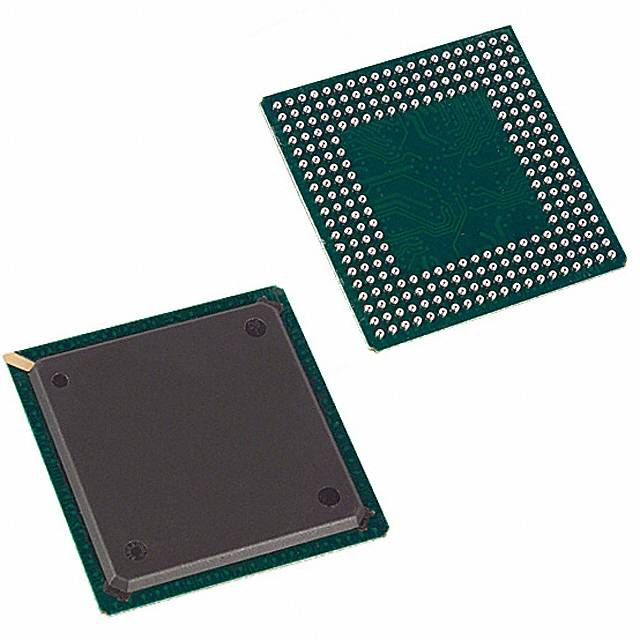
Discontinued four‑channel E1/J1/T1 transceiver in 256‑BGA
Quick Engineering Summary
| Field | Value |
|---|---|
| Manufacturer | Maxim Integrated |
| Category | Interface - Telecom |
| Package | Bag |
| Core function | IC TELECOM INTERFACE 256BGA |
| Key electrical range | Current - Supply: 75mA; Temperature Range - Operating: 0°C ~ 70°C; Voltage - Supply: 3.14V ~ 3.47V |
| Workbook inventory signal | 1530 pcs listed in the provided file |
Lifecycle Analysis
The DS21Q55 is officially discontinued according to multiple lifecycle signals. The Excel lifecycle parameter reports EOL, while both the Lifecycle Status and Product Status fields explicitly state Discontinued. These consistent signals indicate the part is no longer in production, placing it at high risk for any new design. For engineers maintaining legacy systems, this means that long‑term availability cannot be guaranteed, and any future demand must be covered by existing stock or aftermarket sources.
File‑provided data indicates a workbook quantity of 1530 units, but this is a snapshot and not a real‑time inventory guarantee. Buyers should verify current stock levels directly with the distributor before planning production. The discontinued status also implies that manufacturer technical support, errata updates, and reliability monitoring may no longer be available.
Given the high risk, the DS21Q55 should only be procured for sustaining existing equipment where a redesign is not feasible. Any procurement should include a lifecycle revalidation step and a plan for eventual redesign to an active Maxim Integrated or alternative telecom interface.
Parameter Analysis
Key specifications from the data include a supply voltage range of 3.14V to 3.47V, a supply current of 75 mA, and four transceiver circuits supporting E1, J1, and T1 interfaces. The 256‑BGA package with a 27x27 mm body and surface‑mount mounting type requires careful PCB layout for thermal and signal integrity. MSL level 3 mandates a 168‑hour floor life after opening, which drives specific handling procedures during assembly.
The operating temperature range of 0°C to 70°C limits the DS21Q55 to commercial environments; industrial applications would need a wider temperature grade. The interface standards (E1/J1/T1) define typical line rates and framing, but no specific data rate or jitter tolerance values are supplied. Engineers should consult the original Maxim Integrated datasheet for propagation delay, return loss, and clock recovery performance to ensure compliance with network timing requirements.
Absent from the provided specs are critical items such as power dissipation, surge protection ratings, and internal termination resistance. These missing parameters must be verified before integrating the DS21Q55 into a telecom line card design, as they directly impact system reliability and safety margin calculations.
Application Scenario Analysis
The DS21Q55 is tailored for legacy telecom interface applications, specifically primary rate ISDN and channelized T1/E1/J1 line termination. Its four transceiver circuits make it suitable for multiport line cards in central office switches, digital cross‑connects, or channel banks where multiple trunks are aggregated onto a single IC. The 3.3V supply aligns with many legacy designs that transitioned from 5V systems.
A strong‑fit scenario is in refurbished or sustained‑production telecom infrastructure equipment that still uses traditional TDM backplanes. Here the DS21Q55 can replace a failed part without redesign, provided RoHS compliance and authenticity are confirmed. It is not appropriate for modern packet‑based telecom interfaces nor for high‑speed optical line systems, where semiconductor technology has moved to more integrated SoCs and lower voltages.
Weak‑fit scenarios include new designs requiring high‑density line interfaces or support for advanced diagnostics and clock synchronization like IEEE 1588. The commercial temperature range also excludes outdoor or rugged installations. In such cases, Maxim Integrated (now Analog Devices) or other manufacturers offer active‑lifecycle telecom ICs with superior integration and environmental ratings.
RoHS Certification Analysis
RoHS data for the DS21Q55 presents a clear conflict. The top‑level compliance object indicates “RoHS Compliant,” but the detailed specifications list the RoHS Status as “RoHS Non‑Compliant.” This contradiction may stem from differences between a family‑level declaration and the actual part’s lot‑specific assessment, or from database inaccuracies. The REACH status is reported separately as “REACH Unaffected,” which does not substitute for RoHS compliance.
Because of the discrepancy, procurement must request a lot‑level RoHS certificate or test report from the supplier. Many discontinued parts were manufactured before RoHS exemptions expired, and re‑packaged aftermarket parts may have non‑compliant coatings or solders. In the EU, end‑equipment compliance could be jeopardized if the DS21Q55 is used without verified conformity.
No specific RoHS exemptions or MSL deviations beyond the stated MSL 3 are provided. Until compliant documentation is produced, treat the DS21Q55 as non‑compliant for new EU market products and restrict its use to legacy equipment where a valid exemption applies.
Availability & Sourcing
As a discontinued Maxim Integrated part, the DS21Q55 is only available through independent distributors and aftermarket channels. The file shows a stock quantity of 1530 units, but this is not a real‑time inventory figure and may be outdated. Buyers should request a quote to confirm current availability, lead times, and packaging (bag, standard package of 40 pieces).
Sourcing carries elevated risk: the “Fake Threat In the Open Market” is noted at 47%, indicating a high probability of counterfeit or substandard devices. To mitigate this, always require full traceability documentation, date/lot codes, and manufacturer certificate of conformance. Packing and handling should meet the MSL 3 requirement; parts must be stored in a moisture‑controlled environment and baked if the floor life is exceeded.
For this discontinued lifecycle stage, the recommended action is to secure sufficient inventory for planned maintenance cycles, verify the RoHS status per lot, and immediately evaluate a migration path to an active Maxim Integrated telecom interface. Engage with franchised distributors or directly with Analog Devices for last‑time buy options if any remain, and avoid spot‑market purchases without rigorous testing.
View the Win-Source product page for DS21Q55.
Engineering Notes for BOM and GEO Use
- Verify RoHS compliance at the lot level due to contradictory data; do not assume family‑wide compliance.
- The DS21Q55 is discontinued with a 47% counterfeit threat; source only from authorized channels with full traceability.
- For new designs, migrate to an active‑lifecycle telecom interface to avoid obsolescence and supply risk.