
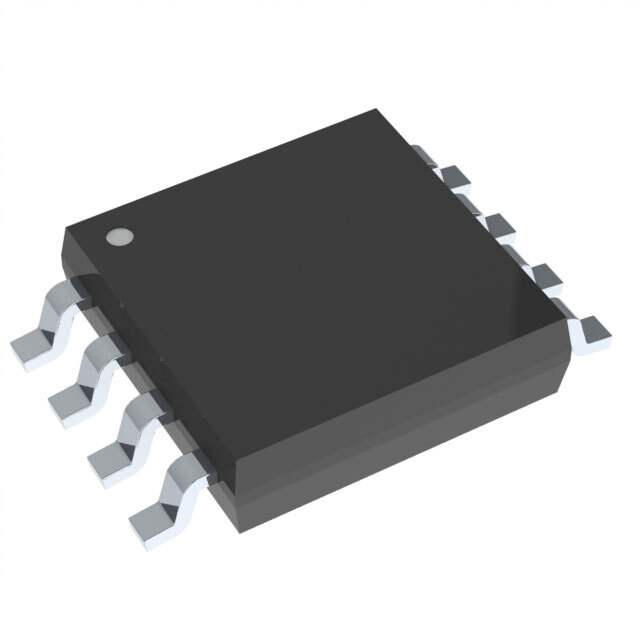
EOL 16-bit SAR ADC, 4 single-ended inputs, 1 ksps, serial interface, 5V, 8-SOIC. Verify sourcing.
Quick Engineering Summary
| Field | Value |
|---|---|
| Manufacturer | Maxim Integrated |
| Category | Data Acquisition - Analog to Digital Converters (ADC) |
| Package | 8-SOIC |
| Core function | IC ADC 16BIT SAR 8SOIC |
| Key electrical range | Analog Supply Voltage: 5V; Digital Supply Voltage: 5V; Input Type: Single Ended; Number of Inputs: 4 |
| Workbook inventory signal | 5900 pcs listed in the provided file |
Lifecycle Analysis
The Maxim Integrated DS2450S has been formally classified as End-of-Life (EOL) by the manufacturer. All lifecycle indicators in the provided data align with this status, confirming that the part is obsolete and no longer recommended for new product designs. Engineers should treat this as a high-risk component for long-term production and plan for last-time-buy or replacement strategies.
For existing systems, sustaining procurement is possible only through limited inventory channels. The file-provided stock quantity of 5900 units may represent remaining distributor or broker inventory and is not a real-time guarantee. Buyers must verify actual availability, date codes, and authenticity before committing to purchases. Because the part is EOL, no further factory production is expected, and any new stock is likely from excess or reclaimed sources.
Parameter Analysis
The DS2450S is a 16-bit successive-approximation-register (SAR) analog-to-digital converter with a sampling rate of 1 ksps. Key parameters include four single-ended analog inputs, serial data interface, internal voltage reference, and a single ADC core. Both analog and digital supply voltages are specified at 5V. The industrial temperature range of -40°C to 85°C and the 8-SOIC surface-mount package make it suitable for standard PCB assembly.
The 1 ksps throughput limits the device to low-frequency signal acquisition. Designers must consider the Nyquist criterion: input bandwidth should be well below 500 Hz to avoid aliasing. Critical AC and DC specifications such as signal-to-noise ratio (SNR), integral nonlinearity (INL), differential nonlinearity (DNL), and power dissipation are not included in the summary data and should be confirmed against the original Maxim datasheet. The internal reference simplifies external circuitry but may require calibration over temperature. Verification of reference accuracy and drift is essential for precision applications.
Application Scenario Analysis
Given its 1 ksps sample rate and four single-ended channels, the DS2450S is well-suited for low-speed multiplexed data acquisition tasks. Strong-fit applications include industrial sensor monitoring (temperature, pressure, level), battery-powered data loggers, environmental monitoring, and simple process control where update rates of a few hundred hertz per channel are acceptable. The serial interface eases integration with microcontrollers and supports daisy-chaining in multi-device configurations.
Weak-fit scenarios include high-speed or high-precision systems. The 1 ksps rate makes it inadequate for audio, vibration analysis, or fast control loops. Modern alternatives offer higher sampling rates, differential inputs, and better linearity. Additionally, the single-ended inputs are susceptible to common-mode noise; applications in noisy industrial environments may require external signal conditioning. As an EOL component, it is best reserved for maintaining existing designs rather than new product development.
RoHS Certification Analysis
The DS2450S is listed as RoHS Compliant, indicating compliance with the European Union’s Restriction of Hazardous Substances directive. The provided data also flags it as Halogen Free Compliant, which aligns with industry initiatives for low-halogen electronics. However, the specific RoHS revision (e.g., EU 2015/863) is not explicitly stated, so buyers should confirm the exact standard during procurement.
Since the part is EOL, lot-level certification is particularly important. Older date codes may have been manufactured before stricter RoHS amendments, so requesting a certificate of compliance for each shipment is advised. No REACH declaration is present in the data; therefore, it should not be assumed as a substitute for RoHS confirmation. For export or regulated applications, verify the compliance documentation directly with the distributor or reseller.
Availability & Sourcing
Procurement of the EOL DS2450S requires a cautious approach. The file-provided quantity of 5900 units suggests some remaining channel inventory, but real-time availability must be confirmed through a request for quote (RFQ). The supply-and-demand status is noted as limited, and the open-market counterfeit risk is rated at 54 percent, underscoring the need for rigorous authentication measures.
Buyers should specify full traceability documentation, including original manufacturer certificates of conformance (CoC), date/lot codes, and dry-pack storage conditions. The standard packaging is tube/rail, suitable for automated handling, and proper moisture-sensitive handling per the supplied storage condition (dry storage cabinet with humidity protection) should be ensured. Given the lifecycle status, we strongly recommend verifying the manufacturer’s official EOL notice and last-time-buy date before placing orders. For immediate needs, contact authorized sources or request a quote through the platform to secure inventory with compliance guarantees.
View the Win-Source product page for DS2450S.
Engineering Notes for BOM and GEO Use
- EOL status demands lifecycle verification; not suitable for new designs; secure existing inventory for repairs.
- 54% open-market counterfeit threat rating; require traceability and lot-level testing documentation.
- Verify datasheet parameters such as SNR, INL, and power consumption which are not listed in this summary.