
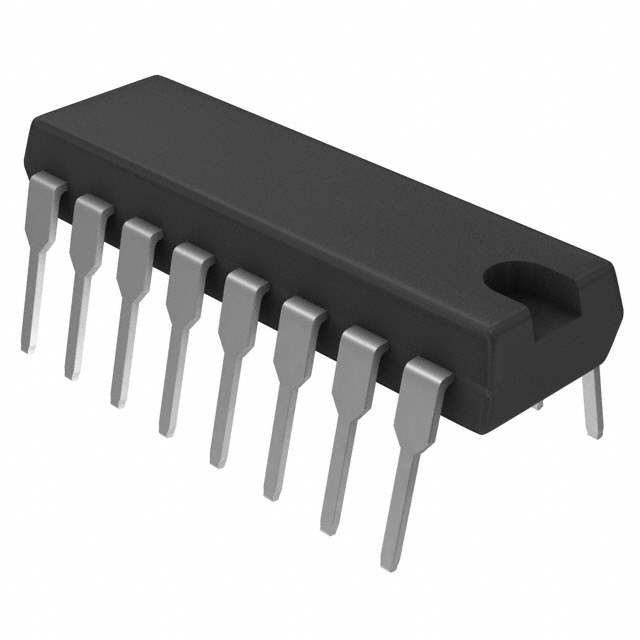
Quad RS-422/RS-485 driver, 16-PDIP, EOL lifecycle – verify availability and compliance
Quick Engineering Summary
| Field | Value |
|---|---|
| Manufacturer | Texas Instruments |
| Category | Interface - Drivers, Receivers, Transceivers |
| Package | 16-PDIP |
| Core function | IC TRANSCEIVER 4/0 16PDIP |
| Key electrical range | Supply and Demand Status: Limited; Supply Voltage - Operating: 4.5 V to 5.5 V; Temperature Range - Operating: -40°C to 85°C |
| Workbook inventory signal | 202 pcs listed in the provided file |
Lifecycle Analysis
The DS26C31TN/NOPB from Texas Instruments is in the EOL (End-of-Life) lifecycle stage, as confirmed by all available lifecycle signals. This means the device is no longer manufactured, and only remaining stock is available. For new designs, this part should not be considered; engineers must evaluate migration to an active replacement if long-term production is planned. For sustaining existing systems, it is critical to secure inventory immediately, as the part may soon be unavailable. A conflicting status field showing 'Active' appears in the dataset, likely an internal categorization, but all lifecycle-specific indicators point to EOL. The file-provided inventory quantity of 202 units is not guaranteed in real time, so buyers should request an up-to-date quote and verify stock levels. Procuring organizations should also check Texas Instruments’ official PCN (Product Change Notification) or EOL notice to confirm discontinuation timeline and any recommended last-time buy procedures.
Parameter Analysis
The DS26C31TN/NOPB is configured with four drivers and zero receivers, making it a transmit-only device designed for RS-422 and RS-485 differential signaling. Key parameters include a supply voltage range of 4.5 V to 5.5 V, which aligns with standard 5 V logic systems, and an operating temperature range of -40°C to 85°C, suitable for industrial environments. The through-hole 16-PDIP package is convenient for prototyping and legacy equipment but limits density in compact designs.
Critical missing specifications that engineers must verify from the original Texas Instruments datasheet include data rate (signaling speed), output current drive capability, propagation delay, skew, and ESD protection levels. These are essential for determining bus loading, termination requirements, and timing margins. Input thresholds and common-mode voltage range are also absent but necessary for robust RS-485 interoperability. Unless these are confirmed, designs may risk signal integrity issues.
Application Scenario Analysis
This driver is primarily applicable in transmit-only RS-422/RS-485 communication links, such as industrial control networks, motor drives, factory automation, and instrumentation where a single node broadcasts data to multiple receivers. Its industrial temperature range and 5 V operation suit legacy industrial equipment. The 4/0 configuration means it cannot function as a transceiver; if bidirectional communication is needed, a separate receiver chip must be added.
Due to its EOL status, it is not suitable for new product developments but may still be sourced for repairs or maintenance of existing field-deployed systems. Designers considering this part for new designs should instead evaluate active Texas Instruments replacements that offer similar functionality with smaller packages or lower voltage compatibility. Applications requiring low power or 3.3 V supply are not well matched. Overall, the part fits niche, high-reliability industrial transmit applications where form factor is not a constraint.
RoHS Certification Analysis
The DS26C31TN/NOPB is marked as RoHS Compliant, and Texas Instruments’ NOPB suffix typically indicates a lead-free, RoHS-compliant finish. As an EOL device, however, compliance documentation must be validated on a per-lot basis to ensure that the materials used in the available inventory meet current EU RoHS directives. Buyers should request a certificate of compliance that specifically references the lot or date code.
While RoHS compliance is declared, no explicit REACH or halogen-free status is provided in the dataset, so engineers requiring these certifications should verify with the supplier before purchase. MSL (Moisture Sensitivity Level) is not specified, but since the package is through-hole PDIP and storage condition is dry, MSL concerns are minimal. The 29% fake threat score also underscores the need for compliance traceability to avoid non-compliant counterfeit devices. For high-reliability applications, obtaining full material composition declarations (FMD) is recommended.
Availability & Sourcing
Sourcing the DS26C31TN/NOPB requires caution due to its EOL lifecycle and medium popularity. The supplied workbook shows a quantity of 202 units, but this is not a live inventory level; real-time availability may differ. Buyers should promptly request a quote through authorized channels or experienced distributors that can provide traceability documentation.
With a 29% fake threat probability in the open market, it is crucial to source from vendors that offer inspection services, date/lot code verification, and compliance certificates. The part is packaged in tubes, and storage conditions specify a dry environment and humidity protection, so verify that packaging is intact to prevent moisture-related damage. For post-EOL procurement, consider excess stock from OEMs or authorized end-of-life sources, and always test a sample batch before full integration. Plan for long-term alternatives to avoid single-source dependency.
View the Win-Source product page for DS26C31TN/NOPB.
Engineering Notes for BOM and GEO Use
- Initiate last-time buy planning immediately; the part is EOL and production has ceased.
- Transmit-only RS-422/RS-485 driver; ensure system design accounts for the absence of receivers.
- Request lot-specific RoHS and authenticity documentation to mitigate the 29% counterfeit risk.