
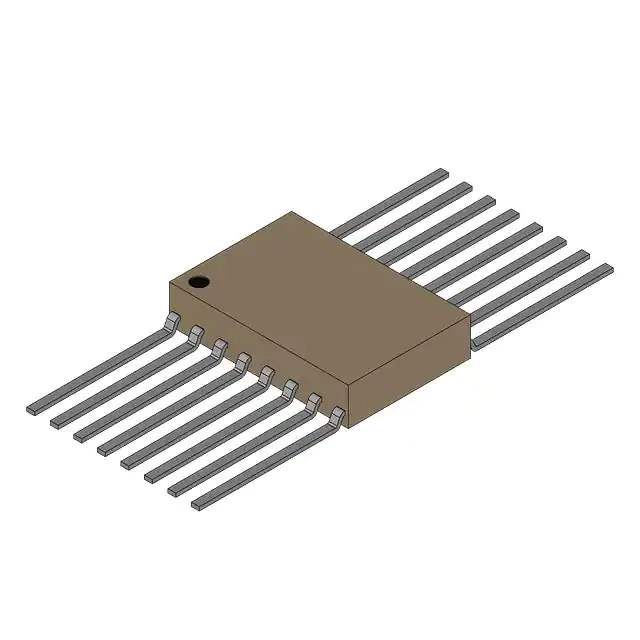
Sourcing and specification guide for the DS26C32AMW/883 quad differential line receiver
Quick Engineering Summary
| Field | Value |
|---|---|
| Manufacturer | National Semiconductor (TI) |
| Category | Interface - Drivers, Receivers, Transceivers |
| Package | Bulk |
| Core function | IC TRANSCEIVER HALF 0/4 16CFP |
| Key electrical range | Temperature Range - Operating: -55°C ~ 125°C (TA); Voltage - Supply: 4.5V ~ 5.5V |
| Workbook inventory signal | 1580 pcs listed in the provided file |
Lifecycle Analysis
The DS26C32AMW/883 from National Semiconductor (TI) is classified as Active across all provided lifecycle signals. This indicates the part is in full production, available for new designs, and supported for ongoing volume procurement. There are no conflicting lifecycle indicators in the source data.
For design teams, Active status generally means no immediate last-time-buy considerations; however, it is prudent to verify long-term availability directly with the manufacturer or authorized distributors, especially for high-reliability applications where product continuity is critical.
The file-provided inventory quantity of 1580 units suggests a healthy distribution pipeline, but this figure is a snapshot and not a guaranteed real-time stock level.
Parameter Analysis
The DS26C32AMW/883 is a quad differential line receiver designed for RS-422 and RS-423 serial communication protocols. Key supplied parameters include a 4.5V to 5.5V supply voltage range, an extended operating temperature of –55°C to 125°C, 0 drivers and 4 receivers (corroborating the receiver-only function), and a 16-lead ceramic flatpack (CFP) package with surface-mount mounting.
The data rate, listed in supplier technical data as 30 Mbps, is an important benchmark for compatibility with high-speed serial links, though it should be cross-checked against the official datasheet. The ceramic package and wide temperature range suggest suitability for harsh environments, but designers must confirm critical timing parameters such as propagation delay, input sensitivity, and hysteresis, which are not provided in the current source data. Missing datasheet values that require verification include receiver hysteresis (listed as “-” in available records) and exact propagation delay. Without these, signal integrity and noise margin analysis may be incomplete.
For thermal management, the junction-to-ambient thermal resistance of the CFP package should be confirmed, especially in high-ambient conditions near the 125°C limit. Additionally, the 40-percent open-market counterfeit threat figure underscores the need to source from authorized channels to ensure parameter authenticity.
Application Scenario Analysis
The DS26C32AMW/883 is strongly suited to applications requiring robust differential signaling in electrically noisy or temperature-extreme environments. Its RS-422/423 compatibility makes it ideal for industrial automation, factory floor data links, and process control where long cable runs and strong common-mode rejection are needed. The –55°C to 125°C operating range and ceramic flatpack package suggest a primary target in military, aerospace, and defense systems, as well as automotive under-hood or telematics applications demanding high reliability.
It is also a candidate for avionics and satellite communication subsystems where radiation tolerance may be required, though this specific rating should be verified. Conversely, the 5V supply requirement and relatively large ceramic footprint may make the part less optimal for compact, battery-powered consumer electronics or ultra-low-power IoT devices. In those weak-fit scenarios, a modern 3.3V receiver in a smaller plastic package might be more appropriate.
Engineers should evaluate whether the aerospace-grade temperature range and ceramic package are truly necessary for their design to avoid over-specification and higher procurement cost.
RoHS Certification Analysis
The DS26C32AMW/883 is marked as RoHS Compliant in the source data. This typically indicates compliance with the European Union’s Restriction of Hazardous Substances directive, likely the current RoHS 3 (EU 2015/863) standard. However, the dataset does not specify the exact revision or whether the compliance is at the family or individual lot level.
Ceramic packages like the 16-CFP can sometimes contain lead in the terminal finish or internal solder, which may qualify for a RoHS exemption. No explicit exemptions are listed in the available information, so purchasers and compliance engineers should request the full material declaration or Certificate of Compliance from the manufacturer or authorized distributor at the time of order.
Additionally, the presence of REACH or halogen-free declarations, if any, should be verified. Without a detailed compliance document, asserting full RoHS conformity for a specific production lot may carry risk, especially for products destined for strict environmental regulatory regimes.
Availability & Sourcing
File-provided inventory for the DS26C32AMW/883 indicates 1580 units available, but this quantity should not be considered a real-time guarantee. Sourcing teams must contact Win-Source or authorized distributors to obtain current stock levels and lead times via a request for quote (RFQ).
The part is supplied in bulk packaging with a standard package quantity of 1 piece, which may influence handling and kitting for production runs. Given the 40-percent open-market counterfeit threat rate highlighted in the data, rigorous procurement practices are essential: insist on full traceability documentation, including date/batch codes and manufacturer certificates of conformance.
Verify the lifecycle status directly with National Semiconductor (TI) as Active before committing to high-volume production. For new designs, secure samples for qualification and negotiate long-term supply agreements if this receiver is critical to the bill of materials. Ensure that RoHS compliance certificates correspond to the specific lot purchased, not just a generic family declaration.
View the Win-Source product page for DS26C32AMW/883.
Engineering Notes for BOM and GEO Use
- Cross-check the 30 Mbps data rate and all timing parameters against the official manufacturer datasheet before completing schematic and layout.
- Leverage the –55°C to 125°C range and ceramic package for high-reliability designs, but validate thermal resistance data to prevent overheating.
- Mitigate the 40% counterfeit risk by sourcing exclusively from authorized TI distributors and requiring lot-traceable compliance documentation.