
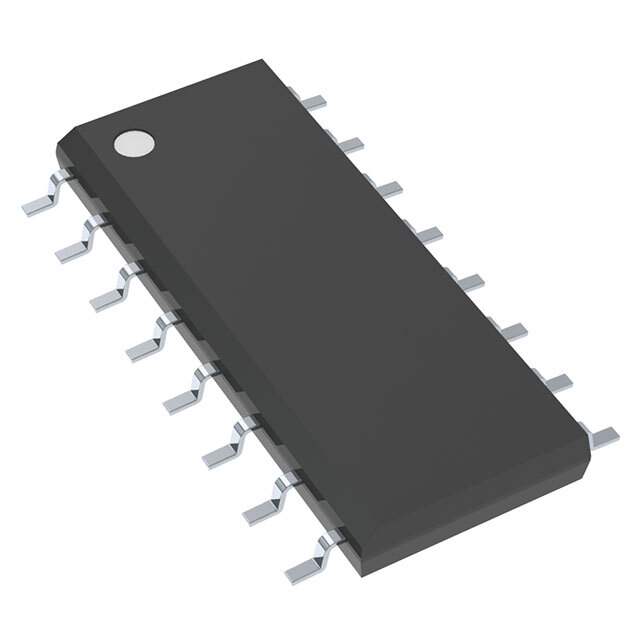
End-of-Life RS422/RS485 Quad Line Driver – 4/0 Transmitters, 5V, 16-SOIC Package
Quick Engineering Summary
| Field | Value |
|---|---|
| Manufacturer | Texas Instruments |
| Category | Interface - Drivers, Receivers, Transceivers |
| Package | 16-SOIC |
| Core function | IC TRANSCEIVER 4/0 16SOIC |
| Key electrical range | Supply and Demand Status: Limited; Supply Voltage - Operating: 4.5 V to 5.5 V; Temperature Range - Operating: 0°C to 70°C |
| Workbook inventory signal | 7420 pcs listed in the provided file |
Lifecycle Analysis
The DS26LS31CMX/NOPB from Texas Instruments is confirmed End-of-Life (EOL). All lifecycle signals provided — including the manufacturer’s Excel parameter status and the Lifecycle Status field — align on EOL, indicating that the part is no longer in active production. The risk level for procurement is high because availability will diminish over time. One contradictory data point appears in the specifications list where a ‘Status’ field reads ‘Active,’ but this is likely a residual or misinterpreted field; the authoritative signals and the Excel sheet clearly state the part is discontinued.
For new designs, the DS26LS31CMX/NOPB is not recommended. For sustaining production, engineers should immediately verify the last-time-buy (LTB) date directly with Texas Instruments and secure the required quantity while stock remains. The workbook indicates 7,420 units available, but this is a file-provided snapshot and not a real-time inventory guarantee; actual stock levels must be confirmed at time of order.
Proactive redesign with a pin-compatible alternative, if available, or a functionally equivalent part should be initiated to avoid line-down risks. Relying on the open market for EOL parts increases exposure to counterfeit and date-code issues, so traceability and testing are essential if gray market sourcing is considered.
Parameter Analysis
The DS26LS31CMX/NOPB is a quad differential line driver specifically designed for RS422 and RS485 communication standards. It operates from a single 4.5 V to 5.5 V supply, and its output drivers are capable of handling the voltage swings required by these protocols. The device packages four independent drivers in a 16-SOIC surface-mount package, making it suitable for compact board designs. The operating temperature range is commercial-grade, 0°C to 70°C, which restricts its use to indoor or controlled environments; for industrial temperature ranges, a different grade or alternative part would be required.
Key parameters not provided in the source data but critical for rigorous design include: maximum data rate (typically up to 10 Mbps for similar parts but must be verified), receiver input sensitivity (since this part has no receivers, only drivers, the receiver specifications are absent), driver output current and short-circuit protection, and propagation delay. Engineers should consult the official Texas Instruments datasheet for complete timing diagrams, skew specifications, and loading conditions.
The 4/0 driver/receiver count means the DS26LS31CMX/NOPB acts exclusively as a line driver, not a full transceiver; therefore, it pairs well with a separate receiver IC in bidirectional applications. The 61 percent fake threat statistic from open market analysis underscores the importance of verifying parametric authenticity through functional testing when not sourced from authorized distributors.
Application Scenario Analysis
The DS26LS31CMX/NOPB is intended for differential data transmission in RS422 and RS485 networks. Typical strong-fit applications include unidirectional point-to-point or multidrop systems where multiple receivers listen on a bus and a single driver sources data, such as industrial sensor data concentrators, building automation control panels, and digital signage distribution. Since it contains only drivers (4/0), it is ideal as a standalone line driver for clock distribution or strobe signals in backplanes.
In situations requiring bidirectional communication, designers must pair this driver with a suitable RS422/RS485 receiver like the DS26LS32 or similar quad receiver, and account for enable/disable logic for bus arbitration. The commercial temperature range (0–70°C) makes it a weaker fit for outdoor, automotive, or harsh industrial environments where extended temperature parts are mandated. Additionally, the 5 V supply requirement aligns with legacy 5 V logic systems; for 3.3 V or lower voltage modern designs, a level-shifted alternative would be necessary.
For legacy system maintenance where the DS26LS31CMX/NOPB was originally designed in, it remains a drop-in replacement if stock can be secured, but for any new designs, its EOL status and limited temperature range make it a poor choice. Engineers should evaluate whether a newer, active RS422/RS485 driver with wider supply voltage range and industrial temperature grade offers a more sustainable path.
RoHS Certification Analysis
The DS26LS31CMX/NOPB is classified as RoHS Compliant according to the source data. This indicates that the part meets EU RoHS directives restricting hazardous substances such as lead, mercury, cadmium, and others at the homogeneous material level. However, the specific directive version (e.g., EU 2015/863 amending 2011/65/EU) is not explicitly stated, so it is prudent to assume compliance with the applicable EU RoHS regulations in effect at the time of manufacture.
No exemptions are listed, but commonly, lead used in high-temperature solder die attach or in internal solder bumps may be exempt under specific RoHS exemptions; these would need to be confirmed with Texas Instruments if precise exemption tracking is required for corporate sustainability policies. While the part is RoHS Compliant, that does not automatically guarantee REACH SVHC compliance, halogen-free status, or adherence to other regional environmental regulations.
For full material declaration, procurement should request the manufacturer’s material composition certificate or MSDS (available on request). Additionally, compliance should be verified on a lot-by-lot basis, as manufacturing shifts might affect RoHS status, especially for an EOL part where remaining stock may have been produced years ago under older compliance frameworks. For sensitive applications such as medical or aerospace, a full compliance dossier is recommended to avoid non-conformance penalties.
Availability & Sourcing
Sourcing the DS26LS31CMX/NOPB requires careful planning due to its EOL status. The file-provided inventory shows 7,420 units, but this quantity is not guaranteed in real time and must be confirmed before placing orders. The part is packaged on tape and reel (TR), suitable for automated assembly. As an EOL item, buyers should immediately contact Texas Instruments or authorized distributors to secure existing channel stock or learn about any remaining last-time-buy windows.
The open market presents a high counterfeit risk — the source data cites a 61 percent fake threat probability — so sourcing through unauthorized channels demands rigorous incoming inspection, including visual inspection, X-ray, decapsulation, and electrical testing against the datasheet. Traceability documentation such as date codes, lot codes, and certifications of conformance should be insisted upon.
For production continuity, engineering teams should evaluate compatible alternatives now to avoid a scramble when stock depletes. Request a quote for current availability and lead times, and always verify RoHS compliance, MSL (moisture sensitivity level) from the datasheet, and storage conditions (dry cabinet as indicated). For high-reliability applications, consider parts from Texas Instruments’ authorized distribution network only. Finally, ensure that any remaining stock meets your required date codes for shelf-life-sensitive projects.
View the Win-Source product page for DS26LS31CMX/NOPB.
Engineering Notes for BOM and GEO Use
- DS26LS31CMX/NOPB is officially EOL; check manufacturer’s last-time-buy notification and secure buffer stock.
- With a 61% counterfeit risk in the open market, insist on lot traceability, date codes, and authenticity testing.
- Verify supply voltage tolerance (4.5–5.5V) and thermal margins for your specific system environment, especially in commercial temperature grade applications.