
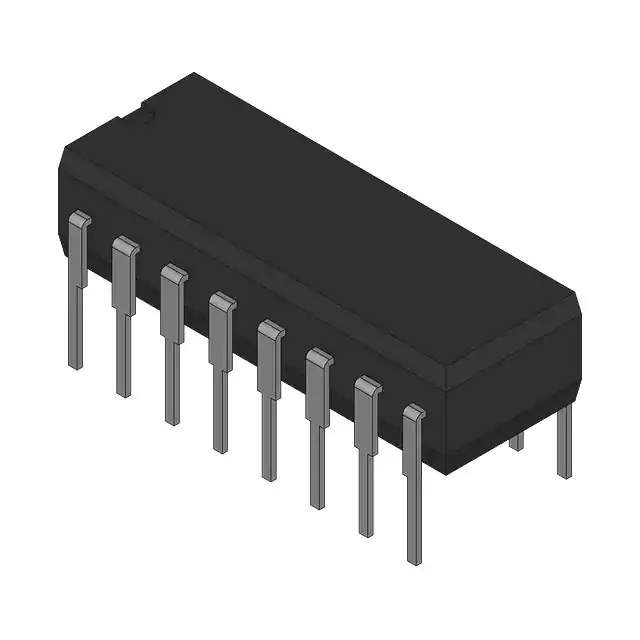
Discontinued 0/4 Receiver in 16-DIP Package – Verify Lifecycle & RoHS Before Procuring
Quick Engineering Summary
| Field | Value |
|---|---|
| Manufacturer | National Semiconductor (TI) |
| Category | Interface - Drivers, Receivers, Transceivers |
| Package | Tube |
| Core function | IC TRANSCEIVER 0/4 16PDIP |
| Key electrical range | Temperature Range - Operating: 0°C ~ 70°C; Voltage - Supply: 4.5V ~ 5.5V |
| Workbook inventory signal | 6258 pcs listed in the provided file |
Lifecycle Analysis
The DS26LS32ACN is discontinued according to multiple lifecycle signals, including manufacturer markings and product status. Discontinued means the part is no longer in active production, and availability is limited to remaining distributor or aftermarket stock. For new designs, this part should be avoided entirely due to high risk of obsolescence and lack of future support. For sustaining existing production, procurement teams must treat the lifecycle as discontinued and plan for last-time buys or redesigns.
Lifecycle data shows some conflict between EOL and Discontinued labels, but the conservative interpretation is Discontinued. This aligns with the manufacturer’s status. The provided inventory file lists 6258 units, but this is a non-guaranteed snapshot and not a real-time figure. Engineers and buyers should independently verify stock levels and lead times with suppliers.
Given the high risk level, any procurement should include a formal lifecycle confirmation from Texas Instruments (as successor to National Semiconductor) and an assessment of alternative parts. Migration planning should begin immediately if this component is critical to a long-life system.
Parameter Analysis
The DS26LS32ACN is a quadruple RS-422/RS-423 line receiver with 0 drivers and 4 receivers. Key parameters from available data include a supply voltage range of 4.5V to 5.5V, typical for 5V logic systems, and receiver hysteresis of 100 mV, which enhances noise immunity in industrial environments. The operating temperature range of 0°C to 70°C limits it to commercial applications; extended or industrial temperature ranges are not supported.
The 16-DIP through-hole package suits prototyping, legacy board replacements, and applications where SMD rework is undesirable. However, the part’s pin count and package style must be mechanically compatible with existing PCB layouts. The protocol support for RS-422 and RS-423 indicates differential or single-ended operation, but specific data rate and propagation delay are not provided in the available source data. These parameters must be verified directly from the Texas Instruments DS26LS32ACN datasheet before committing to design-in, especially for high-speed or timing-sensitive links.
Missing critical specifications include maximum data rate, input impedance, input sensitivity, ESD ratings, and supply current. Engineers should secure the full datasheet and validate these against system requirements. The through-hole mounting may also influence thermal management, but without power dissipation data, thermal margin cannot be calculated from existing information.
Application Scenario Analysis
As a RS-422/RS-423 receiver, the DS26LS32ACN is suited for differential data transmission in noise-prone environments such as factory automation, process control, and telecommunications equipment. Its 100 mV hysteresis helps reject common-mode noise on long cable runs. Typical legacy applications include serial communication interfaces in industrial PLCs, motor drives, and remote data acquisition units where 5V logic levels are standard.
However, because the part is discontinued and limited to commercial temperature range, it is a weak fit for new designs that require long-term availability, industrial temperature grades (-40°C to +85°C), or modern low-voltage interfaces. The through-hole package may be an advantage for repair and maintenance of older equipment, but it is incompatible with modern high-density SMT manufacturing. For new projects, engineers should consider active RS-422/RS-423 receivers in surface-mount packages with wider temperature ranges and guaranteed supply continuity.
Given the high counterfeiting risk in the open market, this part should only be used when directly sourced from authorized distributors with full traceability, and even then only for sustaining purposes. It is not recommended for any product where extended lifecycle support is required.
RoHS Certification Analysis
The RoHS compliance status for the DS26LS32ACN is contradictory in the supplied data: the compliance field lists it as RoHS Compliant, but the specifications list it as RoHS Non-Compliant. This conflict requires careful resolution before procurement, especially for products destined for the EU market under RoHS 3 (EU 2015/863).
A likely explanation is that the part was manufactured in both compliant and non-compliant variants over its production lifetime, which ended when the device was discontinued. Existing stock may include non-compliant older date codes. Without a specific lot-level certificate of compliance, the part cannot be assumed to meet RoHS requirements. Buyers must request documentation from the supplier that explicitly confirms RoHS compliance for the specific batch being purchased.
No REACH statements, halogen-free declarations, or moisture sensitivity levels (MSL) are provided. For through-hole DIP components, MSL is typically not a concern, but for reflow-compatible applications, this is largely irrelevant. Engineers should also verify that any solder or assembly processes are compatible with the declared finish of the leads, as plating materials are not specified.
Availability & Sourcing
The DS26LS32ACN from National Semiconductor (TI) is discontinued, meaning new production has ceased and availability is constrained to existing distributor inventory or aftermarket channels. The file-provided quantity of 6258 pieces is a static snapshot and does not represent guaranteed real-time stock. Procurement teams must request current quotes and stock verification from suppliers before placing orders.
Sourcing this part requires strict attention to traceability due to a 42% counterfeit threat in the open market. Buyers should insist on full compliance documentation, including RoHS certificates, date and lot codes, and proof of authorized distribution chain. The component is shipped in tube packaging with a standard package quantity of 351 pieces, suitable for manual assembly or low-volume production.
Given the high risk of obsolescence and counterfeits, direct quotes should be obtained with explicit confirmation of lifecycle status and origin. For sustaining production, consider securing enough stock to cover the product’s remaining lifetime, and simultaneously initiate redesign efforts to replace this receiver with an active alternative. The RFQ process should include requirements for traceability paperwork and acceptance testing of samples to mitigate quality risks.
View the Win-Source product page for DS26LS32ACN.
Engineering Notes for BOM and GEO Use
- Verify lifecycle status with manufacturer; part is discontinued, suitable only for sustaining existing designs, not new designs.
- RoHS status reports conflict; confirm compliance documentation per lot before export to EU markets.
- Open-market counterfeit risk is high (42%); insist on traceability and authorized source verification.