
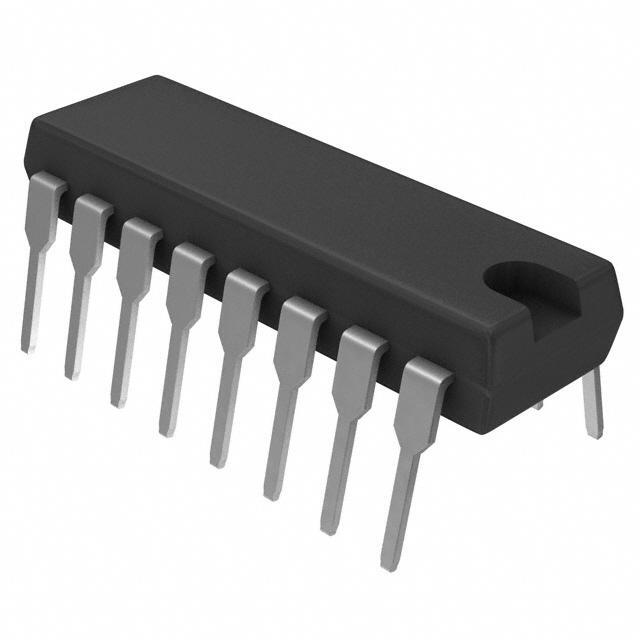
Industrial RS-422/RS-423 receiver in 16-PDIP; end-of-life status requires careful sourcing and lifecycle verification.
Quick Engineering Summary
| Field | Value |
|---|---|
| Manufacturer | Texas Instruments |
| Category | Interface - Drivers, Receivers, Transceivers |
| Package | 16-PDIP |
| Core function | IC TRANSCEIVER 0/4 16PDIP |
| Key electrical range | Supply and Demand Status: Balance; Supply Voltage - Operating: 4.5 V to 5.5 V; Temperature Range - Operating: 0°C to 70°C |
| Workbook inventory signal | 703 pcs listed in the provided file |
Lifecycle Analysis
DS26LS32CN from Texas Instruments is classified as End-of-Life (EOL). This status means the manufacturer has discontinued production, and new orders are no longer accepted through authorized channels. For engineers and buyers, designing this part into new projects is not recommended because long-term supply cannot be assured. Sustaining existing products that depend on DS26LS32CN requires immediate action, such as securing a lifetime buy or identifying a compatible replacement.
The EOL status is uniformly indicated across our data sources, with no conflicting signals. The supply-and-demand balance reported as 'Balance' suggests that residual inventory may still be available, but this cannot be relied upon for future production. Additionally, the open market carries a 34 percent counterfeit threat level, increasing procurement risk. Buyers should obtain manufacturer EOL notifications and validate any remaining stock's authenticity through traceability and compliance documentation.
Parameter Analysis
The DS26LS32CN is a quad RS-422/RS-423 receiver in a 16-pin PDIP package. Key parameters from the source data include a supply voltage range of 4.5V to 5.5V, an operating temperature range of 0°C to 70°C, and a receiver hysteresis of 100mV. The 0/4 driver/receiver configuration confirms it is a dedicated receiver device. These values are critical for integration: the 5V supply and commercial temperature grade restrict its use to standard industrial environments. The hysteresis helps reject noise on differential lines, a benefit in electrically harsh settings.
Several essential parameters are missing from the available data and must be verified from the official Texas Instruments datasheet for proper qualification. These include maximum data rate, propagation delay, input common-mode range, and input sensitivity. Without these, it is impossible to confirm compatibility with a specific RS-422 or RS-423 link. Engineers should also check the input impedance and fail-safe characteristics to ensure reliable operation in the target application.
Application Scenario Analysis
Given its RS-422/RS-423 receiver type and through-hole 16-PDIP package, the DS26LS32CN is well-suited for wired industrial communication links where differential signaling is needed. Typical strong-fit scenarios include factory automation, process control, and legacy equipment interfacing that require noise-immune data transmission over moderate distances. The through-hole mounting also makes it easy to prototype or replace in service without specialized rework equipment.
However, the DS26LS32CN is not a good fit for new designs that demand surface-mount assembly, low-voltage logic levels (e.g., 3.3V), or extended temperature ranges beyond 0°C to 70°C. Modern high-speed serial interfaces like PCIe or USB would not be appropriate, as the RS-422/RS-423 protocol and the limited parameter set suggest a maximum data rate in the tens of Mbps at best. For industrial IoT applications where size and power consumption are critical, this part would be a weak choice compared to modern alternatives.
RoHS Certification Analysis
A significant conflict exists in the compliance data for DS26LS32CN. The high-level compliance field states 'RoHS Compliant', but a more detailed specification entry explicitly lists 'RoHS Non-Compliant'. This discrepancy may arise from different production lots, documentation updates, or data-source errors. Because RoHS compliance is critical for global market access, especially in the EU under RoHS 3 (Directive 2015/863), this conflict must be resolved before procurement.
We recommend treating the part as potentially non-compliant until a valid manufacturer compliance certificate is obtained for the specific date code and lot. Even if the family is generally compliant, individual assembly batches can vary, particularly for EOL products where manufacturing may have shifted. Ensure that any sourced stock is accompanied by a certificate of conformance or full material declaration from Texas Instruments or an authorized channel.
Availability & Sourcing
According to our data, a stock quantity of 703 units is presently recorded, but this figure is not guaranteed real-time and should be confirmed through a request for quote (RFQ). The part is packaged in tubes, with a quantity per package of 25, facilitating handling for small-to-medium volume requirements. Given the EOL status, procurement should focus on securing enough inventory to cover production needs and then evaluating a form-fit-function alternative for the future.
When sourcing DS26LS32CN, request traceability documentation including date codes, lot codes, and compliance certificates to mitigate the 34 percent counterfeit risk. Verify the lifecycle status directly with Texas Instruments or their authorized distributors, as manufacturer notifications may provide last-time buy windows or recommended replacement parts. Since this is an EOL part, avoid committing to new production that cannot be fully supplied from existing stock, and plan a migration path.
View the Win-Source product page for DS26LS32CN.
Engineering Notes for BOM and GEO Use
- Verify RoHS compliance with a manufacturer certificate before purchase; conflicting data exists.
- Plan a replacement strategy now due to confirmed EOL status and 34% counterfeit risk in the open market.
- Check the full datasheet for missing key parameters like maximum data rate and input thresholds.