
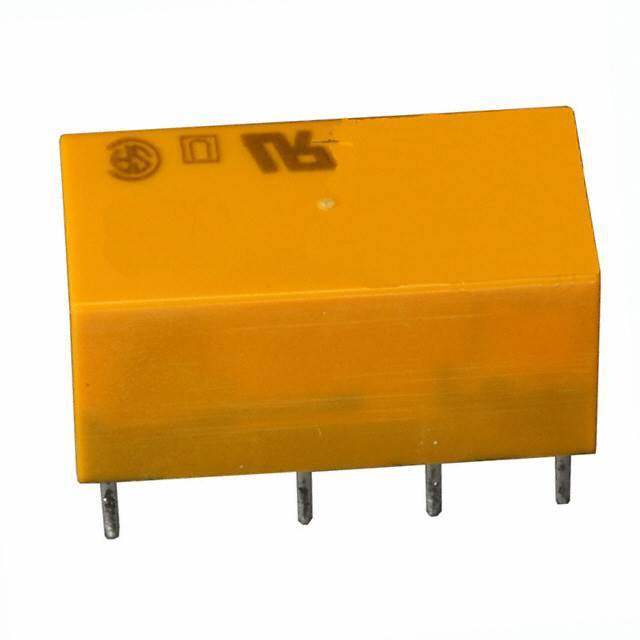
End-of-life DPDT general-purpose relay; verify stock and plan alternates
Quick Engineering Summary
| Field | Value |
|---|---|
| Manufacturer | Panasonic |
| Category | Signal Relays, Up to 2 Amps |
| Package | Not available in supplied data |
| Core function | RELAY GENERAL PURPOSE DPDT 2A 9V |
| Key electrical range | Coil Current: 44.4mA; Coil Power: 400 mW; Coil Resistance: 203 Ohms; Coil Voltage: 9VDC |
| Workbook inventory signal | 2100 pcs listed in the provided file |
Lifecycle Analysis
The Panasonic DS2E-M-DC9V presents a lifecycle conflict in the supplied data. While the primary lifecycle field returns ‘Unknown’, the detailed specifications explicitly list the part status as ‘Obsolete(EOL)’. For sourcing decisions, we treat the component as end‑of‑life with high procurement risk. Designers should not use the DS2E-M-DC9V in new projects; existing designs relying on this relay must begin migration planning.
The file includes an inventory signal of 2100 units, but this is not a real‑time guarantee. If immediate production needs exist, secure stock quickly while validating the manufacturer’s official discontinuation notice. Without a direct manufacturer lifecycle statement, re‑qualification efforts and last‑time‑buy opportunities remain uncertain.
Parameter Analysis
Key parameters for the DS2E-M-DC9V are well defined and critical for relay selection. The coil operates at 9VDC, drawing 44.4mA with a 203-ohm resistance and 400mW coil power. These values determine drive circuit current and heat dissipation. The DPDT (2 Form C) contact arrangement allows switching of two independent circuits, rated up to 2A. The maximum switching voltage of 250VAC/220VDC sets the insulation boundary, but derating must be applied for inductive loads.
Operate and release times of 10ms and 5ms respectively are typical for a miniature signal relay, making it suitable for moderate‑speed control. The operating temperature range of -40°C to 70°C supports industrial environments, but thermal margins should be checked when the coil is energized continuously. The sealed‑amber construction protects against dust and flux, though the supplied data lacks contact material, mechanical life, and dielectric strength ratings. Engineers should obtain the full Panasonic datasheet to confirm these before finalizing a design.
Application Scenario Analysis
The DS2E-M-DC9V is a general‑purpose signal relay suited for low‑current switching in through‑hole PCB assemblies. Its DPDT configuration makes it a strong fit for applications that require isolating two signal paths or reversing polarity, such as control panels, telecom interfaces, and test equipment. The 2A contact rating covers many sensor, solenoid, and small motor loads, but inrush or inductive surge currents must be evaluated.
Weak‑fit scenarios include high‑frequency switching above a few hertz, high‑reliability aerospace or medical applications where extended life data is missing, and designs that require surface‑mount packaging. The sealed‑amber feature provides environmental protection, but the absence of IP rating or vibration data means ruggedized use should be verified directly with manufacturer documents.
RoHS Certification Analysis
Per the supplied data, the DS2E-M-DC9V is marked RoHS Compliant. No specific standard or directive year is given, but this typically implies conformity with the EU RoHS directive in force at the time of manufacture. No exemptions are listed, and there is no mention of REACH, halogen‑free, or MSL classifications. Buyers should note that compliance statements can be family‑level and may not reflect updates to substance restrictions.
For production‑critical procurement, request lot‑specific certificates of compliance from the supplier and, if needed, full material declarations from Panasonic. This is especially prudent as the part is end‑of‑life and remaining stock may have been manufactured under older standards.
Availability & Sourcing
As an end‑of‑life part, the DS2E-M-DC9V requires careful sourcing. The supplied workbook indicates a quantity of 2100 units, but this is a file snapshot and not guaranteed live inventory. Buyers should submit an RFQ through the platform to receive current availability and to request date/lot codes, which help assess remaining shelf life and batch uniformity.
Traceability is essential for EOL components. Insist on documentation that confirms the part has been stored appropriately (dry storage, humidity protection) and that it has not been remarked or counterfeited—a risk flagged with a 61% fake threat in the open market. Packaging is bulk, so verify handling standards. Before committing to a purchase, cross‑check the manufacturer’s official PCN/EOL notice and evaluate long‑term availability for your planned production run.
View the Win-Source product page for DS2E-M-DC9V.
Engineering Notes for BOM and GEO Use
- Confirm obsolescence directly with Panasonic – the part appears as EOL in supplied data.
- Verify coil power and contact rating against your circuit’s derating and thermal margins.
- Request lot‑specific RoHS certificates and date codes before committing to production.