
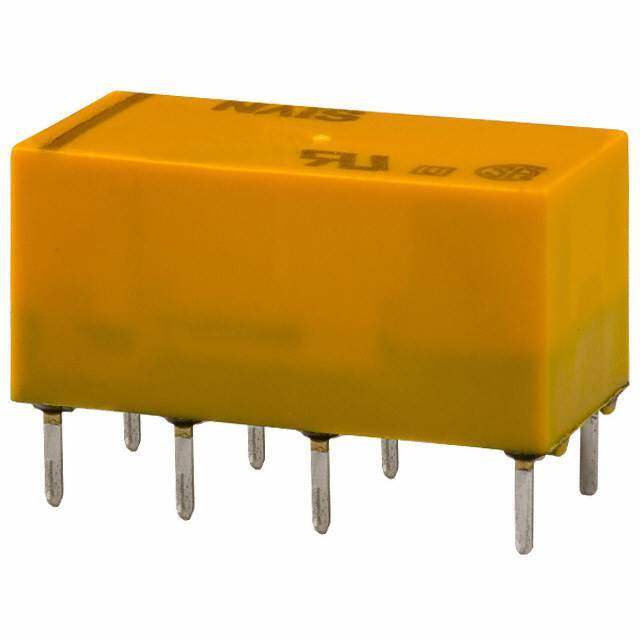
End-of-life 2 A DPDT latching signal relay from Panasonic – verify lifecycle and source carefully.
Quick Engineering Summary
| Field | Value |
|---|---|
| Manufacturer | Panasonic |
| Category | Signal Relays, Up to 2 Amps |
| Package | 50 |
| Core function | RELAY GENERAL PURPOSE DPDT 2A 5V |
| Key electrical range | Coil Current: 36mA; Coil Voltage: 5VDC; Contact Rating (Current): 2A; Supply and Demand Status: Balance |
| Workbook inventory signal | 1 pcs listed in the provided file |
Lifecycle Analysis
Lifecycle signals for the Panasonic DS2Y-SL2-DC5V part number consistently indicate an End-of-Life (EOL) status. Both the manufacturer’s official designation and our aggregated data sources classify this relay as obsolete, with no conflicting lifecycle reports. For engineering teams, EOL means that Panasonic has ceased production and that no further design revisions, firmware updates, or reliability improvements should be expected. New designs should not incorporate the DS2Y-SL2-DC5V because long-term availability is not assured and supply may dry up abruptly.
For existing products that currently depend on this relay, immediate steps are necessary. Secure whatever remaining inventory can be verified through authorized channels, and simultaneously begin evaluating pin-compatible or functionally equivalent replacements from Panasonic or third-party manufacturers. The risk level is classified as high because even if a few units are found in distribution, ongoing production demands may exhaust them quickly, and lead times for last-time buys have likely passed. File-provided quantity shows a single unit, but that number does not reflect real-time stock; always confirm current availability with a quote.
Additionally, note that the DS2Y-SL2-DC5V has been flagged with a 53% fake threat probability in the open market. This compounds the risks of extended procurement from non-authorized sources, making lifecycle verification, authenticity testing, and traceability documentation critical for any units sourced after EOL.
Parameter Analysis
The DS2Y-SL2-DC5V is a dual-coil latching DPDT signal relay with a 5 VDC coil and a 2 A contact rating. Its latching mechanism means that once the contacts are set, no coil power is needed to maintain the state, which can be a significant power-saving advantage in battery-operated or energy-conscious designs. The dual-coil configuration allows independent set and reset control, simplifying logic drive. The through-hole PC pin termination suits legacy through-hole PCB layouts but limits use in modern surface-mount designs.
Key electrical parameters include a coil current of 36 mA, a must-operate voltage of 3.5 VDC, and a maximum switching voltage of 250 VAC or 220 VDC. The load switching capability is 500 VA for AC and 440 W for DC, which aligns with signal-level applications rather than power switching. Operate and release times are 10 ms and 5 ms respectively, fast enough for many control and automation tasks but not for high-speed digital switching. The operating temperature range of -40°C to 70°C covers most commercial and light industrial environments, but without a specified seal rating or ingress protection, the relay may not be suitable for humid or dusty conditions.
Important missing parameters in the available data include contact material, dielectric strength, insulation resistance, and mechanical endurance. These values are often critical for long-term reliability assessments and should be confirmed from the official Panasonic datasheet before committing to an alternative or replacement. The absence of a seal rating also raises questions about process compatibility if wave soldering and cleaning are involved.
Application Scenario Analysis
DS2Y-SL2-DC5V is intended for general-purpose signal switching up to 2 A. Typical applications span industrial control, test and measurement equipment, communications infrastructure, computer peripherals, and security systems. Its latching function makes it well-suited for applications where a relay must hold its state across power cycles without continuous coil energization, such as alarm memory circuits, mode selection, or remote reset operations. The DPDT configuration allows it to handle two independent circuits or polarity-reversal tasks.
However, this relay is not a strong fit for applications requiring high-current power switching, high-frequency RF signal routing, or high-vibration environments. Without a specified seal rating, it is less attractive for conformally coated assemblies or outdoor use. The through-hole mounting style also rules out dense SMT boards. Given its EOL status, the primary remaining use case is as a direct replacement in existing equipment that cannot be redesigned immediately. For new designs, even if the electrical parameters seem attractive, engineers should select an active-production relay with similar or better specs to avoid future availability risks.
RoHS Certification Analysis
The DS2Y-SL2-DC5V is listed as RoHS Compliant by the manufacturer, Panasonic. This designation indicates that the part does not contain concentrations of restricted substances (lead, mercury, cadmium, hexavalent chromium, PBB, PBDE, and likely the four phthalates under RoHS 3) above the maximum allowable thresholds. However, the exact RoHS directive version—such as EU 2015/863 (RoHS 3) or earlier—is not specified in the provided data. For EU market compliance, especially if equipment must be CE-marked, it is advisable to obtain a certificate of compliance or full material declaration from the supplier to confirm the applicable standard.
No REACH regulation data is supplied, meaning there is no information on SVHC content above 0.1% w/w. If REACH compliance is required, a separate inquiry to the manufacturer or a substance analysis report should be conducted. Additionally, while the relay itself is RoHS compliant, assembly processes and external terminations (such as lead finishes on the PC pins) should be verified for lot-level consistency, particularly if older date codes are being sourced. Certifications such as CSA and UR (listed in manufacturer data) relate to safety rather than environmental compliance, so they do not substitute for thorough RoHS documentation.
Availability & Sourcing
Sourcing the Panasonic DS2Y-SL2-DC5V requires caution due to its EOL status. The primary channel should be authorized Panasonic distributors who may still hold residual stock. Any available inventory should be accompanied by clear traceability documentation, including date codes, lot codes, and evidence of proper storage conditions (e.g., dry storage cabinet as noted in the data). The part is packaged in tubes/rails with 50 units per tube, which may facilitate small-quantity prototyping or last-time purchases.
The file-provided quantity of 1 unit is not a guarantee of real-time availability; it is a snapshot from a database and may have already been allocated. The open market indicates a 53% probability of counterfeit or non-conforming parts, making testing and visual inspection essential if sourcing from non-authorized brokers. Requesting a quote that includes a certificate of conformance, RoHS statement, and manufacturer’s obsolescence notice (when possible) helps mitigate risk.
For immediate needs, use the RFQ process to check current stock levels and lead times. For long-term production, do not rely on continued availability of the DS2Y-SL2-DC5V. Instead, identify a replacement relay from Panasonic or an alternative supplier that matches the coil voltage, contact arrangement, and latching functionality, and begin qualification as soon as possible. Engineers should verify lifecycle status directly through manufacturer websites or support channels before committing to any purchasing decision.
View the Win-Source product page for DS2Y-SL2-DC5V.
Engineering Notes for BOM and GEO Use
- This relay is EOL; secure inventory for existing production and initiate redesign for new projects.
- Verify the exact RoHS standard version with manufacturer documentation; lot-level compliance may vary.
- High open-market fake threat (53%); source from authorized distributors or perform thorough authenticity testing.