
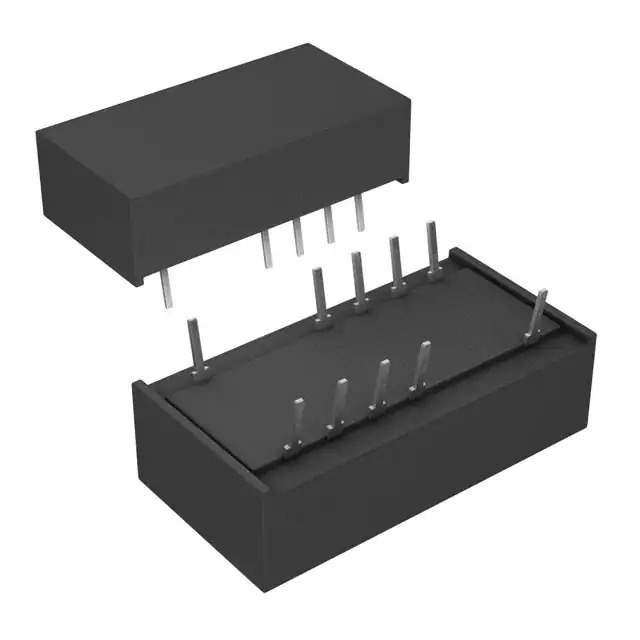
Discontinued 32.768 kHz TCXO in 14-DIP through-hole package from Maxim Integrated.
Quick Engineering Summary
| Field | Value |
|---|---|
| Manufacturer | Maxim Integrated |
| Category | Oscillators |
| Package | Tube |
| Core function | XTAL OSC TCXO 32. |
| Key electrical range | Current - Supply (Max): 220µA; Frequency: 32.768 kHz; Frequency Stability: ±7.5ppm; Output: CMOS |
| Workbook inventory signal | 270 pcs listed in the provided file |
Lifecycle Analysis
The DS32KHZ/DIP is officially Discontinued by Maxim Integrated, placing it in a high-risk category for procurement and design. A Discontinued lifecycle status means the manufacturer has ceased production, and no additional units will be manufactured. Technical support, documentation updates, and failure analysis are no longer provided. This part is unsuitable for new designs and should only be considered for sustaining existing production if absolutely necessary.
For systems still depending on the DS32KHZ/DIP, immediate action is required. Examine the bill of materials to quantify exposure and initiate a last-time buy if any authorized stock remains. The file-provided quantity of 270 units is not a live inventory figure and cannot be relied upon for planning; always request a current quote and lead time from authorized sources.
Given the reported 54% fake threat in the open market, sourcing from unauthorized channels carries significant risk. Counterfeit components may exhibit out-of-spec frequency stability, incorrect output levels, or early failure. Always verify date codes, lot traceability, and manufacturer certificates when procuring discontinued parts.
Parameter Analysis
The DS32KHZ/DIP operates at a nominal frequency of 32.768 kHz, the standard timing frequency for real-time clocks and microcontroller sleep timers. Its TCXO (Temperature Compensated Crystal Oscillator) architecture provides ±7.5 ppm frequency stability over the 0°C to 70°C commercial temperature range. This level of stability is suitable for applications requiring accurate timekeeping without external trimming, such as data loggers or industrial controllers.
Key specifications include a 5V supply voltage with a maximum current consumption of 220 µA, making it compatible with standard digital logic levels. The CMOS output ensures compatibility with common microcontrollers and peripheral circuits. The through-hole 14-DIP package (21.84 mm x 11.68 mm) is ideal for prototyping, legacy designs, or applications where rework is likely. The MSL Level 1 rating indicates no moisture sensitivity, simplifying storage and assembly.
Important parameters not fully specified in the available data include start-up time, long-term aging rate, phase noise, and output drive capability. Engineers should consult the original Maxim Integrated DS32KHZ datasheet for these details, particularly if the oscillator is used in applications sensitive to signal integrity or phase jitter. Verify that the operating temperature range aligns with the end-product's environmental requirements, as commercial-grade limits may not suffice for extended or industrial environments.
Application Scenario Analysis
The DS32KHZ/DIP is specifically designed for precision timing applications that demand a stable 32.768 kHz reference. Its strongest fit is in real-time clock (RTC) circuits, microprocessor clock generation, and timekeeping in embedded systems. For example, it can serve as a reliable clock source for data loggers, smart meters, and industrial controllers that require accurate time stamps during power outages or in always-on operation.
Due to its through-hole package, the DS32KHZ/DIP is well-suited for prototyping, test benches, and legacy equipment that cannot be redesigned for surface-mount components. It also fits maintenance and repair scenarios where the physical form factor must match an existing PCB layout.
Weak-fit scenarios include portable or battery-powered devices, where the 5V supply and 220 µA current draw may exceed power budgets. Additionally, applications requiring extended temperature ranges (beyond 0°C to 70°C) or high vibration/shock resistance are not recommended, as the DS32KHZ/DIP lacks specifications for these conditions. For modern high-density designs, the large DIP footprint is a drawback. Consider alternative SMD TCXOs or integrated RTC modules with onboard crystal for new projects.
RoHS Certification Analysis
According to the provided data, the DS32KHZ/DIP is RoHS Compliant, indicating that it meets the European Union's Restriction of Hazardous Substances Directive. This includes limits on lead, mercury, cadmium, and other substances. Additionally, the part is REACH Unaffected, confirming compliance with the EU's Registration, Evaluation, Authorisation and Restriction of Chemicals regulation.
Despite the broad compliance statement, discontinued parts present unique verification challenges. RoHS certificates are typically re-issued per production lot, and for a component no longer manufactured, suppliers may provide only a family-level compliance document. Engineers and buyers should request the specific Certificate of Conformance for any procured lot to ensure that the materials used in that batch meet current standards. Through-hole components historically used tin-lead finishes; therefore, verifying compliance is critical for CE marking and market access.
The MSL Level of 1 (Unlimited) simplifies handling and storage, as no special moisture protection is required. However, moisture sensitivity has no bearing on RoHS status. REACH compliance alone does not constitute RoHS compliance; both must be confirmed independently. When sourcing from brokers or aftermarket channels, require originals of compliance documents and consider third-party lab testing for high-volume or safety-critical applications.
Availability & Sourcing
Procurement of the DS32KHZ/DIP requires a cautious approach due to its Discontinued status and the high risk of counterfeit parts. The file-provided quantity of 270 units is not a real-time guarantee; availability must be confirmed by requesting a quote from a trusted supplier. Always specify the required date code or lot age, as older stock may suffer from solderability issues or parametric drift.
When sourcing, require full traceability documentation, including the manufacturer's original Certificate of Conformance, RoHS certificate, and test reports. Verify the packaging type — the standard package is Tube with 23 pieces per tube — and inspect for signs of resealing or mishandling. Request photographs of the actual stock before purchase to check markings and date codes against known good samples.
Given the commercial lifecycle and limited availability of direct replacements, parallel actions are recommended: secure the remaining DS32KHZ/DIP units for immediate production needs and initiate a redesign using an alternative TCXO. Engage with Maxim Integrated or authorized distributors for possible migration paths and last-time buy notices. For EOL parts, never rely on single-source broker inventory without thorough verification of authenticity and compliance.
View the Win-Source product page for DS32KHZ/DIP.
Engineering Notes for BOM and GEO Use
- Secure remaining inventory of DS32KHZ/DIP and validate authenticity given high open-market fake threat.
- Verify RoHS compliance documentation for lot-specific exemptions when sourcing discontinued parts.
- Evaluate drop-in replacement options and plan for redesign to avoid long-term obsolescence risk.