
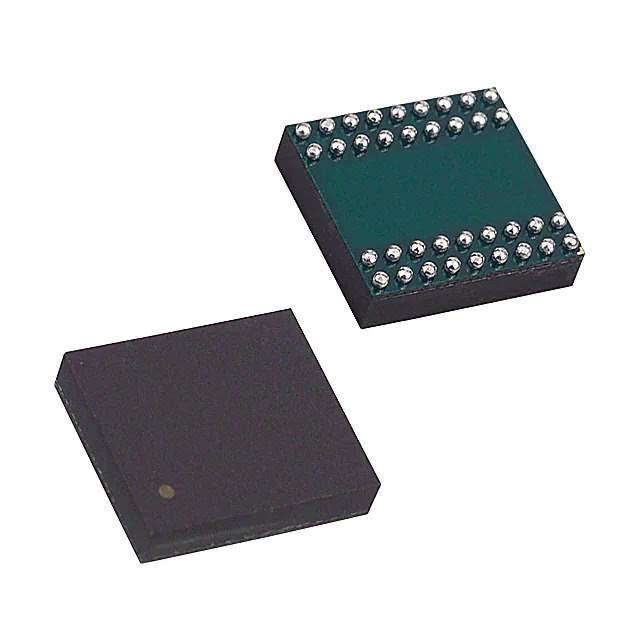
Discontinued TCXO oscillator – verify RoHS and stock carefully before procurement
Quick Engineering Summary
| Field | Value |
|---|---|
| Manufacturer | Maxim Integrated |
| Category | Oscillators |
| Package | Tray |
| Core function | XTAL OSC TCXO 32. |
| Key electrical range | Current - Supply (Max): 220µA; Frequency: 32.768 kHz; Frequency Stability: ±7.5ppm; Output: CMOS |
| Workbook inventory signal | 12444 pcs listed in the provided file |
Lifecycle Analysis
The DS32KHZ/WBGA is firmly discontinued by Maxim Integrated. Signals in the source data all point to end-of-life: the lifecycle status is ‘Discontinued,’ and parallel internal parameter fields also report EOL. There is no indication of a last-time-buy window, so engineering and procurement teams must assume that authorized channels have exhausted all remaining stock. For new designs, this part must not be considered; any new product introduction that relies on the DS32KHZ/WBGA carries unacceptable obsolescence risk.
For existing equipment that requires this exact TCXO, the path forward is limited. First, verify directly with Maxim Integrated whether any authorized distributors hold residual inventory or if a lifetime buy can still be honored. Without such confirmation, the only option is to source from independent distributors or excess inventory markets. That approach introduces additional risks around authenticity, storage conditions, and date codes, so each lot must be subjected to incoming inspection.
Given the high risk level, a migration strategy is strongly recommended. Identify an active, pin-compatible alternative or redesign the timing circuit around a current-production TCXO. If the DS32KHZ/WBGA is maintained as a field-repair part only, quantify the required quantity and secure it in a single transaction to avoid recurring search efforts.
Parameter Analysis
The DS32KHZ/WBGA provides a 32.768 kHz CMOS output from a 5V supply, with a tight frequency stability of ±7.5 ppm. This stability is the most critical performance parameter; it determines the long-term accuracy of any timekeeping function, such as an RTC or system clock. The 220 µA maximum supply current suggests moderate power consumption, which is acceptable for line-powered industrial or telecom applications but may be too high for battery-backed coin-cell designs that often demand sub‑µW clock references.
The CMOS output ensures easy interfacing with standard logic, and the surface‑mount 36‑BGA package requires careful PCB layout. The 11.43 mm × 10.16 mm footprint is relatively large by modern TCXO standards, so mechanical compatibility must be checked against the target board. The operating temperature range is 0°C to 70°C, limiting the part to commercial‑grade environments; it is not suitable for extended or industrial‑range applications without qualification testing.
Several important parameters are missing from the available dataset. Phase noise and jitter specifications are absent, yet they are critical for evaluating performance in communication or precision measurement systems. Aging rate, start‑up time, and load capacitance requirements are also not provided. Before integrating any remaining stock into a design, obtain the original Maxim Integrated datasheet and review these values to ensure they meet the application’s timing budget and noise margins.
Application Scenario Analysis
The DS32KHZ/WBGA is primarily intended as a precise reference oscillator for systems that require a stable 32.768 kHz clock. Classic strong‑fit scenarios include real‑time clock (RTC) circuits in telecom base stations, industrial controllers, and test instrumentation where maintaining accurate time over extended periods is essential. Its TCXO topology provides better stability than a simple XTAL oscillator, making it appropriate for applications that cannot tolerate the frequency wander of a standard crystal.
Weak‑fit or inappropriate use cases are those that demand low‑power operation or extended temperature ranges. The 5V supply voltage and 220 µA current draw are not suited for battery‑powered or energy‑harvesting devices, where sub‑1 µA oscillators are available. Furthermore, the 0°C–70°C rating makes the DS32KHZ/WBGA unsuitable for outdoor or automotive environments without additional thermal management. New designs that require a 32.768 kHz TCXO should consider active alternatives that offer wider temperature ranges and lower power.
Because the part is discontinued, any use case today is limited to sustaining legacy equipment. When supporting fielded products, engineers should first confirm that the oscillator’s stability and electrical timing characteristics match the original design requirements. Using a replacement TCXO with different start‑up behavior or phase noise could introduce subtle failures in communication synchronization or data logging.
RoHS Certification Analysis
RoHS compliance for the DS32KHZ/WBGA cannot be confirmed from the provided data. The source contains a direct conflict: one field states ‘RoHS Compliant,’ while the detailed specifications list ‘RoHS Non‑Compliant.’ This ambiguity is a serious procurement blocker, particularly when sourcing from non‑franchised channels. REACH status is listed as ‘REACH Unaffected,’ which is reassuring but does not substitute for RoHS verification.
In cases of contradictory RoHS data, the only reliable approach is to request a current, lot‑specific Declaration of Conformity from Maxim Integrated or the selling distributor. If the certificate cannot be provided, the part should be treated as non‑compliant for import/export and assembly line purposes. For repair operations that must meet RoHS‑exempt criteria (e.g., military or aerospace maintenance), additional documentation on exemption eligibility will be necessary.
Manufacturers often update compliance status across a product’s lifecycle, and a long‑discontinued item may have lost its original conformity ratings. Therefore, even if early production lots were compliant, later builds might not be. Engineering teams must not rely on datasheet markings or cached distributor web portals; they must obtain fresh compliance evidence for the specific batch being procured.
Availability & Sourcing
The DS32KHZ/WBGA is no longer in active production. A file‑provided quantity of 12,444 units is noted, but this is not a real‑time inventory guarantee and should be validated through a formal RFQ. Because the part is discontinued, all stock will come from remaining distribution or open‑market surplus. The risk of counterfeit components is significant; the data indicates a 37% fake threat in the open market, underscoring the need for rigorous incoming inspection.
When sourcing, demand traceability documentation including manufacturer date codes, lot numbers, and evidence of proper storage (MSL Level 4 requires baking before reflow if the moisture barrier is compromised). Procurement should be consolidated into a single transaction for the entire estimated lifetime quantity, as repeated buys are unlikely to succeed. Verify that the seller can provide the original Maxim Integrated packaging (Tray), though this may not be available for all lots.
Given the high risk and the RoHS compliance conflict, request a quote only after confirming that the offered stock is from an authorized or reputable excess-inventory supplier. For any lot that will be used in equipment shipped to the EU or other RoHS‑regulated markets, obtain a valid compliance certificate. If no compliant stock can be found, begin the migration to an alternative TCXO immediately.
View the Win-Source product page for DS32KHZ/WBGA.
Engineering Notes for BOM and GEO Use
- RoHS compliance data conflicts; obtain a manufacturer certificate before relying on this part for any design.
- Discontinued status means no new designs permitted; only legacy system maintenance qualifies for procurement.
- Open market counterfeit risk is elevated (37% fake threat); demand full traceability and lot codes with any order.