
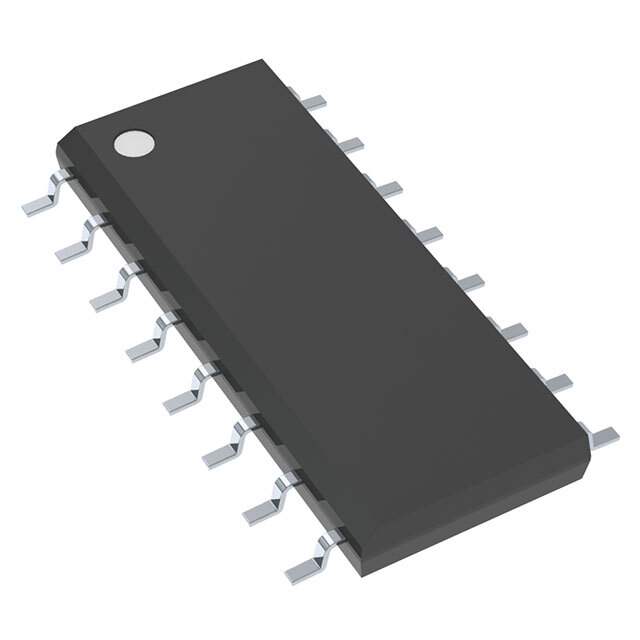
Active lifecycle and RoHS compliant interface receiver in 16-SOIC.
Quick Engineering Summary
| Field | Value |
|---|---|
| Manufacturer | Texas Instruments |
| Category | Interface - Drivers, Receivers, Transceivers |
| Package | 16-SOIC |
| Core function | IC TRANSCEIVER 0/4 16SOIC |
| Key electrical range | Supply and Demand Status: Limited; Supply Voltage - Operating: 4.5 V to 5.5 V; Temperature Range - Operating: -40°C to 85°C |
| Workbook inventory signal | 14320 pcs listed in the provided file |
Lifecycle Analysis
The DS34C86TM/NOPB is currently active according to manufacturer signals, meaning it is in full production with no planned discontinuation. Active status supports both new design starts and ongoing volume production without the need for qualification of alternative parts. All available lifecycle data—Excel parameter, lifecycle status field, and manual status flag—consistently point to Active, with no conflicts.
For sustained production, engineers should periodically revalidate lifecycle status through Texas Instruments’ product page or authorized distributors, as unexpected NRND or EOL notices can appear. The file‑provided inventory count of 14,320 units offers a snapshot of market depth but does not guarantee real‑time availability. For buffer calculations, treat this as a point‑in‑time reference and request a current quote for firm supply commitments.
Parameter Analysis
The DS34C86TM/NOPB is a quad receiver (0 drivers, 4 receivers) designed for RS‑422 and RS‑423 protocols, making it suitable for balanced and unbalanced differential signalling. Its specified supply voltage range of 4.5 V to 5.5 V aligns with legacy 5 V logic systems, and the -40 °C to 85 °C industrial temperature range ensures reliable operation across factory‑floor and outdoor telemetry applications.
Receiver hysteresis of 60 mV is a critical parameter for noise immunity; it determines the input threshold window that must be exceeded before an output transition occurs. In electrically noisy environments, this helps reject glitches, but designers should confirm it meets system‑specific input noise amplitude. Other key decision parameters include SMD mounting and the 16‑SOIC package, which provide a standardized footprint for automated assembly.
Important parameters missing from the supplied data include maximum data rate, propagation delay, input voltage range, and output logic levels. These must be verified against the latest Texas Instruments datasheet to ensure compatibility with UART or serial controller timing budgets. Similarly, verify output drive capability and short‑circuit protection if driving long cables.
Application Scenario Analysis
The DS34C86TM/NOPB is a strong fit for industrial automation systems that rely on RS‑422 or RS‑423 multidrop buses for long‑distance serial communication. Typical applications include factory floor data acquisition, PLC‑to‑actuator links, motor control feedback, and instrumentation networks requiring robust noise immunity and a 5 V supply rail. The 60 mV hysteresis and wide temperature range make it particularly suitable for harsh environments where electrical transients are common.
A weaker fit would be designs migrating to low‑voltage operating points (e.g., 3.3 V or 1.8 V) or requiring protocol options beyond RS‑422/RS‑423, such as RS‑485 transceivers with higher data rates and drive capability. Additionally, ultra‑compact designs may need smaller packages than the 16‑SOIC. For such scenarios, confirm whether pin‑compatible alternatives exist, though none are supplied in this sourcing guide. Always evaluate receiver input impedance and bus loading when deploying multiple nodes on a single RS‑422 line.
RoHS Certification Analysis
The DS34C86TM/NOPB is listed as RoHS Compliant, indicating that it does not contain the restricted substances above threshold levels as defined by the EU RoHS directive. While the exact revision is not specified in the supplied data, active components from Texas Instruments typically comply with RoHS 3 (EU 2015/863), which adds additional phthalate restrictions.
Compliance is asserted at the family or part‑number level; lot‑level verification is recommended for high‑reliability production, as raw‑material or process changes could introduce non‑compliance. Request a certificate of compliance from your distributor alongside your order, especially when shipping to EU markets.
Storage condition data recommends a dry storage cabinet and humidity‑protected packaging—while this relates to moisture sensitivity rather than RoHS, it reinforces the need for proper handling to maintain solderability. No REACH or halogen‑free statements appear in the provided specifications, so those remain unverified.
Availability & Sourcing
The DS34C86TM/NOPB is stocked by multiple distributors, with a file‑provided inventory of 14,320 units, though real‑time availability must be confirmed via RFQ as the data is not guaranteed live. The part is packaged in tubes/rails, standard for SOIC devices, and requires dry storage to maintain integrity—a consideration for long‑term inventory management.
Given its active lifecycle, the procurement workflow is straightforward: request a quote, verify compliance documentation (RoHS certificate, traceability records), and check date/lot codes for authenticity. The component carries a 60% fake threat rating in the open market, underscoring the importance of sourcing through authorized channels and avoiding unauthorized brokers. Always cross‑reference the Texas Instruments official sales page or franchised distributors to validate stock and lifecycle status.
For high‑volume production, negotiate lead times and request date‑code‑specific shipments. For spot buys, confirm that the supplier can provide full traceability back to the manufacturer. Contact Win‑Source or your preferred distributor to check current pricing and delivery for the DS34C86TM/NOPB.
View the Win-Source product page for DS34C86TM/NOPB.
Engineering Notes for BOM and GEO Use
- Verify 60mV receiver hysteresis is adequate for expected noise margins in the target RS-422/RS-423 bus environment.
- Confirm supply voltage range (4.5V–5.5V) matches system power architecture; consider derating for thermal conditions outside 25°C.
- Check datasheet for missing parameters like data rate, propagation delay, and input thresholds before finalizing board design.