
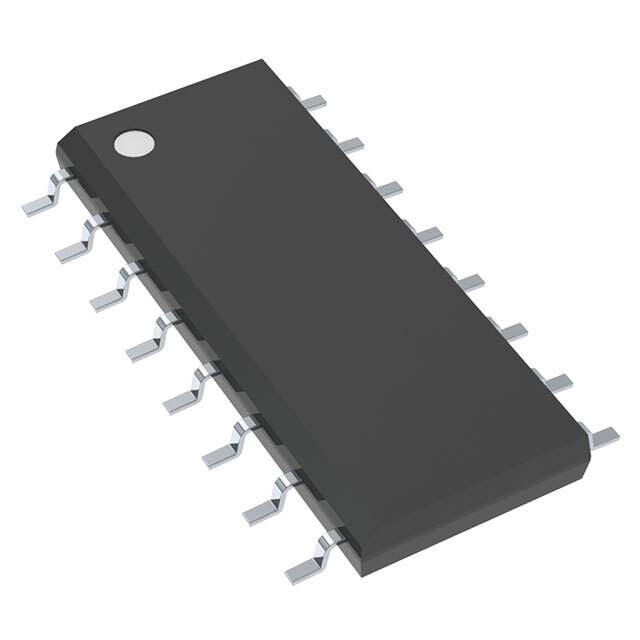
Active 3.3V RS-485 quad receiver with 35mV hysteresis – datasheet verification required for data rate and input common mode.
Quick Engineering Summary
| Field | Value |
|---|---|
| Manufacturer | Texas Instruments |
| Category | Interface - Drivers, Receivers, Transceivers |
| Package | 16-SOIC |
| Core function | IC TRANSCEIVER 0/4 16SOIC |
| Key electrical range | Supply and Demand Status: Balance; Supply Voltage - Operating: 3 V to 3.6 V; Temperature Range - Operating: -40°C to 85°C |
| Workbook inventory signal | 8020 pcs listed in the provided file |
Lifecycle Analysis
Texas Instruments lists the DS34LV86TM/NOPB as an Active lifecycle part. An Active status indicates the component is in full production, with manufacturer support for both new designs and ongoing volume manufacturing. There are no conflicting lifecycle signals in the source data, which simplifies procurement planning. From a design-in perspective, Active parts carry low risk and are typically available with standard lead times.
For sustaining production, the Active designation means no immediate need to qualify a substitute. However, it is still prudent to monitor the manufacturer's product change notifications (PCNs) for any future end-of-life announcements. File-provided inventory data shows a stock quantity of 8020 units; this is a snapshot and not a live inventory commitment. Engineers should confirm real-time availability and factory lead times with authorized distributors when building production schedules.
Parameter Analysis
Key parameters extracted from the datasheet summary define the DS34LV86TM/NOPB's operational envelope. The supply voltage range of 3V to 3.6V allows direct connection to 3.3V logic systems, reducing level-shifting complexity. The 35mV receiver hysteresis (typical) enhances noise immunity in RS-422 and RS-485 differential signaling, preventing output chatter in electrically noisy industrial environments. With zero drivers and four receivers, the DS34LV86TM/NOPB is solely a receiving device, simplifying system design for multi-drop bus applications where only data reception is needed. The operating temperature range of -40°C to 85°C covers most industrial and extended commercial applications.
Missing from the provided specification are several critical parameters that influence design decisions. The data rate is not listed; RS-485 transceivers commonly support speeds from hundreds of kbps to tens of Mbps, and selecting a receiver with insufficient bandwidth will corrupt communication. The input common-mode voltage range is unspecified; RS-485 networks can develop large ground potential differences, and the receiver must tolerate −7V to +12V typical ranges. Additionally, ESD ratings and input impedance are absent. Engineers must consult the official Texas Instruments datasheet for these values to ensure the device meets the reliability and performance requirements of the target application.
Application Scenario Analysis
As a quad RS-422/RS-485 receiver, the DS34LV86TM/NOPB fits securely into industrial communication backbones. It is well-suited for receiving data in factory automation networks, building management systems, and remote sensor interfaces where differential signaling provides robustness against electromagnetic interference. The device's 3.3V operation aligns with modern microcontrollers and FPGAs, making it a direct fit for embedded control and data acquisition systems. Its specified application field mentions power management and sensing & instrumentation, suggesting use in energy monitoring, battery management, and precision analog front-ends that require reliable digital communication.
There are scenarios where the DS34LV86TM/NOPB may not be the optimal choice. Since data rate is not listed, it may be unsuitable for high-speed RS-485 links exceeding 10 Mbps, common in some real-time control or video surveillance systems. As a pure receiver, it cannot terminate or drive a bus, so it must be paired with separate driver ICs (like the DS34LV87T) for bidirectional communication. The 69% fake threat rate in the open market indicates that applications requiring high-reliability sourced parts should avoid gray market channels and insist on full traceability.
RoHS Certification Analysis
The DS34LV86TM/NOPB is documented as RoHS Compliant. This status typically indicates conformity with European Union directives restricting hazardous substances such as lead, mercury, cadmium, and hexavalent chromium. The NOPB suffix commonly denotes a lead-free finish, reinforcing the environmental compliance profile. In the absence of explicit references to REACH or halogen-free claims in the source data, procurement teams should request the manufacturer's full material declaration if these additional compliances are required for product registration or end-market certification.
It is important to note that RoHS compliance can be declaration-based at the part family level. For lot-specific assurance, especially in regulated industries like medical or aerospace, a certificate of conformance or analytical test report from Texas Instruments should be obtained. The source data does not mention any RoHS exemptions (such as lead in glass frit or high-melting-temperature solder), so engineers should verify whether these apply if the device is used in equipment subject to stricter waste directives.
Availability & Sourcing
File-provided inventory data indicates a stock quantity of 8020 units for the DS34LV86TM/NOPB, with a balanced supply-and-demand status. This suggests reasonable near-term availability, but these figures are not real-time and should be confirmed through a request for quote (RFQ) with authorized distributors. The device is packaged in tubes suitable for automated SMD assembly, and storage conditions recommend dry storage and humidity protection, which aligns with industry-standard MSL handling for SOIC packages.
Despite the Active lifecycle and apparent stock, the 69% fake threat percentage in the open market is a significant sourcing concern. Buyers should source exclusively from Texas Instruments' authorized distribution network and insist on full lot-code traceability and date-code verification. For production-critical applications, consider requesting third-party test labs for electrical verification on sample lots. Since the part is Active, standard procurement processes apply, but verifying lead times and obtaining compliance documentation (RoHS, REACH, conflict minerals) alongside the quote will mitigate supply chain risk.
View the Win-Source product page for DS34LV86TM/NOPB.
Engineering Notes for BOM and GEO Use
- Verify receiver input common-mode range from the datasheet to ensure compatibility with your RS-485 bus voltage levels.
- The 35mV typical hysteresis helps reject low-level noise; assess whether your system requires additional filtering for harsh environments.
- With a reported 69% fake threat rate, mandate authorized Texas Instruments distribution and full lot-level traceability.