
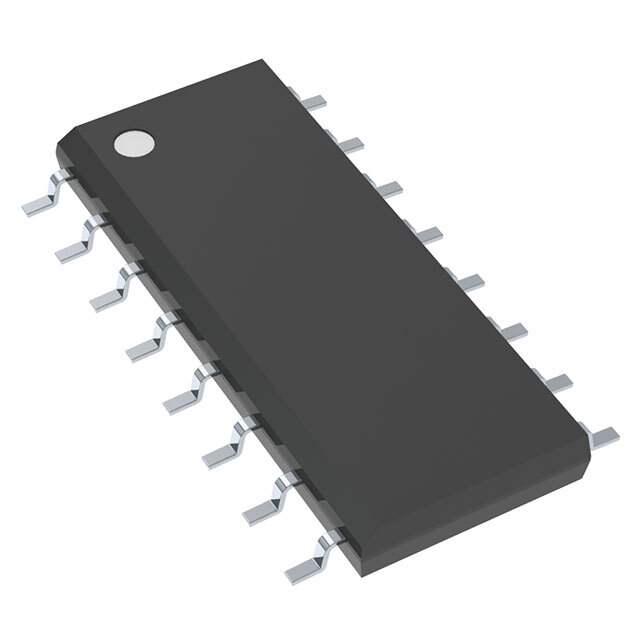
EOL RS422/RS485 quad driver, 3.3V, -40 to 85°C, 16-SOIC. Verify lifecycle and source through authorized channels.
Quick Engineering Summary
| Field | Value |
|---|---|
| Manufacturer | Texas Instruments |
| Category | Interface - Drivers, Receivers, Transceivers |
| Package | 16-SOIC |
| Core function | IC TRANSCEIVER 4/0 16SOIC |
| Key electrical range | Supply and Demand Status: Limited; Supply Voltage - Operating: 3 V to 3.6 V; Temperature Range - Operating: -40°C to 85°C |
| Workbook inventory signal | 16015 pcs listed in the provided file |
Lifecycle Analysis
The DS34LV87TM from Texas Instruments is classified as End-of-Life (EOL). This status indicates that the manufacturer has discontinued production, and no new orders are being accepted for ongoing supply. The EOL designation carries a high risk for new designs; engineers and buyers should not specify this part for new products. For existing production lines, immediate action is required to secure remaining inventory and plan a migration to an alternative part.
All lifecycle signals in the provided data align on EOL, including the manufacturer's lifecycle status parameter and Excel row status. There are no conflicting signals. With a reported fake threat rate of 38% in the open market, procurement teams must be vigilant to avoid counterfeit components. It is recommended to verify EOL notifications and last-time-buy dates directly with Texas Instruments, as no official dates are included in this data set.
Although the workbook indicates a quantity of 16,015 units, this is a file-provided snapshot and not a real-time inventory guarantee. These units may represent remaining distributor stock or last-time-buy allocation. Given the EOL status, treat any available stock as non-replenishable, and prioritize immediate purchase if needed for sustainment.
Parameter Analysis
The DS34LV87TM is a quad driver IC supporting RS422 and RS485 differential signaling protocols, with a 4/0 driver/receiver count—meaning it contains four drivers and no receivers. This configuration limits its use to transmit-only applications unless paired with a separate receiver. The supply voltage operating range is 3 V to 3.6 V, which suits 3.3V nominal systems but requires careful voltage regulation to stay within the narrow tolerance band, especially in noisy industrial environments.
The operating temperature range of -40°C to 85°C indicates industrial-grade capability, making it suitable for extended temperature applications. The 16-SOIC package (surface-mount) is a widely used footprint, simplifying PCB layout, but thermal considerations are moderate given the low driver count and typical power dissipation. Key missing parameters that should be verified from Texas Instruments’ datasheet include data rate, propagation delay, output voltage levels, and ESD protection ratings. These values are critical for signal integrity at high speeds and for system-level compliance.
For procurement, the narrow supply voltage and lack of receiver functionality mean alternatives must match these constraints. Confirm pin-to-pin compatibility if a substitution is being evaluated, as the DS34LV87TM may have vendor-specific pinouts not explicitly stated here.
Application Scenario Analysis
Based on its RS422/RS485 protocol support and quad-driver configuration, the DS34LV87TM is typically used in industrial communication interfaces where multi-drop differential signaling is required, such as factory automation, process control, and instrumentation networks. The 3.3V supply voltage aligns it with low-power embedded systems, though many industrial buses still use 5V, so level translation may be needed in mixed-voltage designs.
It is a strong fit for applications needing only transmission functionality, such as sensor data broadcasting or master nodes in a bus architecture where separate receivers handle inbound data. However, it is a weak fit for full-duplex or bidirectional communication systems that require integrated transceivers; in those cases, a transceiver with both drivers and receivers (e.g., 4/4 or 1/1) would be more appropriate. The part is not suited for high-speed protocols beyond the typical RS485 limits (generally up to 10-50 Mbps depending on cable length), and missing data rate specs prevent precise matching without datasheet verification.
The “Used in Power Management, Sensing & Instrumentation” application field aligns with its use in monitoring and control, but actual deployment should be validated against system requirements for noise immunity, common-mode voltage range, and fail-safe biasing, which are not specified in this sourcing data.
RoHS Certification Analysis
The DS34LV87TM is listed as RoHS Compliant according to the provided data. This indicates that, at the time of manufacture, the part met the European Union’s Restriction of Hazardous Substances Directive, likely under RoHS 2 (2011/65/EU) or the earlier standard. However, no specific RoHS exemption list is supplied, and it is advisable to verify compliance with the latest RoHS 3 (EU 2015/863) which added four phthalates, especially if the part was manufactured before 2019.
Without REACH or halogen-free declarations in the data, procurement teams should request a full material declaration from Texas Instruments or an authorized distributor to confirm SVHC (Substances of Very High Concern) content and any applicable exemptions. Lot-level RoHS certificates can mitigate risk, particularly given the EOL status and potential for older date codes to predate stricter regulations.
Because RoHS compliance is typically manufacturer-declared and not independently verified per batch in this dataset, buyers should include a compliance clause in purchase agreements and consider independent testing for critical applications. The file-provided inventory may consist of mixed-date-code stock, further warranting batch-specific documentation.
Availability & Sourcing
With an EOL lifecycle status, availability of the DS34LV87TM is limited and non-replenishable. The workbook reports a quantity of 16,015 units, but this is a file-provided snapshot and not a real-time stock level. Buyers should immediately request a quote to confirm current availability and secure the necessary quantity for production sustainment. Given a supply and demand status of ‘Limited’ and a high counterfeit risk (38%), sourcing from unauthorized channels is strongly discouraged.
The part is commonly used and popular, which increases the likelihood of aftermarket and gray-market activity. To ensure authenticity, insist on full traceability with manufacturer date/lot codes, and request compliance documentation including RoHS certificates and certificates of conformance. Packaging is specified as reel (TR), but verify actual reel or tube format to match assembly requirements. Storage conditions are noted as dry storage cabinet with humidity protection, indicating MSL sensitivity—request MSL level and vacuum-sealed packaging to prevent moisture damage during storage.
For new designs, do not use the DS34LV87TM; instead, evaluate alternative active parts from Texas Instruments or other suppliers. For existing designs, once inventory is secured, initiate a redesign to replace the component before last-time-buy stock is exhausted. Always verify EOL notifications directly with the manufacturer and incorporate lifecycle verification checkpoints into the procurement process.
View the Win-Source product page for DS34LV87TM.
Engineering Notes for BOM and GEO Use
- The DS34LV87TM is an EOL part with a high counterfeit risk (38%); source only from authorized distributors.
- Verify actual lifecycle and last-time-buy dates directly with Texas Instruments before committing to production.
- Ensure 3.3V supply and RS422/RS485 signal integrity in your design; the device is a 4/0 driver, so external receivers are needed for full transceiver functionality.