
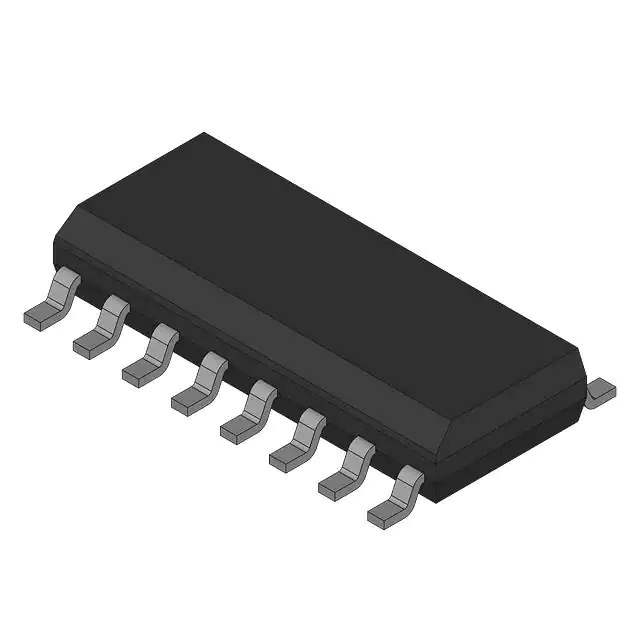
Discontinued Quad Receiver – Verify Lifecycle, RoHS, and Authenticity
Quick Engineering Summary
| Field | Value |
|---|---|
| Manufacturer | National Semiconductor (TI) |
| Category | Interface - Drivers, Receivers, Transceivers |
| Package | Bulk |
| Core function | IC TRANSCEIVER 0/4 16SOIC |
| Key electrical range | Voltage - Supply: 4.75V ~ 5.25V |
| Workbook inventory signal | 1 pcs listed in the provided file |
Lifecycle Analysis
The DS3650MX from National Semiconductor (TI) has been discontinued. Multiple lifecycle signals—EOL, Discontinued, and Discontinued product status—indicate this part is no longer in active production. For new designs, selection of the DS3650MX is not recommended; engineers should evaluate alternative active receiver ICs with compatible footprints and electrical characteristics.
For existing production lines that rely on the DS3650MX, procurement teams must treat remaining inventory as a last-time buy opportunity. Any available stock should be secured quickly, and lifecycle documentation should be revalidated directly with the manufacturer or authorized distributors to confirm no late-stage revisions exist. File-based inventory data shows a limited quantity, but real-time availability must be confirmed via a request for quote.
Conservative sourcing is critical because discontinuation may affect long-term support and traceability. Verify that any sourced DS3650MX parts carry recent date codes and are not reclaimed or counterfeit. Correlate the part number with the manufacturer’s product change notification (PCN) and end-of-life notice to avoid unexpected obsolescence issues in fielded systems.
Parameter Analysis
Despite limited available specifications, several parameters define the DS3650MX’s fit for legacy designs. The device is configured with 0 drivers and 4 receivers, making it a dedicated quad receiver rather than a full transceiver, as indicated by the Type field listing “Receiver.” Supply voltage is specified as 4.75V to 5.25V, requiring a stable 5V rail with tight tolerance. The 16-SOIC surface-mount package (3.90mm width) is standard for many interface ICs, but careful PCB layout consideration is necessary to maintain signal integrity, especially if used in noisy environments.
Critical missing parameters from the available data include data rate, propagation delay, input logic thresholds, and maximum operating temperature. Before integrating the DS3650MX into a design, engineers should consult the original manufacturer’s datasheet for these values and verify that the receiver input levels are compatible with the driving logic. Additionally, the mounting type is surface mount, so thermal and mechanical stress during soldering should be considered, particularly for rework on legacy boards. Lack of detailed electrical characteristics means design validation must rely on original documentation.
Application Scenario Analysis
Given its configuration as a 4-channel receiver, the DS3650MX likely served in legacy industrial or communication systems requiring 5V signaling and multiple receiver channels. Strong-fit scenarios include replacing a failed DS3650MX on existing boards within sustained-production equipment, such as instrumentation, protocol converters, or legacy telecom line cards. The 5V supply aligns with older TTL or CMOS logic levels, making it suitable for systems that have not migrated to lower-voltage interfaces.
Weak-fit scenarios include any new design that demands high-speed data transfer, wide supply range, or support for modern protocols; the missing data rate specification suggests the DS3650MX may not meet contemporary performance requirements. Similarly, applications requiring RoHS certification for new products may be incompatible if the lot is non-compliant. Engineers should restrict use of the DS3650MX exclusively to maintenance of legacy systems where a drop-in replacement with identical electrical and footprint characteristics is essential.
RoHS Certification Analysis
RoHS compliance for the DS3650MX is ambiguous. The source data contains conflicting information: one compliance field states “RoHS Compliant,” while the specifications list “RoHS Status: RoHS Non-Compliant.” This discrepancy necessitates lot-level verification before procurement. Engineers should not assume compliance based on the declaration alone; physical inspection of the device marking or testing may be required. In the European Union and other RoHS-regulated markets, non-compliant parts cannot be used in new designs, so confirming the actual status is essential.
No REACH or halogen-free data is provided, so if compliance with those standards is required, additional documentation must be requested from the supplier. The 16-SOIC package often uses lead-free finishes for compliant versions, but without explicit lot tracking, each purchase of the DS3650MX should be treated as potentially non-compliant. Request certificates of conformance that reference the specific production lot and date code to resolve the conflict.
Availability & Sourcing
The Win Source file lists a stock quantity of 1 unit for the DS3650MX, but this is a static snapshot and does not represent guaranteed real-time availability. With a high fake threat score of 55% in the open market, sourcing this discontinued part demands rigorous inspection. Buyers should request a quote to confirm current inventory, lead time, and exact packaging—whether bulk or in standard 2,500-piece reels.
Given the discontinued status, procurement should focus on securing sufficient quantity to cover the projected lifespan of the supported system. Always verify lifecycle status with the manufacturer and request compliance documentation. Insist on traceability and consider third-party testing for authenticity if sourcing from non-authorized channels. The supplier’s ability to provide CoCs and test reports for the DS3650MX will be a key decision factor.
View the Win-Source product page for DS3650MX.
Engineering Notes for BOM and GEO Use
- Verify RoHS compliance per production lot; conflicting data requires physical inspection.
- Not recommended for new designs; source only to support legacy systems with verified authentic stock.
- High open-market counterfeit risk (55% probability); insist on traceable lot codes and full documentation.