
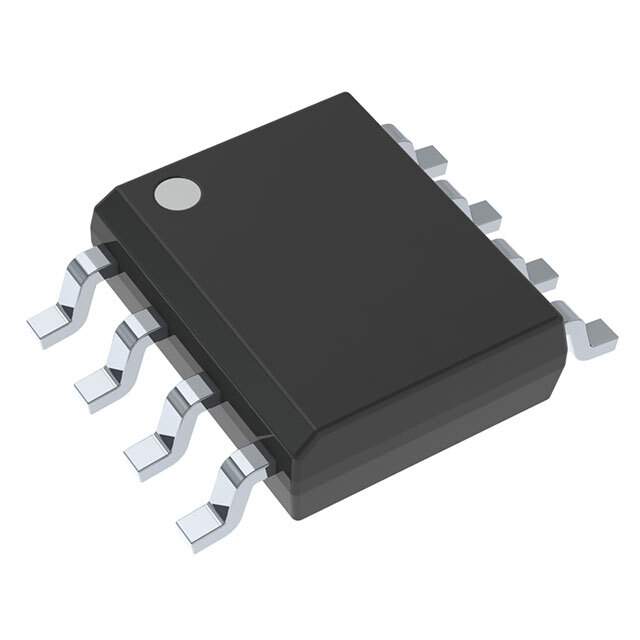
EOL RS-485 Transceiver from Texas Instruments – Verify Lifecycle and Availability
Quick Engineering Summary
| Field | Value |
|---|---|
| Manufacturer | Texas Instruments |
| Category | Interface - Drivers, Receivers, Transceivers |
| Package | 8-SOIC |
| Core function | IC TRANSCEIVER HALF 1/1 8SOIC |
| Key electrical range | Operating Temperature Range: 0°C ~ 70°C; Supply and Demand Status: Limited |
| Workbook inventory signal | 450 pcs listed in the provided file |
Lifecycle Analysis
The DS3695ATM/NOPB has been designated as End-of-Life (EOL) by Texas Instruments, with a part status of Obsolete. This classification indicates that the manufacturer has discontinued production, and no further development or long-term supply contracts are expected. For engineers, this means the DS3695ATM/NOPB should not be used in new designs. Instead, organizations should urgently evaluate migration paths for future production.
For sustaining production, existing designs may still be able to source remaining inventory, but supply is finite and dwindling. All lifecycle signals from the provided data—including the EOL label and Obsolete part status—are consistent, leaving no ambiguity. The risk level is high because once available stock is depleted, obtaining additional genuine parts becomes extremely difficult or impossible. Procurement teams should immediately verify the manufacturer’s official Product Change Notification (PCN) or discontinuation notice to confirm the last-time-buy date and any recommended substitutes, if available.
The file-provided inventory quantity shows 450 units, but this is a snapshot and not a real-time guarantee. Buyers must treat this as indicative only and validate current stock levels directly with authorized distributors. In conclusion, the DS3695ATM/NOPB lifecycle demands conservative procurement planning: avoid new designs, secure remaining stock, and explore alternatives for future needs.
Parameter Analysis
The DS3695ATM/NOPB is a half-duplex transceiver supporting RS-422 and RS-485 protocols, packaged in an 8-SOIC surface-mount case. The half-duplex configuration means it can transmit and receive on a single differential pair, but not simultaneously—critical for shared-bus multidrop networks. The 8-SOIC footprint is widely used, but engineers must verify that the PCB layout accounts for the specific pinout and the 1/1 driver/receiver count.
Supply voltage is specified from 4.75 V to 5.25 V, which is standard for 5 V logic systems. Operating temperature range of 0°C to 70°C limits the DS3695ATM/NOPB to commercial-grade environments; it should not be deployed in industrial extended-temperature applications without careful thermal analysis. The receiver hysteresis of 70 mV provides noise immunity on long differential lines, but the datasheet’s full electrical characteristics—including data rate, propagation delay, and output drive strength—must be obtained for rigorous design validation. Notably, the provided data lacks maximum data rate and common-mode voltage range, which are essential for signal integrity assessments.
Other parameters like ECCN (EAR99) and HTSUS (8542.39.0001) are administrative, but the MSL Level 1 (Unlimited) indicates the package is not moisture-sensitive, simplifying reflow soldering. Engineers should retrieve the complete Texas Instruments datasheet to confirm all timing and parametric details before using the DS3695ATM/NOPB in any surviving production board.
Application Scenario Analysis
The DS3695ATM/NOPB is optimized for half-duplex RS-485 communication links, commonly found in building automation, industrial process control, and legacy data acquisition systems. Its robust noise immunity from 70 mV hysteresis makes it suitable for long cable runs in electrically noisy environments, such as factory floors. Applications where a single master communicates with multiple slave nodes over twisted-pair cabling are a strong fit, provided the data rate requirements are modest and fall within the part’s unspecified but typical RS-485 range.
Weak-fit scenarios include new high-speed protocols beyond the transceiver’s capability, full-duplex systems needing separate transmit and receive paths, or applications requiring extended temperature operation beyond 0–70°C. Additionally, any design targeting future scalability should avoid the DS3695ATM/NOPB due to its obsolete status, as it poses supply continuity risks. Engineers working on field-upgradeable systems should consider replacing it with an active, pin-compatible alternative to ensure long-term availability.
In summary, while the DS3695ATM/NOPB can still serve in maintenance, repair, and replacement contexts for existing equipment, it is ill-suited for innovation or high-reliability new projects. Its operational strengths are relevant only to the specific niche of legacy half-duplex RS-485 networks.
RoHS Certification Analysis
According to the supplied compliance data, the DS3695ATM/NOPB is RoHS Compliant and REACH Unaffected. The RoHS declaration indicates that the manufacturer has self-certified compliance with the EU Restriction of Hazardous Substances directive, likely covering substances such as lead, mercury, and cadmium in homogeneous materials. However, the exact RoHS directive version (e.g., 2015/863 / RoHS 3) is not specified; buyers should request the full compliance certificate to verify compliance scope.
The REACH Unaffected status confirms that no Substances of Very High Concern (SVHC) above the threshold are intentionally added, but REACH does not substitute for RoHS. Engineers must treat these declarations as part-level, acknowledging that lot-to-lot variations or changes in manufacturing sources can affect compliance. For instance, a different mold compound or lead finish could alter RoHS status, so it is prudent to obtain a per-lot certificate of conformance during procurement.
The Moisture Sensitivity Level (MSL) 1 designation means the DS3695ATM/NOPB is unlimited in terms of floor life after opening the dry pack, which simplifies board assembly processes and reduces handling risks. There are no indicated exemptions (e.g., lead in solders for specific applications). In critical applications, request updated documentation from Texas Instruments or an authorized distributor to confirm that the part remains RoHS compliant within your required directive version.
Availability & Sourcing
The DS3695ATM/NOPB is in an EOL stage, making availability highly constrained. The provided workbook indicates a quantity of 450 units, but this figure is a point-in-time snapshot and not a live inventory promise. Procuring this Texas Instruments RS-485 transceiver now requires immediate action: contact authorized distributors to obtain a formal quote and secure stock before it depletes. Note that packages are supplied in tubes of 95 units, which may influence minimum order quantities.
Given the high counterfeit risk in the open market—the provided data notes a 42 pct. fake threat probability—sourcing outside authorized channels should be approached with extreme caution. Always verify date/lot codes, traceability, and compliance documentation directly with the supplier. Request visual inspection and X-ray analysis if necessary to confirm authenticity. For engineering prototypes or small production runs, the available inventory might suffice, but for volume production, alternatives are essential.
Buyers should also confirm the lifecycle status with Texas Instruments via official PCNs, as the manufacturer may have announced a last-time-buy window. Since the part is discontinued, secure any required stock immediately and simultaneously qualify a replacement device to avoid production line stoppages. Do not rely on unvetted independent distributors for the DS3695ATM/NOPB; use only sanctioned sources to minimize business risk.
View the Win-Source product page for DS3695ATM/NOPB.
Engineering Notes for BOM and GEO Use
- EOL status means new designs should not use the DS3695ATM/NOPB; verify inventory for existing production needs.
- The 8-SOIC package and half-duplex RS-485 configuration require checking pin compatibility and signal integrity.
- Request documentation for RoHS compliance and MSL Level 1 to ensure processing compatibility.