
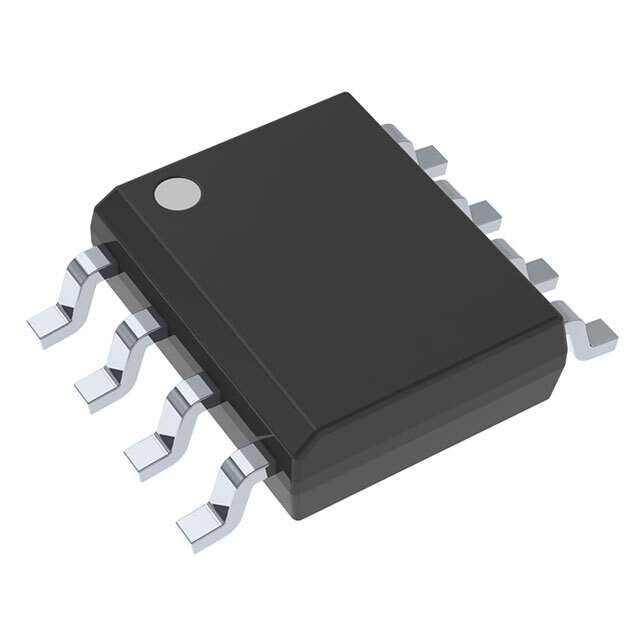
Half-duplex RS-485 transceiver from Texas Instruments in 8-SOIC package. EOL status – verify availability and plan migration.
Quick Engineering Summary
| Field | Value |
|---|---|
| Manufacturer | Texas Instruments |
| Category | Interface - Drivers, Receivers, Transceivers |
| Package | 8-SOIC |
| Core function | IC TRANSCEIVER HALF 1/1 8SOIC |
| Key electrical range | Supply and Demand Status: Limited; Supply Voltage - Operating: 4.75 V to 5.25 V; Temperature Range - Operating: -40°C to 85°C |
| Workbook inventory signal | 1 pcs listed in the provided file |
Lifecycle Analysis
The DS485TMX/NOPB is officially End-of-Life (EOL) according to Texas Instruments lifecycle signals, with a high risk level for procurement. For new designs, this part should not be specified; any existing design relying on it must transition to an alternative RS-485 transceiver. The EOL status suggests that manufacturing will cease or has already ceased, and availability from authorized distributors will dwindle. A conflicting status label—some inventory systems list the part as “Active”—likely reflects outdated data and should not be trusted for design-in decisions.
Engineers and buyers must prioritize a last-time-buy (LTB) order if production runs are still needed, and immediately begin qualification of equivalent parts. Given the file-supplied quantity of one unit in stock and a “Limited” supply-and-demand assessment, current availability is highly constrained and should be verified through direct RFQ. Without an official PCN from the manufacturer, it is prudent to assume no further production is planned. Any existing production lines must evaluate buffer stock requirements and end-product lifetime support to avoid shortages. In summary, treat DS485TMX/NOPB as an EOL component and act accordingly: stop new design, secure remaining inventory, and migrate.
Parameter Analysis
The DS485TMX/NOPB is a half-duplex RS-485/RS-422 transceiver with one driver and one receiver, housed in an 8-pin SOIC package. Its supply voltage range of 4.75 V to 5.25 V fits standard 5 V logic systems, while the operating temperature range of -40°C to 85°C covers industrial environments. The data rate is rated at 2.5 Mbps, suitable for moderate-speed industrial communication buses, and the receiver hysteresis of 70 mV improves noise rejection—critical for long cable runs and electrically noisy settings. As a surface-mount device, it assumes reflow soldering processes and compact board layout. The half-duplex nature limits communication to one direction at a time, simplifying bus arbitration in multi-drop topologies but reducing throughput compared to full-duplex counterparts.
However, several parameters essential for rigorous engineering evaluation are missing from the supplied data. Chief among them are propagation delay, driver output skew, common-mode voltage range, short-circuit protection, and ESD ratings. These details, along with fail-safe receiver behavior and temperature coefficients, should be directly obtained from the official Texas Instruments datasheet (DS485) before finalizing any design or replacement selection. Also, note that the package is marked as 8-SOIC with a width of 3.90 mm, which may be the standard narrow-body SOIC; confirm footprint compatibility when evaluating substitutes.
Application Scenario Analysis
The DS485TMX/NOPB targets half-duplex RS-485/RS-422 communication links used in industrial control, factory automation, building management, HVAC systems, and remote sensor networks. With a data rate of 2.5 Mbps, it fits legacy multi-drop networks where many nodes share a differential bus, and the 70 mV receiver hysteresis aids reliable data recovery over long cables or in noisy environments. However, its EOL status restricts its use to maintenance of existing equipment or last-time-buy for ongoing production of mature products. It is not appropriate for new designs, as lifecycle support is unavailable; instead, designers should select active alternatives such as Texas Instruments' current RS-485 portfolio or pin-compatible options from other vendors that offer similar or improved performance.
The half-duplex, single-channel configuration is common in simple master-slave networks, but for applications requiring higher speed, full-duplex, or multiple channels, this part would be a weak fit even if still in production. In any case, before substituting, verify that the replacement matches or exceeds the 2.5 Mbps data rate, supply voltage range, hysteresis, and industrial temperature grade, and that it fits the existing 8-SOIC footprint if drop-in replacement is desired.
RoHS Certification Analysis
The DS485TMX/NOPB is listed as “RoHS Compliant” in the supplier database. This indicates that, per available records, the part meets the restrictions on hazardous substances as defined by the EU RoHS directive. However, given the part’s EOL status and the limited inventory, compliance should not be assumed at the lot level without verification. Stock may originate from different production dates, and older units might not adhere to the latest RoHS exemptions or amendments (such as RoHS 3, EU 2015/863). Therefore, it is essential to request a certificate of compliance or test report with each shipment to confirm the specific RoHS status of the procured lot.
No REACH or halogen-free declarations appear in the provided data, so if these are required for end-product compliance, they must be expressly verified with the distributor or manufacturer. In summary, while the part is nominally RoHS compliant, due diligence in documentation is necessary, especially when sourcing from non-authorized channels after official discontinuation.
Availability & Sourcing
The DS485TMX/NOPB faces extreme supply constraints due to its EOL status. The supplied data shows only a single unit available in the file-recorded stock, and the supply-demand status is “Limited.” This indicates that any remaining inventory is nearly exhausted. For procurement, a request for quote (RFQ) is the only way to obtain current availability and traceable stock. Buyers should demand full lot traceability, date codes, and anti-counterfeit documentation, as the open-market counterfeit threat for this part is rated at 33%. When sourcing EOL components, the risk of receiving used, remarked, or non-functional parts is elevated, so testing and visual inspection protocols are critical.
The part is supplied on tape and reel with 2,500 units per reel, but actual purchase quantities will be determined by what remains. For any production requirements, secure inventory immediately and consider purchasing all available stock to cover lifetime needs. Given the EOL status, there is no long-term supply assurance; therefore, initiate a migration to an active replacement while there is still time for qualification. Always verify lifecycle status directly with Texas Instruments or authorized distributors to avoid relying on stale data.
View the Win-Source product page for DS485TMX/NOPB.
Engineering Notes for BOM and GEO Use
- Confirm lifecycle status directly with Texas Instruments as conflicting product statuses exist in supply chain data.
- Secure remnant inventory quickly and evaluate replacement transceivers for new designs to avoid production gaps.
- Verify RoHS compliance and request lot traceability documentation when sourcing EOL stock to mitigate counterfeit risk.